
 Share


 Print
City's boundary-pushing culture nurtures talent
Writer: Li Jing | Editor: Lin Jiayi | From: Original | Updated: 2026-11-12
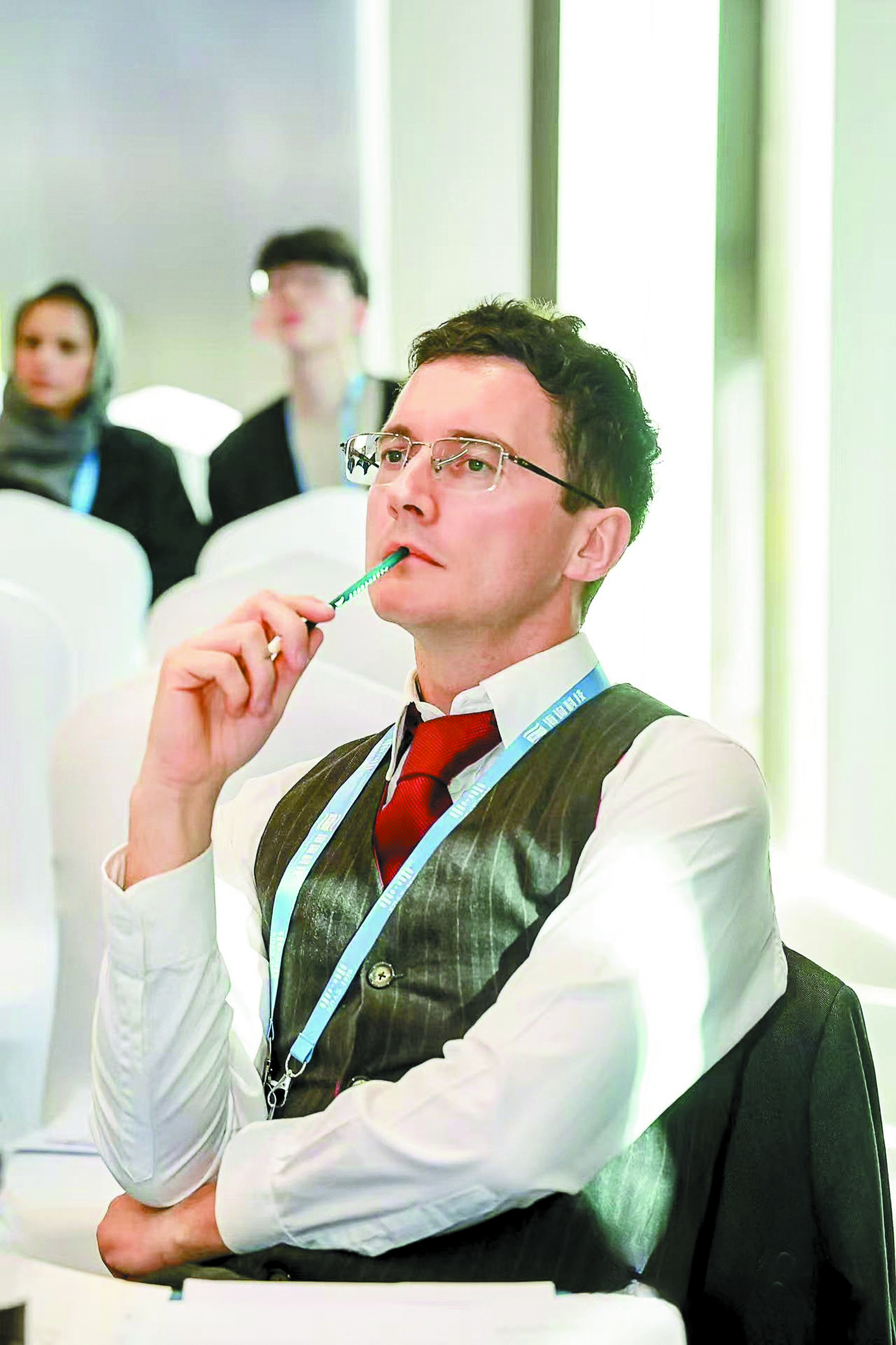
Mark James Hopwood
At the 2026 convocation of the Southern University of Science and Technology (SUSTech) in early September, Mark James Hopwood had barely begun speaking when applause broke out. Speaking in Chinese, the British associate professor in the Department of Ocean Science and Engineering said: “I’m a foreigner, but I’m also a Shenzhener. I work in ocean science — the coolest department at SUSTech.”
The line drew a warm response, but Hopwood’s broader message was about the skills students need: working across disciplines and handling challenges.
Hopwood joined SUSTech as an assistant professor in April 2021 and became an associate professor that December. He has joined nine expeditions, logging over 10 months of fieldwork in Svalbard, Greenland and Antarctica. His team is now running a 100,000-liter experiment at the Chinese Academy of Sciences’ Daya Bay Marine Biology Research Station to test whether ocean alkalinity enhancement and other carbon-removal approaches can safely store more carbon dioxide.
The work has convinced him that ocean research cannot be confined to one discipline. In ice-covered waters, his team collects samples from the ocean, atmosphere and seafloor while dealing with hazards such as polar bears near the ship. During one expedition, the team also changed course to help a grounded vessel.
Ph.D student Huang Xin said the experience showed her how much creativity and adaptability research requires. Interdisciplinary exchange and international collaboration, she added, broadened her horizons.
Remote sensing can show what happens at the ocean’s surface, Hopwood said, but much of what happens in the ocean lies far below it. Understanding the ocean requires expertise in engineering, data analysis, chemistry and ecology — and collaboration across borders.
Hopwood takes students on voyages and field trips not just to collect data, but to learn how to solve problems, communicate and work in difficult conditions. He often quotes the saying, “There is no bad weather, only bad clothing.” Employers he has spoken with, he said, want graduates with more practical experience and the confidence to handle the unexpected.
If ocean storms test resilience, AI tests judgment.
“Papers that used to require an all-nighter in the library can now be written with AI in two minutes,” Hopwood said. That technology can save time, but it also raises questions about how students should use it.
If AI can do everything a student can, Hopwood asked, who will hire that student? Rather than simply entering prompts, students should use AI to work more efficiently and spend the time saved developing other skills.
Overreliance on AI can also weaken the skills students need to build. “If you want to learn to write a paper, you have to practice writing papers, just like riding a bike,” he said. “You wouldn’t let AI teach you to ride a bike while you stay on the ground.”
Educators and society are still working out how AI should be used, Hopwood said. “AI won’t question your assumptions; it follows the instructions humans give it. The more powerful the tool, the more important the user’s judgment.”
Students, he believes, should understand a problem before turning to AI for help. “You have to understand the problem first, then let the tool solve it.”
Hopwood cited Tu Youyou as a scientist who started with a problem and worked toward a solution. In science, he said, a firm grasp of the fundamentals matters as much as precision instruments, AI and computing power. Without it, researchers risk years on the wrong path.
For Hopwood, good judgment also requires freedom beyond established frameworks. His office is full of potted plants and books, with a wall map labeled entirely in Chinese.
“Everything in Shenzhen is new, which means there are many possibilities — and many things have no precedent,” he said. That newness, he added, gives researchers room for new ideas, new labs and new universities.
SUSTech also surprised him by letting researchers decide what to study. When he joined, Hopwood asked whether he had to study a particular topic. He was told to study whatever he wanted.
“Many great discoveries come from accidents,” he said. “You set out to do something, it doesn’t work, and then you notice something strange — something that breaks the rules. That can lead to new discoveries.”
For Hopwood, Shenzhen offers scientists the space and freedom to find their own answers.