
 Share


 Print
Students develop AI glasses for people with visual impairments
Writer: Cao Zhen | Editor: Cao Zhen | From: Original | Updated: 2026-11-09
A ninth-grade student at Shenzhen Experimental Pingshan School has developed an assistive device for people with visual impairments with his classmates and teacher, earning national and provincial awards.
Liu Hongye was inspired by his great-grandfather, who lost his sight in an accident and said he wished he could go out without having to rely on others.
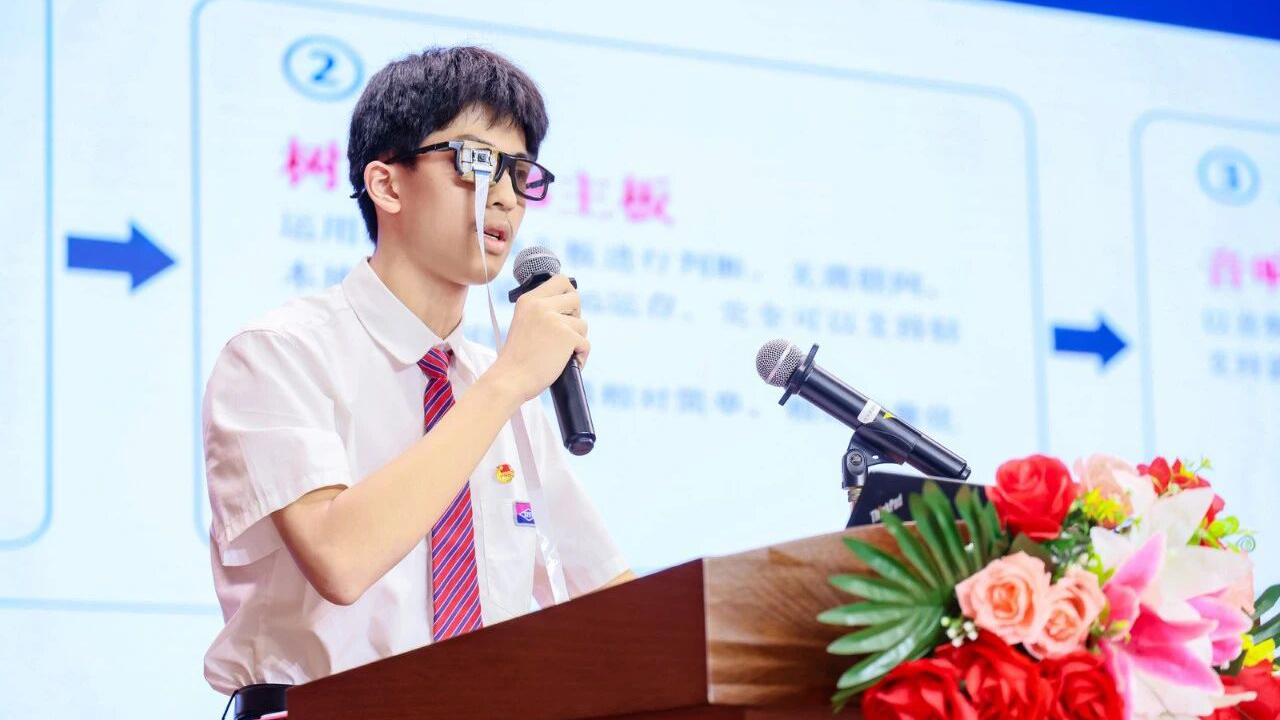
Liu Hongye introduces his AI glasses.
In June, Liu teamed up with two classmates and their teacher, Xiong Can, to work on the project. Their research found traditional canes and ultrasonic devices can detect nearby obstacles, but cannot read traffic lights or identify distant vehicles and crosswalks.
The team set out to build a device that could work without an internet connection. They designed it to use a camera to “see,” AI to process information and voice alerts to communicate with the wearer.
The team mounted a camera on a glasses frame and installed a lightweight object-detection model, MobileNetV2-SSD, built with the TensorFlow Lite framework, along with an HSV color-recognition algorithm, on a low-power Raspberry Pi 4B. The system runs entirely offline, works without network coverage and does not upload images, helping protect users’ privacy and making the device easier to use.
After five rounds of refinement, Liu’s classmates tested the glasses while blindfolded. They said the device made them feel more confident about moving forward and gave timely alerts when the traffic light turned green.
Liu began exploring technology, from robotics to aerospace, in fifth grade. He reached the national finals of the World Robot Contest for three consecutive years and won first prize at the 2025 National Youth Aerospace Innovation Competition. After countless nights of coding and sensor calibration, he came to believe that good innovation means turning technology from a “project” into “something people want to use every day.”
Liu’s smart glasses have won a provincial second prize and a national third prize at the Invention Convention China. The team is preparing a patent application.
Liu acknowledges that the device still needs improvement in low-light recognition, long-distance detection and determining the direction of approaching vehicles. The team plans to add infrared lighting, digital zoom and binocular vision, while improving comfort and battery life. Its goal is to produce a lighter, sleeker sixth version.