
 Share


 Print
Shenzhen upgrades China's first bird-friendly noise barrier
Writer: Windy Shao | Editor: Lin Jiayi | From: Original | Updated: 2026-11-06
A noise barrier along Binhai Boulevard, next to the Futian Mangrove Nature Reserve in Shenzhen, has been given a new look under the leadership the Urban Planning and Natural Resources Bureau of Shenzhen Municipality, turning a long-standing wildlife protection facility into a landmark showcasing the city's efforts to build a bird-friendly urban environment.
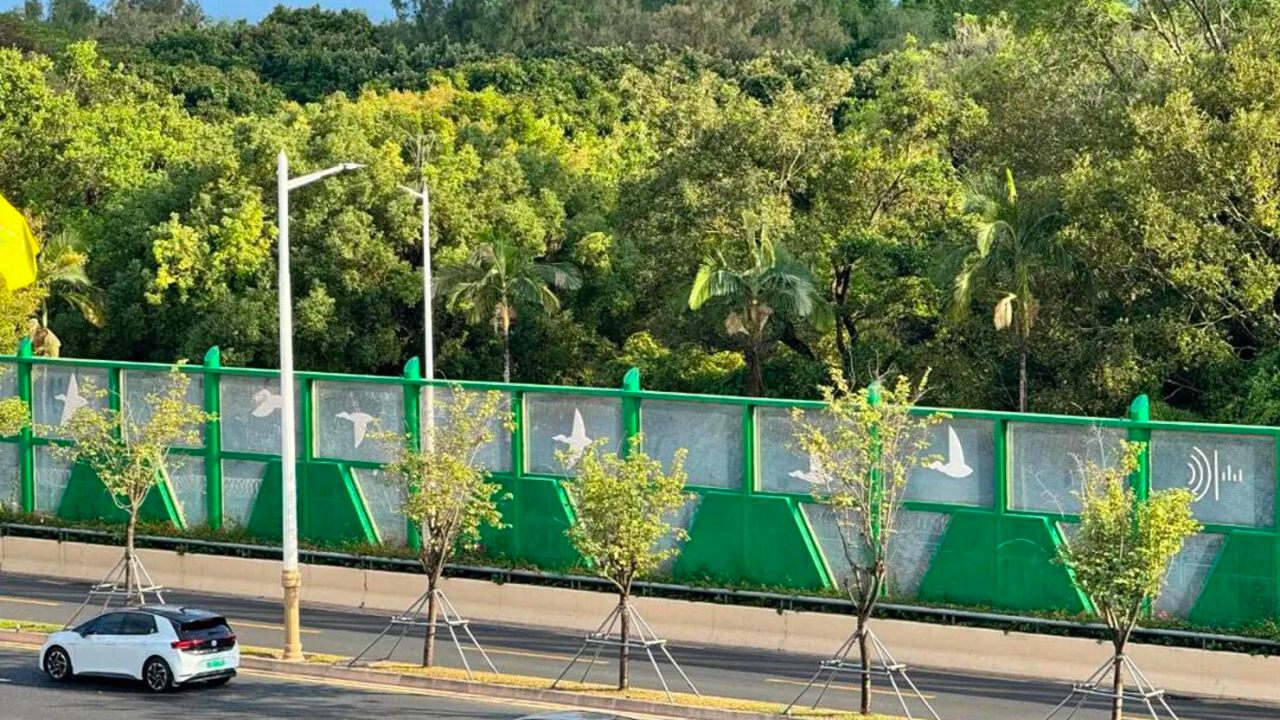
The upgraded bird-friendly noise barrier along Binhai Boulevard beside the Futian Mangrove Nature Reserve in Shenzhen. Photos courtesy of the Urban Planning and Natural Resources Bureau of Shenzhen Municipality
Built in 2002, the barrier was China's first designed specifically to protect wild birds from traffic noise. Its recent facelift features white silhouettes of 10 representative local bird species, including black-faced spoonbills, great egrets, pied avocets and black-winged stilts. The designs show birds in different poses, from flying and feeding to resting, while sound-wave patterns highlight the barrier's noise-reduction function.
The project reflects Shenzhen's evolving approach to balancing urban development with ecological conservation, and offers a practical example of the city's efforts under the Shenzhen Urban Index (UIS), particularly its livability, aesthetics and humanism dimensions.
The barrier has a history dating back to the construction of Binhai Boulevard in 1994. To avoid damaging the core habitat of the mangrove reserve, the city moved the planned road more than 200 meters north. However, traffic noise continued to disturb birds after the road opened, prompting the construction of the 5-meter-high barrier in 2002. With an investment of approximately 13 million yuan, it reduced noise levels in the reserve to below 55 decibels.
In 2025, the city introduced its first Bird-Friendly Urban Planning and Design Guidelines, providing standards for incorporating birds’ needs into urban development. These include controlling building heights to preserve migratory routes, making building facades safer for birds, improving ecological landscaping and restoring wetland habitats.
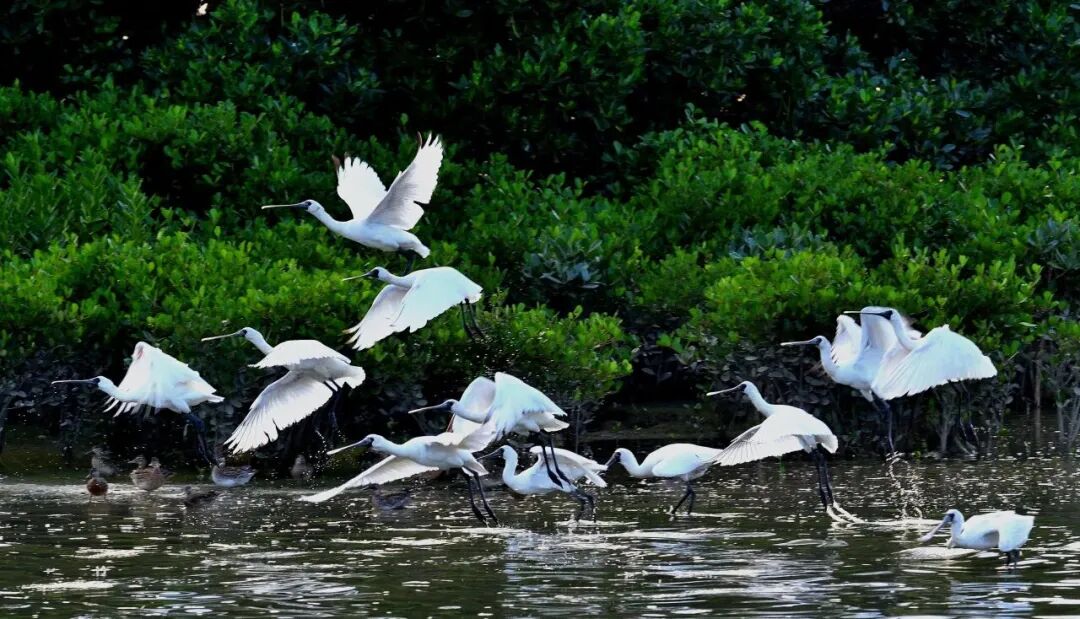
A flcok of black-faced spoonbill fly over the Futian mangrove wetland in Shenzhen.
The city has also strengthened legal protection. The Shenzhen Special Economic Zone Regulations on Mangrove Wetland Protection, which took effect Nov. 5, include specific provisions for migratory bird conservation, including measures to reduce artificial light and human disturbance.
Technology is playing an increasingly important role. At the Futian reserve, smart water gates adjust pond levels according to tides and birds' needs, while AI-powered identification systems monitor bird species and populations around the clock.
Public participation is another part of the effort, with residents and environmental organizations involved in wetland education, bird monitoring, habitat restoration and volunteer patrols.

Birds captured by high-definition monitoring cameras at the Guangdong Neilingding-Futian National Nature Reserve.
The results are reflected in biodiversity records. More than 270 bird species have been recorded at the Futian reserve, including over 60 species under national key protection. A 2026 global survey recorded 341 black-faced spoonbills in Shenzhen Bay, accounting for 4.4% of the global population.
Wang Yongjun, a mangrove conservation expert and former head of the Futian Mangrove Nature Reserve administration, said the barrier had witnessed Shenzhen's changing understanding of ecological protection.
“From initially having little awareness of ecological conservation, to repeatedly evaluating whether to move the road north, and finally developing a strong commitment to environmental protection, this barrier has witnessed the city's continued progress,” he said.