
 Share


 Print
Pingshan pilots unmanned sweepers to detect sinkhole risks
Writer: Cao Zhen | Editor: Cao Zhen | From: Original | Updated: 2026-11-04
Unmanned street sweepers may soon do double duty: cleaning roads while scanning underground soil layers with ground-penetrating radar mounted at the rear.
A pilot project is underway in Pingshan District. Proposed by Shijing Subdistrict and jointly implemented with Shenzhen Geoscience Co. Ltd., Shenzhen CowaRobot Co. Ltd. (also known as COOWA) and Xiangjiang Laboratory at Central South University, the project is described as China’s first 24-hour dynamic sinkhole-hazard monitoring system.
The trial has covered 43 municipal roads and 20 village roads and lanes, spanning more than 180 kilometers. It has identified four underground hazards, allowing authorities to take preventive measures early.
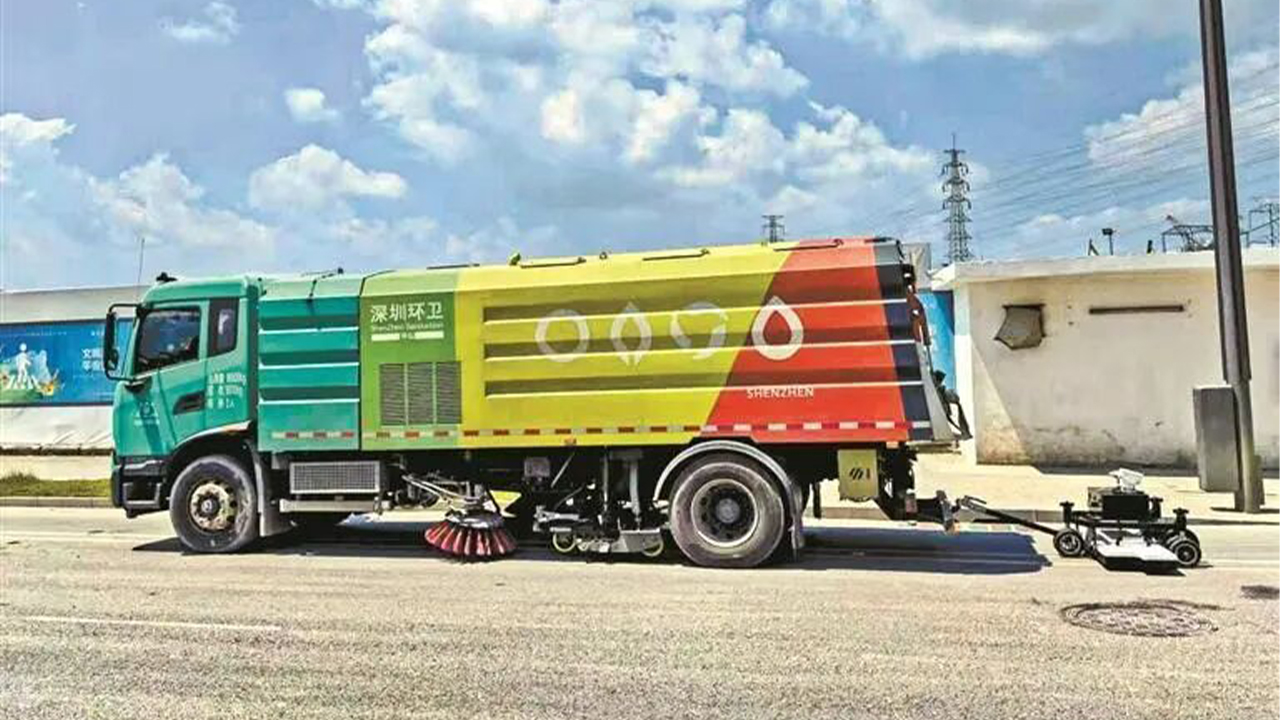
An unmanned street sweeper cleans a road while scanning underground soil layers with ground-penetrating radar mounted at the rear. Photo by Xiong Qixia
According to a staff member from Shijing Subdistrict, traditional geological surveys can take up to six months, from data collection and comparison to the preparation of written reports. The new approach reduces survey time to one-third or one-quarter of the conventional timeframe.
Sweepers conduct underground scans as they clean, transmitting data in real time to a back-end system for AI analysis. More than 2,000 underground samples have been used to train the model, supporting a closed-loop process of data collection, AI identification, manual review and algorithm optimization.
Quick-mount radar units can be fitted to multiple sweeper models, avoiding the mobility and accessibility constraints of specialized detection vehicles. The system could enable four to six inspections a year, with the total distance covered by scans reaching two to three times that of conventional methods, allowing more continuous monitoring. Comprehensive inspection costs are about 50% lower per kilometer than with traditional approaches.