
 Share


 Print
Shenzhen's reform story comes alive for young sinologists
Writer: Chen Siqi | Editor: Lin Jiayi | From: Original | Updated: 2026-10-29
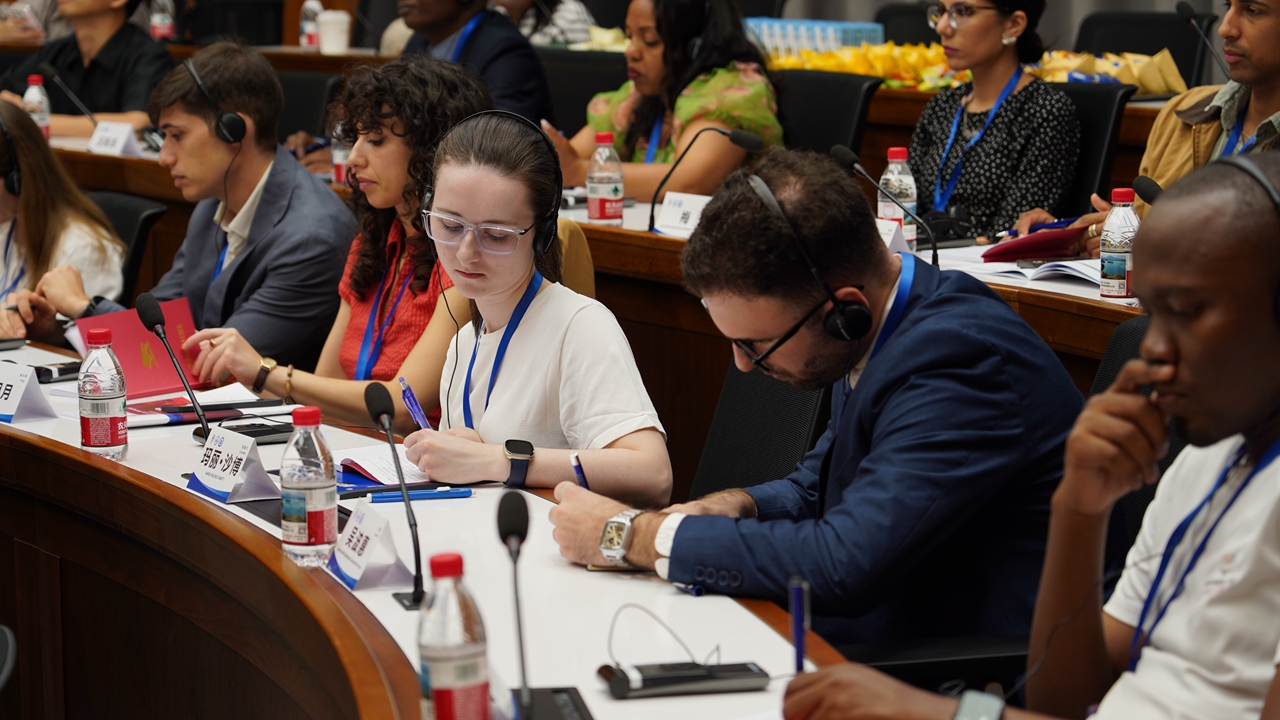
Young sinologists take notes during a lecture on Shenzhen’s reform and opening up at the Shenzhen Reform and Opening Up Executive Leadership Academy yesterday. Photos by Lin Songtao
A lesson on Shenzhen’s transformation over the past four decades came alive yesterday, as international participants repeatedly pulled out their phones to photograph lecture slides at the Shenzhen Reform and Opening Up Executive Leadership Academy.
The session marked the start of the Shenzhen leg of the Visiting Program for Young Sinologists, which brought together 20 young sinologists from 20 countries.
During the five-day Shenzhen leg of the program, the scholars will attend lectures and explore the special economic zone firsthand. Their itinerary includes the Qianhai Shenzhen-Hong Kong Youth Innovation and Entrepreneur Hub (E-Hub) and Sea World in Shekou, as well as company visits to BYD headquarters, Han’s Laser, and EngineAI, taking them beyond the classroom to explore the city’s reform and innovation firsthand.
Martina Cafaro, a young sinologist from Argentina pursuing a master’s degree in China-Argentina relations, said seeing Shenzhen in person had deepened her understanding beyond what textbooks could offer.
“This is my first time in Shenzhen,” Cafaro said. “What we know about Shenzhen from textbooks is always linked to reform and opening up, and I really hope to see with my own eyes the development and huge changes of the past 40 years.”
She described the program as an “amazing way to build bridges between China and people from around the world,” adding that she feels responsible for sharing a more accurate picture of China when she returns to Argentina. She said the more than 30-hour journey to attend the program was worthwhile.
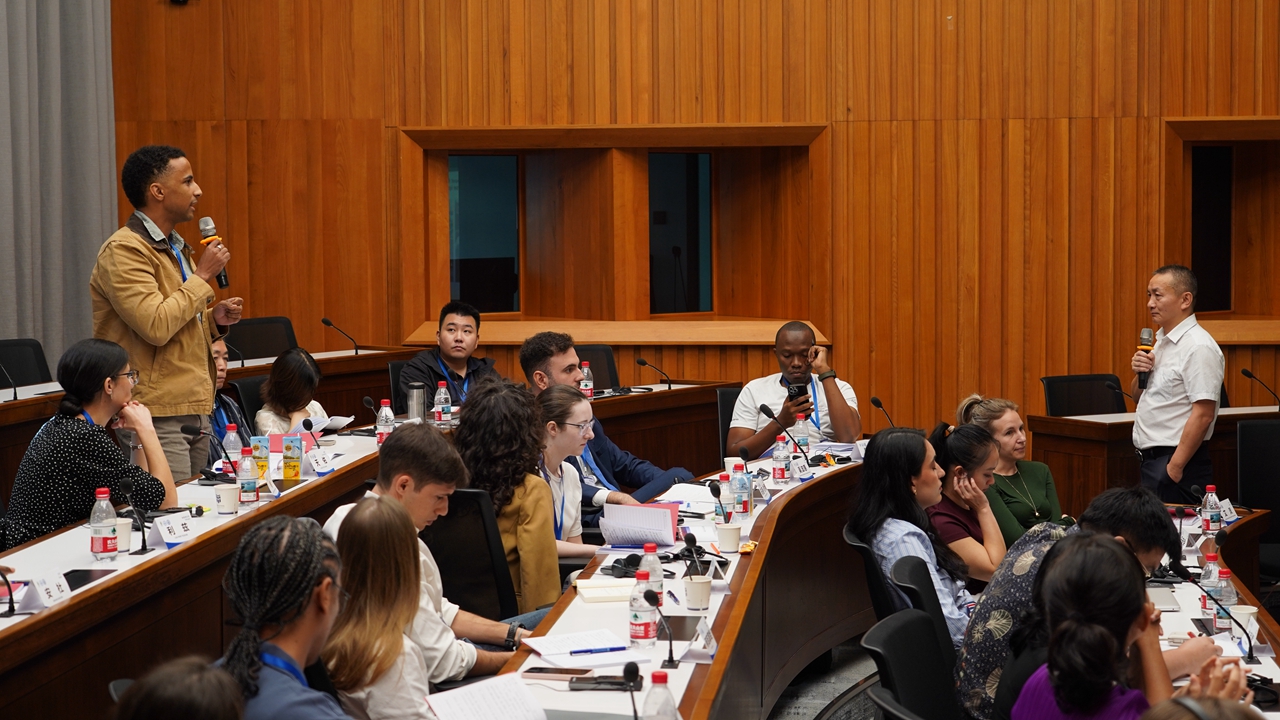
Luyolo Tos Sijake (L), a teacher at the University of Cape Town in South Africa, asks Dong Haitao (R), a lecturer and deputy director of the Shenzhen Reform and Opening Up Executive Leadership Academy, a question during a Q&A session.
Dong Haitao, deputy director of the academy, said at the opening ceremony that Shenzhen has transformed from a fishing village into a global model city in just over 40 years — a story of openness and innovation that offers the young scholars tangible examples of China’s reform and opening up.
He Xinhong, director of the Shenzhen Academy of Social Sciences, highlighted Shenzhen’s achievements in sustaining rapid economic growth while advancing green, low-carbon development amid industrialization and urbanization. “I hope all young sinologists will gain a true and comprehensive understanding of Shenzhen,” He said.
Before arriving in Shenzhen, the group completed research and field trips in Shanghai, visiting cultural and historic landmarks as well as technology companies and startups.
Since its launch in 2014, the Visiting Program for Young Sinologists has helped young scholars from around the world understand China’s development, history, culture and modernization through lectures, field trips and cultural experiences. This year marks the first time the program has extended to Shenzhen.
Shen Guilong, director of the Institute of World Chinese Studies at the Shanghai Academy of Social Sciences, said the contrast between the two cities enriched participants’ understanding: Shanghai offers a sense of historical depth, while Shenzhen showcases the dynamism and agility of a rapidly developing city.
The event was coordinated by the China International Culture and Tourism Exchange Center and the Shanghai Academy of Social Sciences, and co-organized by the Shenzhen Academy of Social Sciences and the Shenzhen Reform and Opening Up Executive Leadership Academy.