
 Share


 Print
Shenzhen airport opens direct passenger flight to Ulaanbaatar
Writer: | Editor: Zhang Chanwen | From: Shenzhen Daily | Updated: 2026-10-23
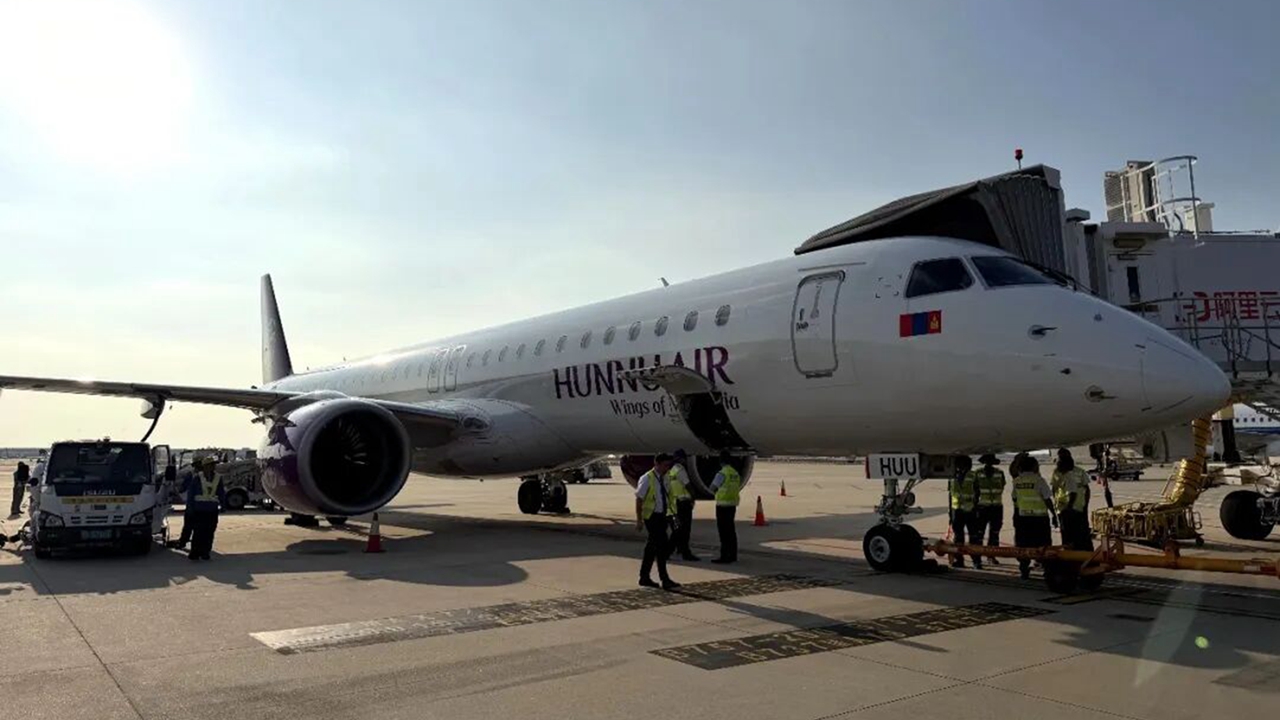
A Hunnu Air passenger aircraft is parked at Shenzhen Bao’an International Airport following the launch of a direct air service between Shenzhen and Ulaanbaatar, Mongolia, on Oct. 22. Photos courtesy of Shenzhen Bao'an International Airport
A direct passenger air service between Shenzhen and Ulaanbaatar, the capital of Mongolia, officially opened yesterday. The route is operated by Mongolia’s Hunnu Air, marking the airline’s first passenger service to and from Shenzhen Bao’an International Airport.
The new connection adds another important destination to the Shenzhen airport’s Northeast Asia network, providing a more convenient air link for business, tourism and other exchanges between the Guangdong-Hong Kong-Macao Greater Bay Area and Mongolia.
Hunnu Air
Hunnu Air is scheduled to operate one round trip every Thursday using an Embraer E190-series aircraft. Flight MR867 departs Ulaanbaatar at 11:05 p.m. Beijing time and arrives in Shenzhen at 3:05 a.m. the following day. The return flight, MR868, leaves Shenzhen at 4:05 a.m. and arrives in Ulaanbaatar at 8:05 a.m.
Ulaanbaatar is Mongolia’s political, economic, cultural and transport hub. The country is known for its vast grasslands and distinctive cultural heritage. Exchanges and cooperation between China and Mongolia in trade, tourism and culture have continued to grow in recent years.
The direct service is expected to make travel between the two cities more convenient for business travelers, people visiting family and friends, and tourists.
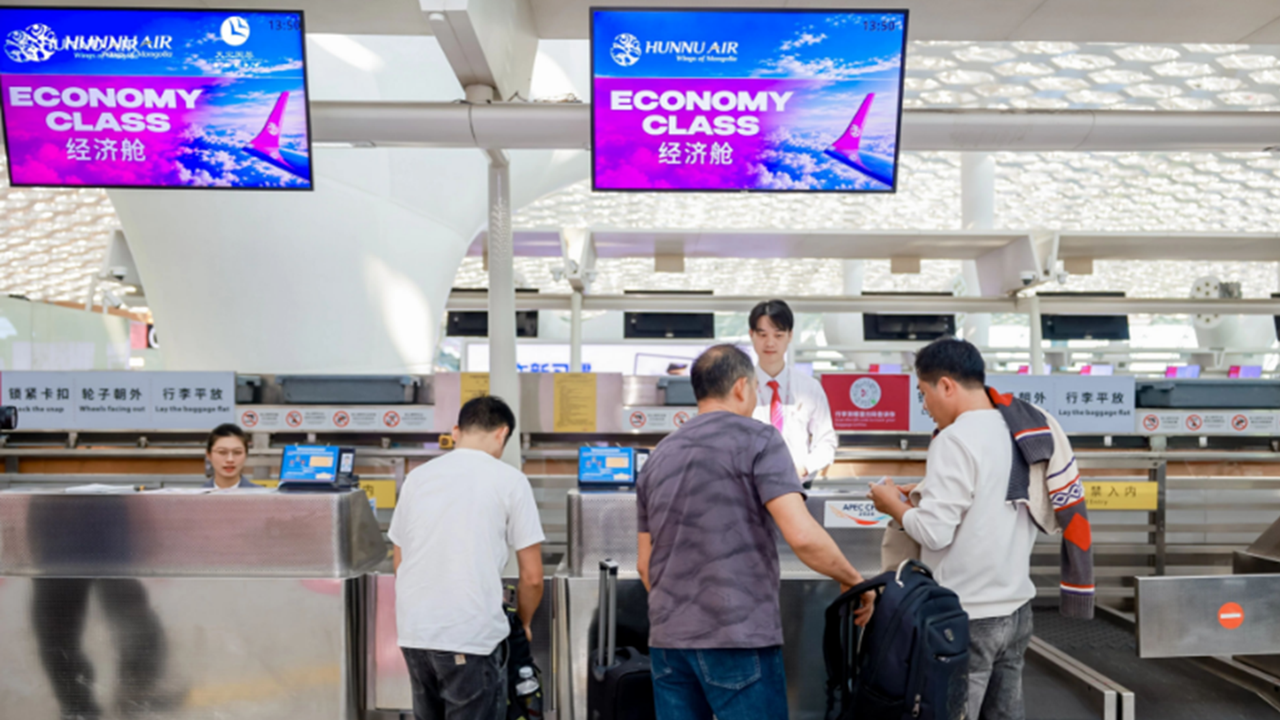
Passengers check in for a Hunnu Air flight at Shenzhen Bao’an International Airport. The airline launched its first passenger service connecting Shenzhen and Ulaanbaatar yesterday.
The Shenzhen airport has been expanding its air links with countries participating in the Belt and Road Initiative. With the launch of the Ulaanbaatar route, the Shenzhen airport now operates 46 passenger routes connecting Shenzhen with 25 Belt and Road partner countries.
The airport has also introduced measures to improve the international travel experience. For arriving passengers, it has worked with the border inspection authority to conduct preliminary checks before arrival. During peak periods, the time needed to clear immigration procedures has fallen from around 45 minutes to under 15 minutes.
Nearly 400 new signs in Chinese, English, Japanese and Korean have been installed along international arrival and departure routes. The airport has also added AI-powered travel assistants, translation devices and food-delivery robots as part of its efforts to expand the use of artificial intelligence in services for international travelers.