
 Share


 Print
From Bandung to Shenzhen: The Roots of South‑South Cooperation
Writer: Li Li, Chen Jingchun | Editor: Zhang Chanwen | From: Original | Updated: 2026-10-16
Editor’s Note: From the 1955 Bandung Conference to the 2026 APEC meetings in Shenzhen, the spirit of South‑South cooperation has traveled a long way. In this special report, two articles from China Agricultural University’s Indonesia program examine how that legacy is being translated into concrete cooperation—and what “depth” means for Shenzhen’s next stage of globalization.
A journey through Indonesia’s past offers context for the partnerships shaping APEC 2026

Li Li in front of Archaeological Site of Nalanda Mahavihara, Bihar, India.
On Jalan Asia‑Afrika in Bandung, Indonesia, stands a three‑story cream‑colored building: Gedung Merdeka. Once the venue of the historic Bandung Conference, it now houses the Museum of the Asian‑African Conference. Inside, wax‑figure tableaux and yellowed archival photographs capture a defining moment in global history.
From April 18 to 24, 1955, 340 delegates from 29 Asian and African nations convened in Bandung for the first major international conference led primarily by countries that had recently emerged from colonial rule. Together, they represented over 31 million square kilometers and roughly 1.44 billion people — more than half of the world’s population at the time.
The conference marked a milestone in the struggle against colonialism and racism, and in the pursuit of national sovereignty and world peace. Its guiding spirit — often summarized as “seeking common ground while shelving differences” — became a foundation for South‑South cooperation.
Seven decades later, that spirit is being carried forward in new forms. As APEC 2026 prepares to convene in Shenzhen under the theme “Building an Asia‑Pacific Community to Prosper Together,” the question of how countries can transcend divergences and expand collaborative ties remains as relevant as ever.
For China and Indonesia, the journey from Bandung to Shenzhen is not merely symbolic. It is a story of how political solidarity has been translated into concrete cooperation — and how that cooperation is being adapted to meet today’s development challenges.
From principles to projects
In the decades after Bandung, Asian and African nations established multilateral frameworks such as the Non‑Aligned Movement and the Group of 77, strengthening mutual support. South‑South and triangular cooperation gradually extended into economic and technical spheres, with priority given to technology research, market connectivity, knowledge exchange and capacity building.
Indonesia and China have been active participants in this evolution. Hasanuddin University, working with Indonesian research institutions and Chinese counterparts, has set up large‑scale hybrid‑rice demonstration plots across major rice‑producing regions in Indonesia. Joint research has identified high‑yield, drought‑tolerant varieties adapted to tropical soils, contributing to national food security.
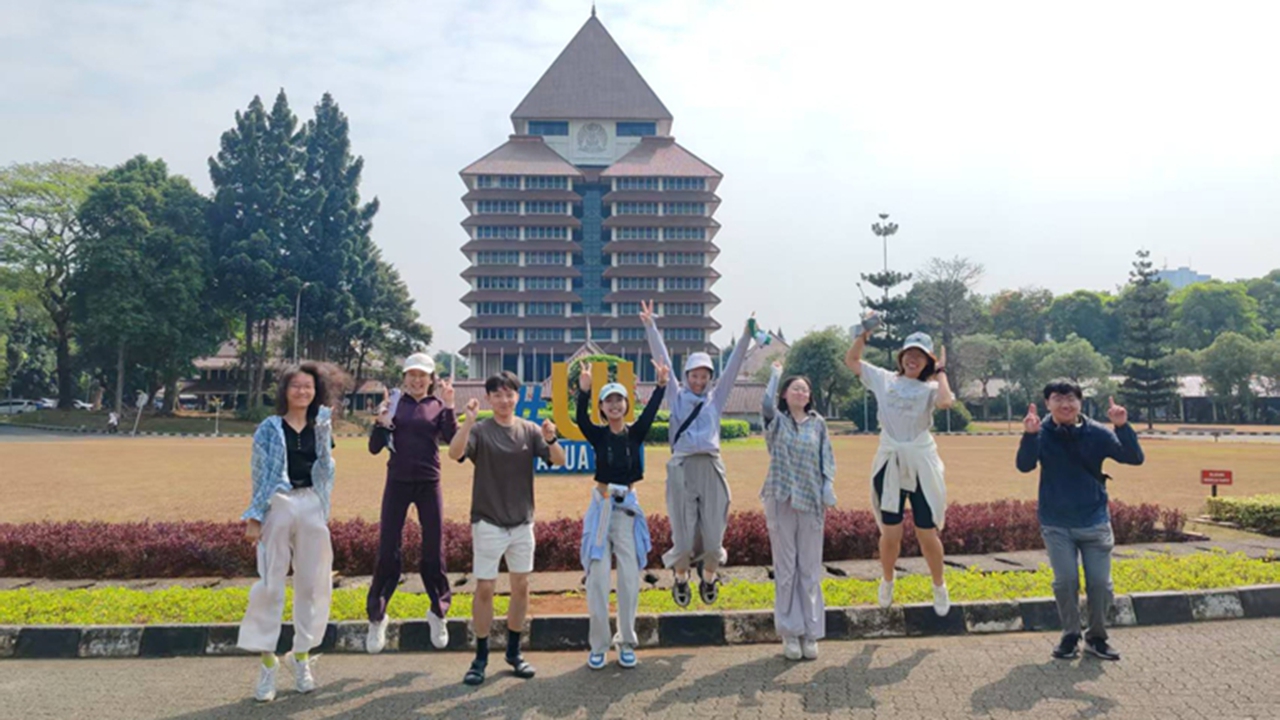
Group photo of all students participating in the project at Universitas Indonesia.
Universities from both countries have also launched paired mangrove field observation stations, undertaking joint research on coastal ecosystem restoration and carbon‑sink valuation to mitigate climate‑driven coastal hazards.
These projects reflect a broader approach: aligning national development strategies and sharing adaptable experiences from the Global South. By matching local needs with available resources, China and Indonesia have built a mutually reinforcing network for capacity building.
Beyond the high‑speed railway
The Jakarta‑Bandung High‑Speed Railway, locally known as “Whoosh,” is perhaps the most visible example of this cooperation. But its significance goes beyond speed. During the international tender under the Joko Widodo administration, Indonesia set conditions tailored to its own needs: no state‑budget financing, no government guarantees, and a business‑to‑business implementation model. These stipulations strengthened Indonesia’s negotiating position and steered the project toward a mutually beneficial outcome.
The railway has opened a key national development corridor, cut travel times, and stimulated industries along its route. Yet for many observers, the deeper lesson lies in how the project was structured — not simply what was built.
Building ties that last
The next stage of cooperation is about nurturing people‑to‑people friendships that take root locally. Indonesia’s Golden Indonesia 2045 vision prioritizes agricultural modernization, balanced regional development, disaster risk reduction and human‑capital advancement. China’s global initiatives and rural‑revitalization objectives are closely aligned with these priorities.
The two sides have gradually built a three‑tier cooperation model engaging governments, universities and villages. This framework allows bilateral friendship to embed within local communities and deliver concrete benefits for ordinary citizens.
China Agricultural University, working with Tencent, headquartered in Shenzhen, has established and will establish 10 Countries and Area Studies Centers across developing countries in the Global South. Building on successful training programs for rural professional managers — known as “rural CEOs” in China — the initiative has been scaled through the Global South Youth Rural Entrepreneurs Initiative in Tanzania, Uganda, Kenya, Indonesia, Bangladesh, Vietnam, Laos and elsewhere.
In Indonesia, the initiative connects with the national One Village One CEO scheme and the Kuliah Kerja Nyata community‑service program run by Bogor Agricultural University. A “1+1” mentorship scheme bridges China’s rural‑development experience with locally situated knowledge systems in Indonesia, providing support for young Indonesian returnee entrepreneurs.
These “small yet impactful” projects follow a collaborative, locally grounded and self‑driven pathway. Equal‑status partners draw on complementary strengths while guarding against dependency.
What Shenzhen can learn
As APEC economic leaders prepare to meet in Shenzhen, the journey from Bandung offers more than historical reflection. It suggests that true cooperation is not simply about what one side can offer, but about how both sides can adapt, learn and create something together.
From Bandung to Shenzhen, the spirit of seeking common ground remains a guiding principle. The challenge now is to turn that principle into partnerships that are not only broad, but deep — rooted in local needs, shared interests and mutual respect.
(Li Li, Associate Professor, Chen Jingchun, Junior Undergraduate, College of Humanities and Development Studies / College of International Development and Global Agriculture, China Agricultural University)