
 Share


 Print
From Speed to Depth: Shenzhen's Next Stage of Globalization
Writer: Nimawengbo, Li Li | Editor: Lin Jiayi | From: Original | Updated: 2026-10-15
Editor’s Note: From the 1955 Bandung Conference to the 2026 APEC meetings in Shenzhen, the spirit of South‑South cooperation has traveled a long way. In this special report, two articles from China Agricultural University’s Indonesia program examine how that legacy is being translated into concrete cooperation—and what “depth” means for Shenzhen’s next stage of globalization.

Nimawengbo
A journey through Indonesia offers a closer look at what “han shendu” means in practice.
From Jakarta to Shenzhen, this year’s APEC business agenda traces a telling arc. In February, the APEC Business Advisory Council (ABAC) launched its 2026 work program in Jakarta under the theme “Openness, Connectivity, Synergy.” Its final meeting of the year will take place in Shenzhen.
Shenzhen now uses a distinctive phrase to describe the next stage of its engagement with the global economy: increasing its “han shendu” in global markets. The expression does not translate neatly into English. The Chinese character shen means “deep,” but it is also the conventional one‑character shorthand for Shenzhen. The phrase therefore carries two meanings at once: greater depth in global markets, and deeper integration of “Shenzhen” into those markets. The city’s latest five‑year plan uses the phrase as the heading of a section on expanding international markets, while calling for more overseas production bases, marketing networks and global industrial links.
This summer, I traveled to Indonesia to see what that depth looks like on the ground.
Seeing: A familiar logo, far from home
One of the first familiar names I encountered after arriving in Jakarta was BYD, a company born in Shenzhen. Thousands of kilometers from southern China, its logo appeared at the Indonesian airport. For a moment, globalization felt remarkably tangible.
That is perhaps the most visible meaning of han shendu: Shenzhen products, technologies and brands are reaching more corners of the world.
But “arriving” is only the beginning. What does it really mean for a city, a company or an idea to take root somewhere else? That question stayed with me throughout the journey.
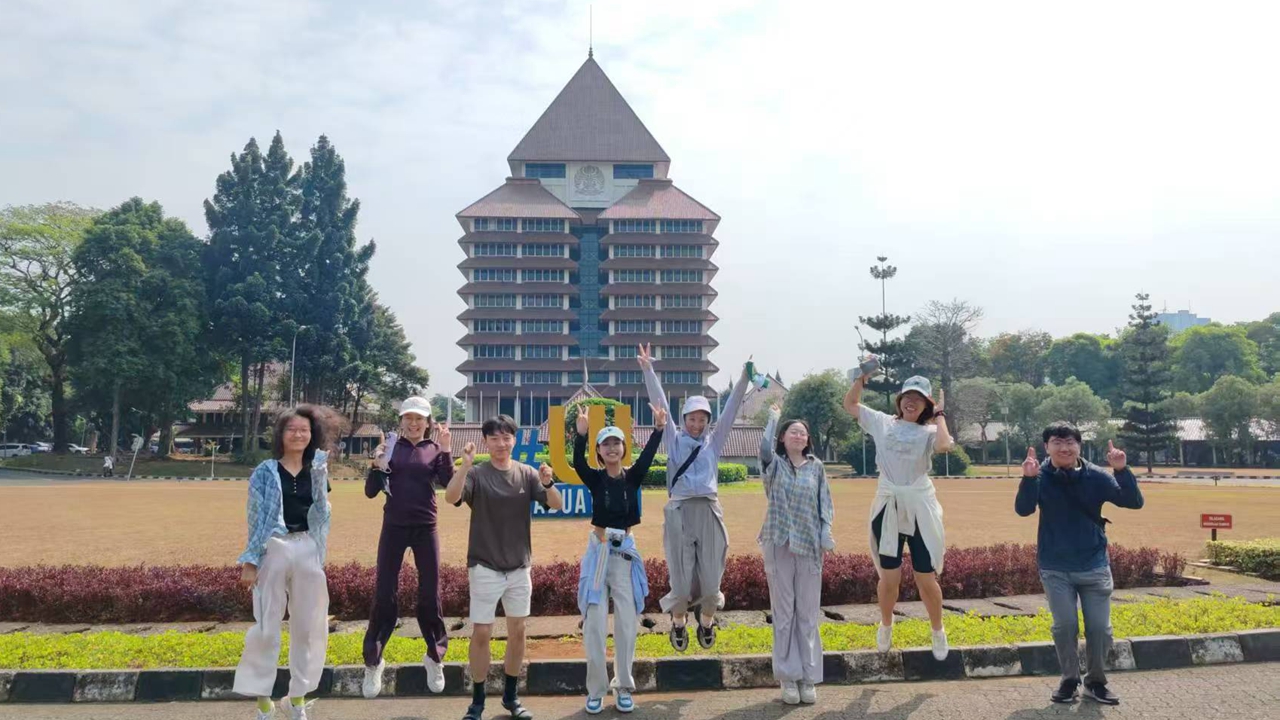
Group photo of all students participating in the project at Universitas Indonesia
Understanding: The choice behind Whoosh
A few days later, I experienced another form of connectivity aboard the Jakarta‑Bandung High‑Speed Railway, known locally as “Whoosh.” The 142.3‑kilometer line has cut the journey between Jakarta and Bandung from about 3.5 hours to roughly 46 minutes. In July 2026, direct Shenzhen‑Jakarta services doubled from one to two round trips a day.
Before traveling to Indonesia, I had approached Whoosh with a question shaped largely by undergraduate competition: In 2015, both China and Japan sought involvement in the project. Why did Indonesia ultimately choose the Chinese proposal?
After reviewing the literature and interviewing local people and officials at Indonesia’s Ministry of National Development Planning (BAPPENAS), I found that China understood Indonesia better and offered a more flexible institutional arrangement. The Chinese proposal was built on business‑to‑business (B2B) contracts signed between state‑owned enterprises of both countries, which meant it did not create foreign debt for the Indonesian government.
Japan’s traditional official development assistance (ODA), carried out by the Japan International Cooperation Agency (JICA), could not achieve that, constrained by rules set by the Development Assistance Committee of the Organisation for Economic Co‑operation and Development (OECD‑DAC). Under those rules, ODA yen loans must constitute inter‑governmental sovereign loans. The contracting borrower must be the central government of the recipient country, which is obliged to furnish national sovereign guarantees, with the relevant debt entered directly into the country’s sovereign external debt register.
China, which has not joined OECD‑DAC, does not limit international development cooperation to the sphere of aid. By combining investment and trade, it could use the B2B model to shorten the distance between Indonesian needs and the partner’s supply.
There is another side to this story. Indonesia did not simply wait passively for two foreign bidders to offer competing visions. Its government first set the conditions it was prepared to accept: no direct use of the state budget and no conventional sovereign guarantee. Whoosh was not only a story about what China could offer, but also about Indonesian agency — about a country defining its own development constraints and choosing cooperation accordingly.
For Shenzhen, this distinction matters. The city’s five‑year plan pairs greater global “depth” with an outward economic strategy that includes overseas production bases, supply‑chain nodes and what it calls a “Shenzhen creation, global delivery” model. That already points beyond simple exports, calling for overseas design centers, production bases and marketing networks.
Learning: From “What can we bring?” to “What do our partners need?”
“Depth” can be understood even more broadly. It means moving from “What can we bring?” to “What do our partners need?” Perhaps it goes one step further: a relationship becomes truly deep when the place we enter is able to change our own assumptions as well.
On Sept. 3, 2026, BYD formally opened its manufacturing facility in Subang, West Java. According to Indonesian news agency ANTARA, the plant employs around 5,000 local workers and has capacity for up to 150,000 vehicles a year. BYD has also said it will shift from importing complete vehicles to local production, while developing training and technology‑transfer programs for Indonesian workers and engineers.
Local production brings companies into contact with local workers, skills, suppliers, institutions and expectations. Once that happens, globalization is no longer simply the movement of a finished product from one place to another. It becomes a process of adaptation.
BAPPENAS Deputy Director Maliki offered an important reminder: China and Indonesia are both vast and internally diverse. An approach that works in one place may not work unchanged somewhere else.
Co‑creating: The next stage of localization
That is where localization becomes something more ambitious: co‑creation.
Co‑creation does not mean turning a Chinese model into an Indonesian copy. Nor does it mean finding an Indonesian model that China can simply reproduce. It means understanding why an idea worked in one setting, placing it inside another society, industry and community, and allowing something to emerge that neither side originally possessed.
In that sense, han shendu also means convergence.
For decades, “Shenzhen speed” has captured the city’s extraordinary ability to build, innovate and transform. The next stage of internationalization calls for “Shenzhen depth.”
To go global in a deeper manner, Shenzhen should not simply make its markets seen. It should also understand and learn how multiple stakeholders can co‑create win‑win scenarios. From Jakarta to Shenzhen, what matters is not only how far the city has traveled, but how deeply it has taken root.
(Nimawengbo, Junior Undergraduate & Li Li, Associate Professor, College of Humanities and Development Studies / College of International Development and Global Agriculture, China Agricultural University)