
 Share
Share


 Print
PrintBIRS to launch pilot mathematics workshops in Shenzhen
Writer: Zhang Yu | Editor: Lin Jiayi | From: Original | Updated: 2026-10-13
Video by Lin Jianping
The Banff International Research Station for Mathematical Innovation and Discovery (BIRS), a globally renowned Canadian mathematics hub, is expanding its international presence to Shenzhen under a new partnership agreement signed today at the Shenzhen Park of the Hetao Shenzhen‑Hong Kong Science and Technology Innovation Cooperation Zone.
Starting in 2027, the Shenzhen International Center for Industrial and Applied Mathematics, known as SICIAM, will host a series of BIRS pilot workshops, bringing mathematicians from around the world to the southern Chinese tech metropolis for intensive collaborative research.
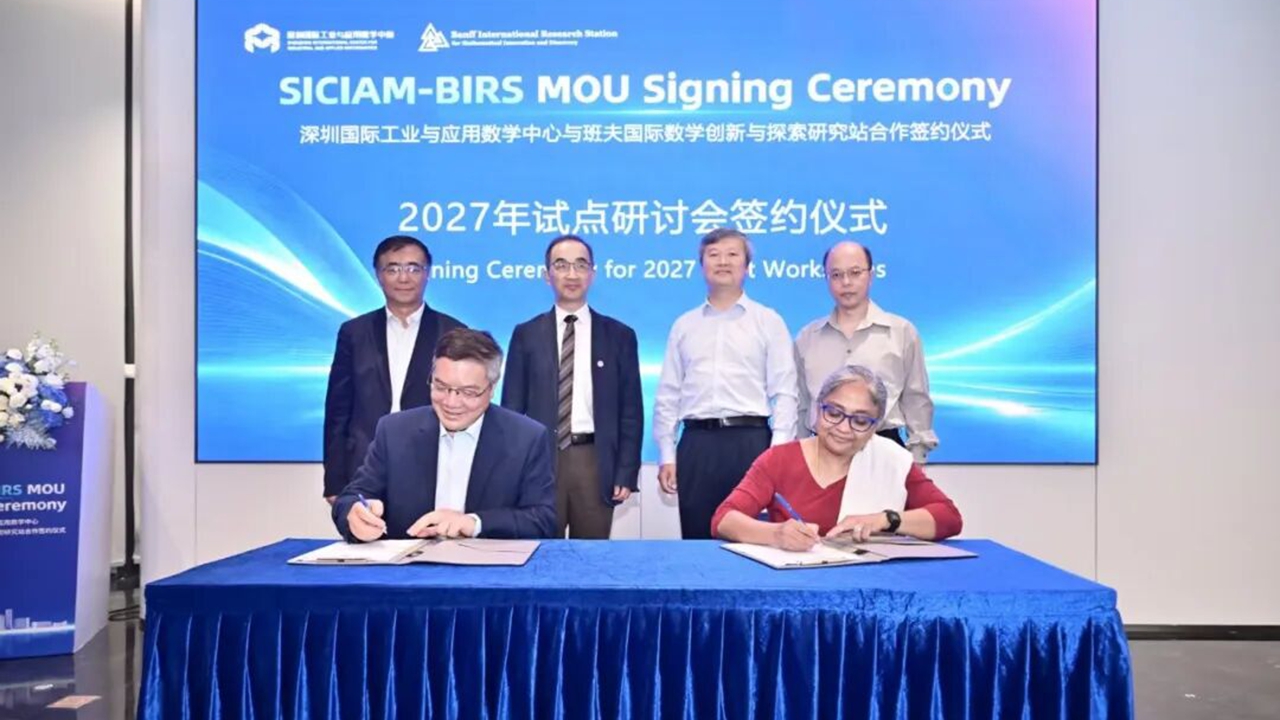
Professor Wang Xiaoping (L), executive deputy director of the Shenzhen International Center for Industrial and Applied Mathematics, and Professor Malabika Pramanik, scientific director of the Banff International Research Station, sign a cooperation agreement in Shenzhen today. Photos courtesy of event organizer
Professor Malabika Pramanik, BIRS scientific director and vice‑president of the American Mathematical Society, signed the cooperation agreement alongside Professor Wang Xiaoping, executive deputy director of SICIAM. Academic leaders, academy members and heads of university mathematics departments from across the Guangdong-Hong Kong-Macao Greater Bay Area witnessed the ceremony, which also included a joint project plaque‑unveiling moment.
For Pramanik, who arrived in Shenzhen ahead of the signing, the city offers a rare blend of technological dynamism and natural surroundings.
“It is stunning. On one hand, it is so scientifically and technologically vibrant with the high‑rises and all the different companies flourishing here. At the same time, you see green hills and the river. So peaceful,” Pramanik said in an interview. “In a way it’s an emblem of China itself.”
A global platform for mathematical exchange
BIRS was founded in 2003. It builds cross‑border mathematical research partnerships across five continents, with existing partner sites in Canada, Mexico, China’s Hangzhou, Spain and India. Its signature small‑group, multi‑day workshop format brings researchers together to explore emerging topics, fostering intellectual exchange that large‑scale conferences seldom replicate.
“Part of mathematics depends on individual thought, but there is another part which depends on intellectual exchange,” Pramanik explained. “Maybe a conversation at lunchtime, a question posed after a lecture, different communities building shared language to combine their tools to attack the same problem.”

Representatives of SICIAM and BIRS pose for a group photo following the unveiling of their joint project to launch international mathematics workshops in Shenzhen in 2027.
Connecting research with industry
The Shenzhen pilot marks a fresh node in BIRS’s global network. Under the deal, SICIAM will act as a regional bridge linking Greater Bay Area academic communities with BIRS’s worldwide research network. Workshop themes will cover both foundational mathematics and real‑world industrial needs, including scientific computation, statistics, topological data analysis, partial differential equations and probability‑based mathematical modeling. All proposals will undergo rigorous independent peer review, Pramanik noted.
Wang said SICIAM plans to hold four pilot workshops in 2027, one each quarter, following BIRS’s standard five‑day intensive workshop model. SICIAM researchers will take part in the scientific review process for workshop proposals.
“World‑class mathematicians will come to Shenzhen. We want young researchers to sit down and talk over scientific questions. Young people have bold ideas, and deep conversations often spark unexpected intellectual breakthroughs,” Wang said. “We hope to nurture an open academic platform rooted in Shenzhen that holds equal‑footing dialogue with the rest of the world.”
Established in 2021 and formally registered in late 2022, SICIAM focuses on artificial‑intelligence theory, industrial‑software core solvers and advanced scientific computing, aiming to address major technological bottlenecks in the digital economy across the Greater Bay Area.
Nurturing the next generation of mathematicians
A core goal of the Shenzhen collaboration is to expand opportunities for early‑career researchers across the Asia‑Pacific region. BIRS has a well‑documented record of supporting rising talent: three of the four 2026 Fields Medal winners previously took part in BIRS workshops.
“We want young researchers in this region to disseminate their work on a globally distinguished forum, raise questions freely and leave with greater confidence,” Pramanik said. “It is about bringing the world to young researchers and showing the world that young researchers’ contributions are truly valued.”
Pramanik emphasized that BIRS promotes a research culture that combines rigorous mathematical insight with openness and generosity, allowing junior scholars to present unfinished work and approach senior academics for feedback.
The partnership will explore the full innovation chain, from abstract mathematical theory to practical industrial applications, while strengthening BIRS’s global reach.