
 Share
Share


 Print
PrintWhen the Nobel Prize met a teenage star: A GBA boy's 'Universe Class' fills a Zhuhai bookstore
Writer: | Editor: Zhang Chanwen | From: | Updated: 2026-10-10
On Oct. 6, the same day the Nobel Prize in Physics honored humanity’s new ability to “listen” to the universe through neutrinos — an 18-year-old filled a bookstore in Zhuhai with a 90-minute “universe class.” Chen Tianwei, a 12th-grader at the International Department of the Affiliated High School of South China Normal University (HFI) in Guangzhou, took his audience from the scale of the cosmos to its history and its motion, ending with a line that hushed the room: “We are made of star stuff.”
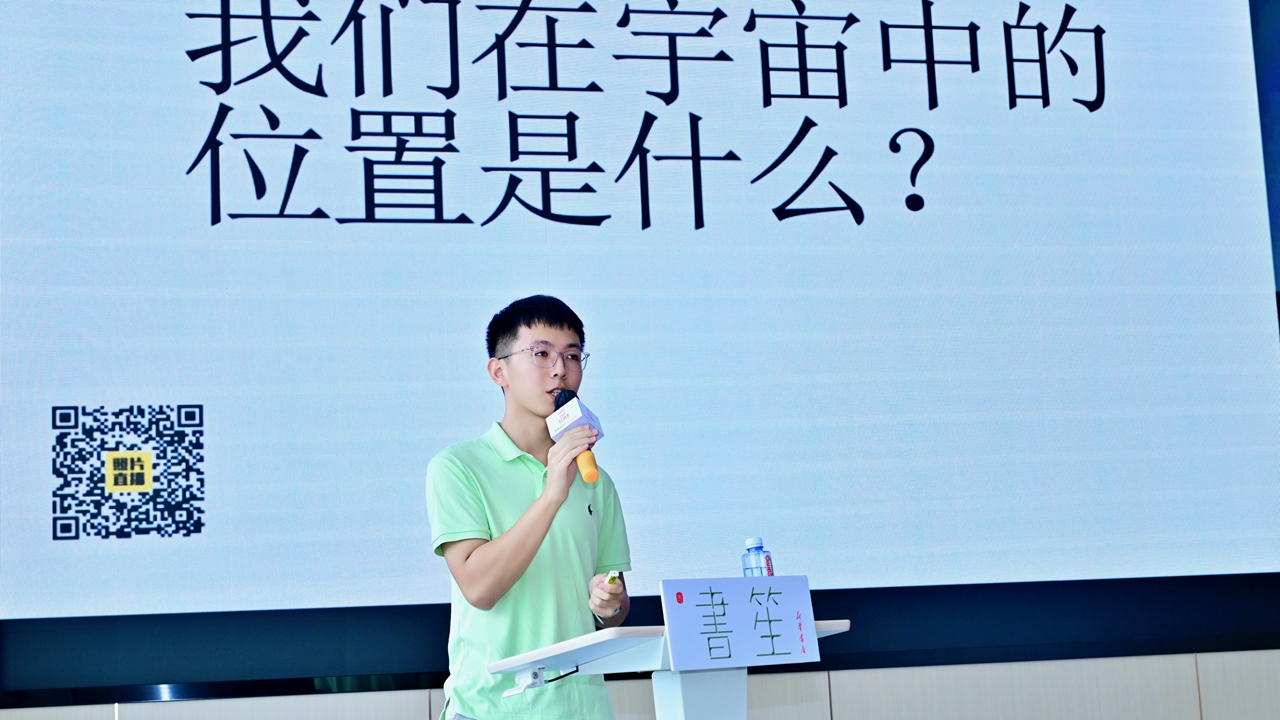
Chen Tianwei delivers his universe lecture at the bookstore.
The lecture opened “Lighthouse Project: Into the Stars,” a 12-session free public science series organized by Zhuhai Xinhua Bookstore and the Xiangzhou District Astronomy Enthusiasts Association of Zhuhai. All 150 seats were full. During the National Day holiday, families chose the stars over travel: children raised their hands — “Can people live on the Moon?” “How far away are the stars?” — and winners took home star-themed prizes, eyes brighter than the stars themselves. Many adult astronomy enthusiasts came too; the audience truly spanned generations.
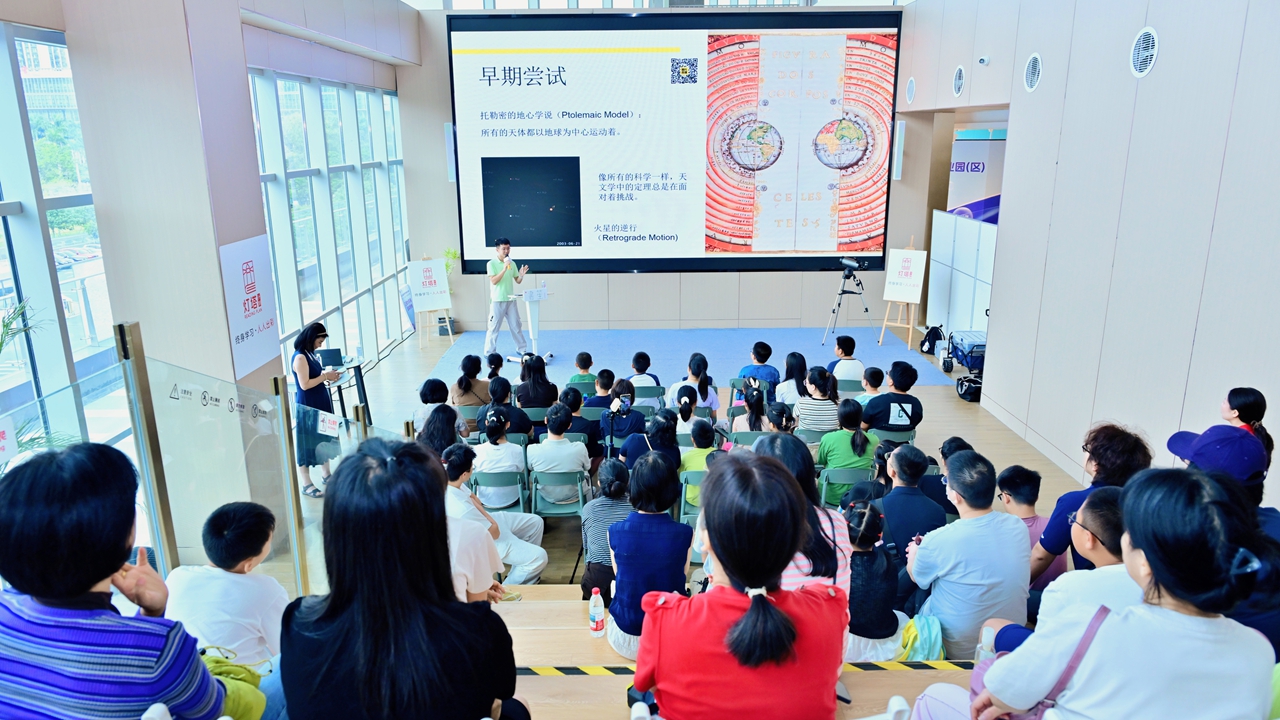
A full house of audience attends Chen Tianwei’s astronomy lecture at the bookstore.
Chen’s story is written across the Greater Bay Area. Born and raised in Zhuhai, where he studied through primary and junior high school, he now studies at HFI in Guangzhou, and is a frequent visitor to Shenzhen — a city famous worldwide for technology and innovation, whose energy of turning “impossible” into “possible” fascinates him. He also loves strolling along Shenzhen Bay Park, watching the sunset tint the sea gold, then, as night falls, hunting for the first star to appear above the city lights. For children growing up in the Bay Area, Zhuhai, Guangzhou and Shenzhen are never far apart: one ticket, one hour, and you are in another city. He has grown up moving through this connected skyline — and carrying a whole universe in his heart.
At school, Chen spent four years in the HFI Astronomy Club. Every club fair, he stood at the club’s booth, introducing astronomy to passing students — campaigning, recruiting, and eventually winning the presidency by election. As president, he led members on overnight star-gazing trips to Shaoguan, planning routes, preparing equipment and giving on-site explanations; on campus, he wrote and taught astronomy classes himself. Back home in Zhuhai, on clear nights, he sets up his Newtonian reflector telescope on the neighborhood lawn, teaching children their constellations and star names. From campus to city, from podium to grass, he brings astronomy to everyone willing to look up.
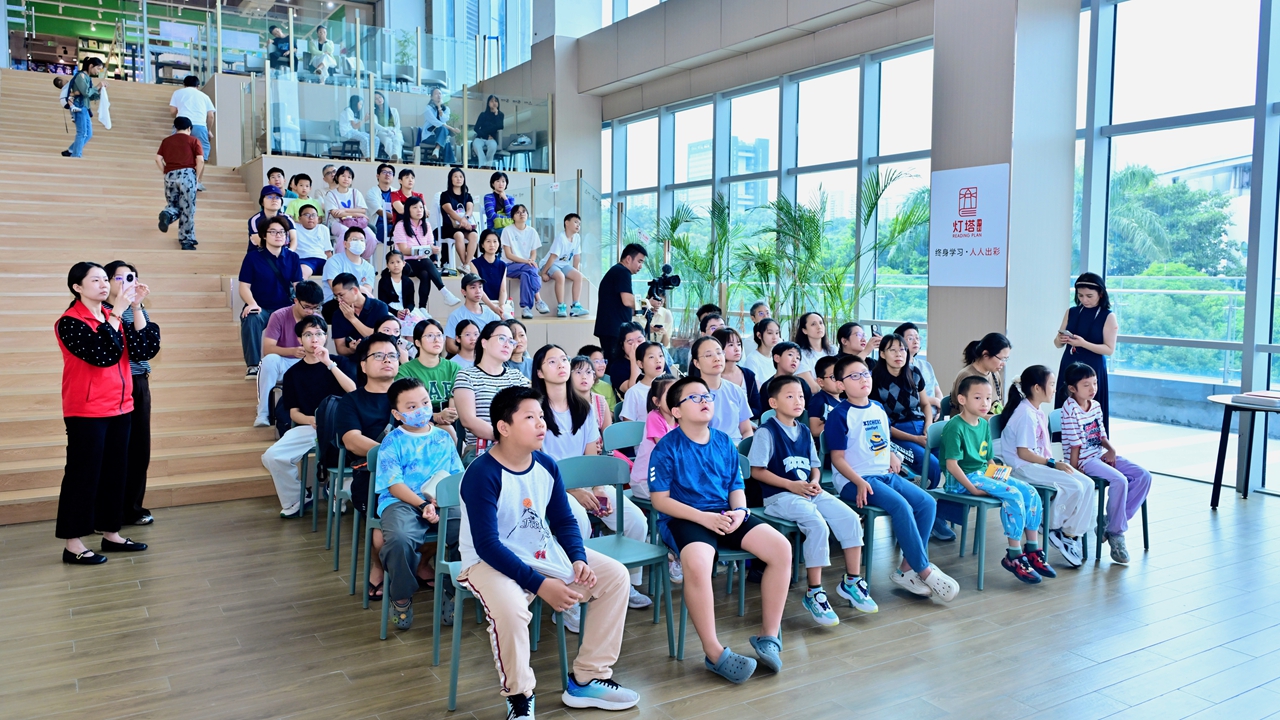
Audience of all ages listen closely to the “Universe Class” in the bookstore.
Astronomy entered his life early and deepened steadily. Summer programs at Johns Hopkins’ CTY (astronomy), UC Santa Cruz (Introduction to Astronomy) and the University of Hong Kong (AI×Python) gradually turned “gazing at the stars” into “studying the stars.” This summer he also visited the TianQin Center at Sun Yat-sen University (Zhuhai campus) — home of China’s space-based gravitational-wave detection program, which plans to deploy three satellites forming an equilateral triangle in Earth orbit to catch gravitational waves from deep space with lasers. If astronomy is watching the cosmos, TianQin is listening to its pulse; fascinated by both observation and cutting-edge hardware, he is coming to understand astrophysics more completely. Now he is sharing everything he has learned with more people.
His next step is sharing. He designed the 12-session “Lighthouse Project” and its opening lecture sold out; next, he plans to bring astronomy classes to schools in remote areas of Zhuhai, so more children can look up. “The romance of the universe is the fairest gift to all of humanity,” he said at the lecture.
It is a fitting note for young people of the Greater Bay Area who carry big dreams. The Bay Area is prosperous, its lights bright, and light pollution has made stars rarer in the night sky — but when you look up at midnight, they are still there. What matters is not how bright a city is, but whether one carries a cosmic vision in the heart. Carl Sagan called astronomy a humbling, character-building experience; Oscar Wilde wrote that we are all in the gutter, but some of us are looking at the stars; Stephen Hawking urged us to look up at the stars and not down at our feet; Elon Musk said that when something is important enough, you do it even if the odds are against you. The brightest lights of this region are not only in its skyscrapers, but in the aspirations of its young people to reach for the universe — just as the stars of a constellation are bound together, the children of Zhuhai, Guangzhou and Shenzhen are looking toward the same sky in their own ways.