
 Share
Share


 Print
PrintShenzhen-made robot becomes a hit at European trade show
Writer: Wei Jie | Editor: Cao Zhen | From: Original | Updated: 2026-10-09
A next-generation underwater pipeline inspection robot developed by a Shenzhen firm recently attracted considerable attention at a major European trade show, where industry professionals gathered to learn more about its technology and potential applications.
At No-Dig Live 2026, the 18th biennial trenchless technology exhibition, held in the U.K. from Sept. 29 to Oct. 1, Shenzhen Qianhai Yuntong Water Co. Ltd. showcased its new underwater pipeline inspection robot, the Turbid Water Inspector TW-2, drawing large numbers of professional visitors.
The event marked Yuntong Water’s first appearance in Europe, as well as the European debut of a Chinese robot designed to inspect municipal drainage pipelines under high-water-level conditions. The robot quickly became one of the exhibition’s most popular attractions at the show.
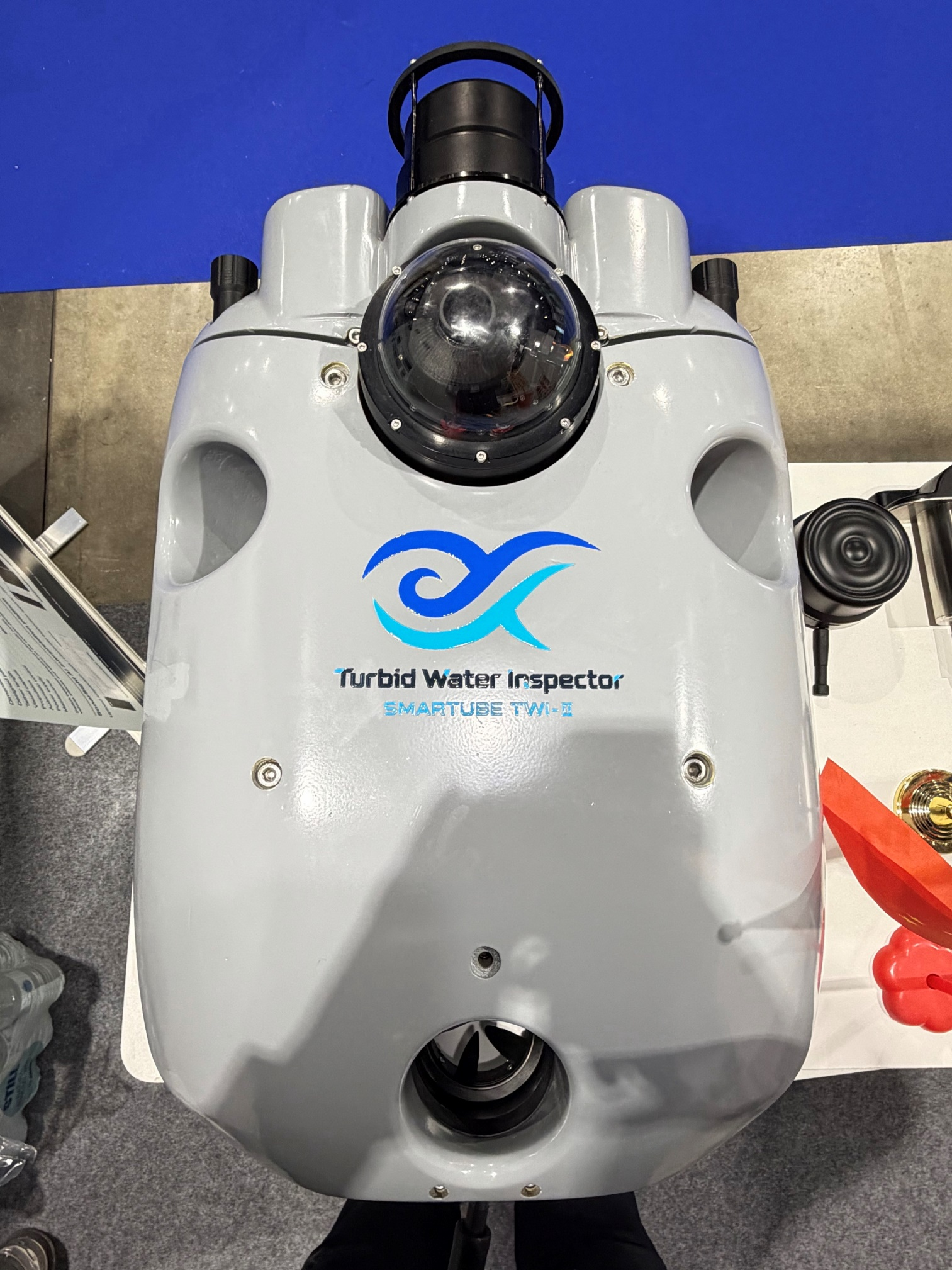
The Turbid Water Inspector TW-2
The Turbid Water Inspector TW-2 addresses the poor visibility that hampers traditional inspection methods used in urban drainage networks. Conventional inspection methods rely heavily on optical images, which can be severely limited by muddy water and poor visibility.
Rather than relying on a single sensor, the Yuntong robot integrates profiling sonar, forward-looking sonar and visual imaging on one platform. When optical visibility is poor, sonar can help reveal the internal geometry of a pipeline. When conditions permit, visual imaging provides additional details. The complementary technologies can be used to identify critical information, including sediment accumulation and structural defects, while supplying data to support subsequent trenchless repair decisions.
The robot features a streamlined body and shaftless propulsion system. Equipped with seven thrusters, it can maintain both heading and depth, making it suitable for operations in confined spaces and pipelines with complex water flows. The system is powered from the surface, with data transmitted through a tether. Operators can monitor sonar images, the robot’s position and warning information in real time, and switch between manual and automatic operating modes.
On the data application side, the optional SonarSight AI interpretation platform allows users to upload inspection data, generate inspection reports and create three-dimensional models. The system aims to deliver a complete workflow covering on-site data collection, data interpretation and support for repair planning.
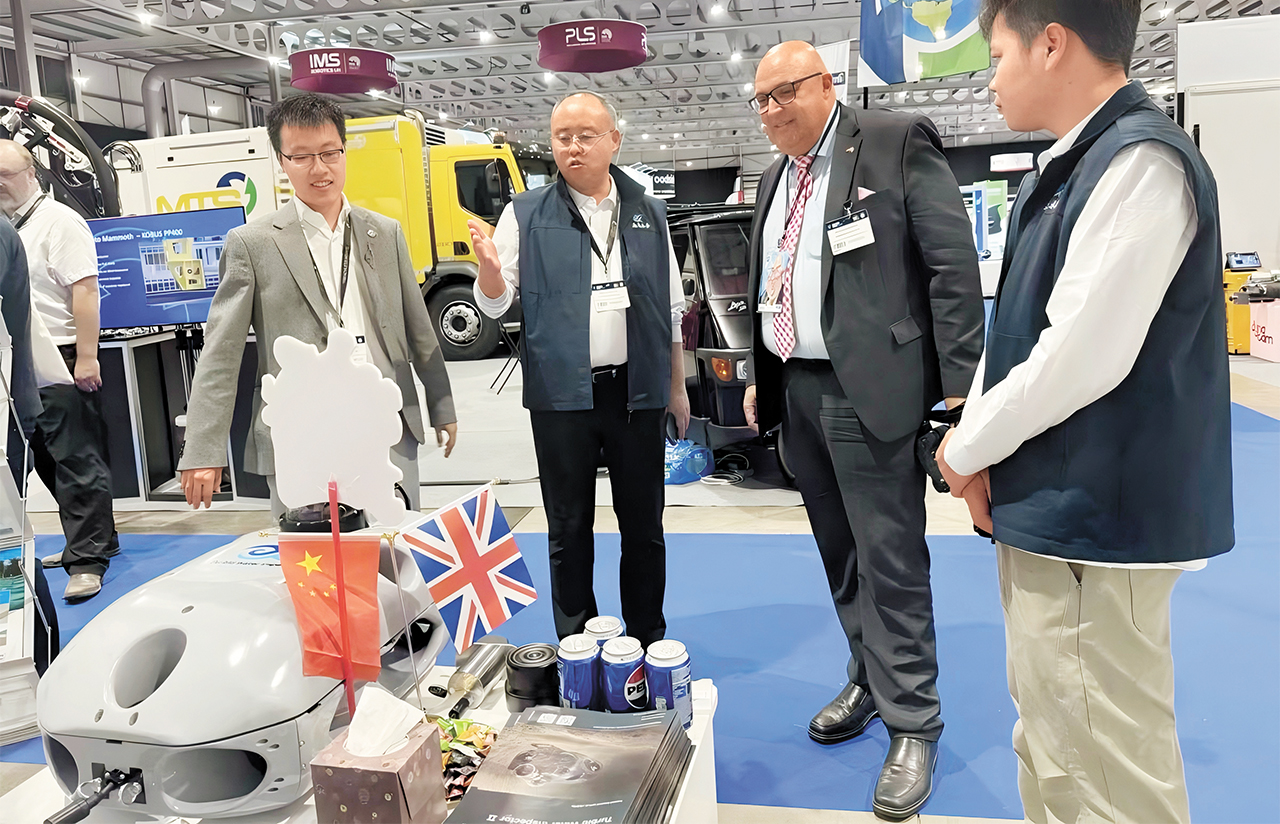
The Turbid Water Inspector TW-2 draws fairgoers at No-Dig Live 2026.
After visiting Yuntong Water’s booth, Roland Waniek, chairman of Germany’s IKT Group, said that Germany currently also lacks practical technologies for inspecting municipal drainage pipelines under high-water-level conditions.
“China’s intelligent technology for inspecting high-water-level pipelines is already capable of entering the European and even global markets,” Waniek said.
He invited the Yuntong Water team to participate in an exhibition in Germany next year, expressing hope that the high-water-level pipeline inspection technology would be deployed in Germany at an early date.
Since 2020, Yuntong Water’s high-water-level pipeline defect inspection technology has been applied in six cities in Guangdong. The technology has been used to inspect 592 pipeline sections with a combined length of 43,292.8 meters, identifying 357 structural defects and 1,171 functional defects. Pilot demonstrations have also been conducted in Zhejiang, Hunan and Hebei provinces, as well as Tianjin.
In 2022, the technology received the Grand Prize for Science and Technology from the Guangdong Municipal Engineering Industry Association. In April 2026, the Turbid Water Inspector TW-1 was included in the 2025 Key Promotion and Guidance Catalogue of Advanced and Practical Water Technologies in Shenzhen and listed on Guangdong’s Construction Engineering Scientific and Technological Achievements Service Supermarket platform.