
 Share


 Print
When a nation earns its celebration — China’s 77th National Day
Writer: Naveen Silva | Editor: Cao Zhen | From: Original | Updated: 2026-09-28
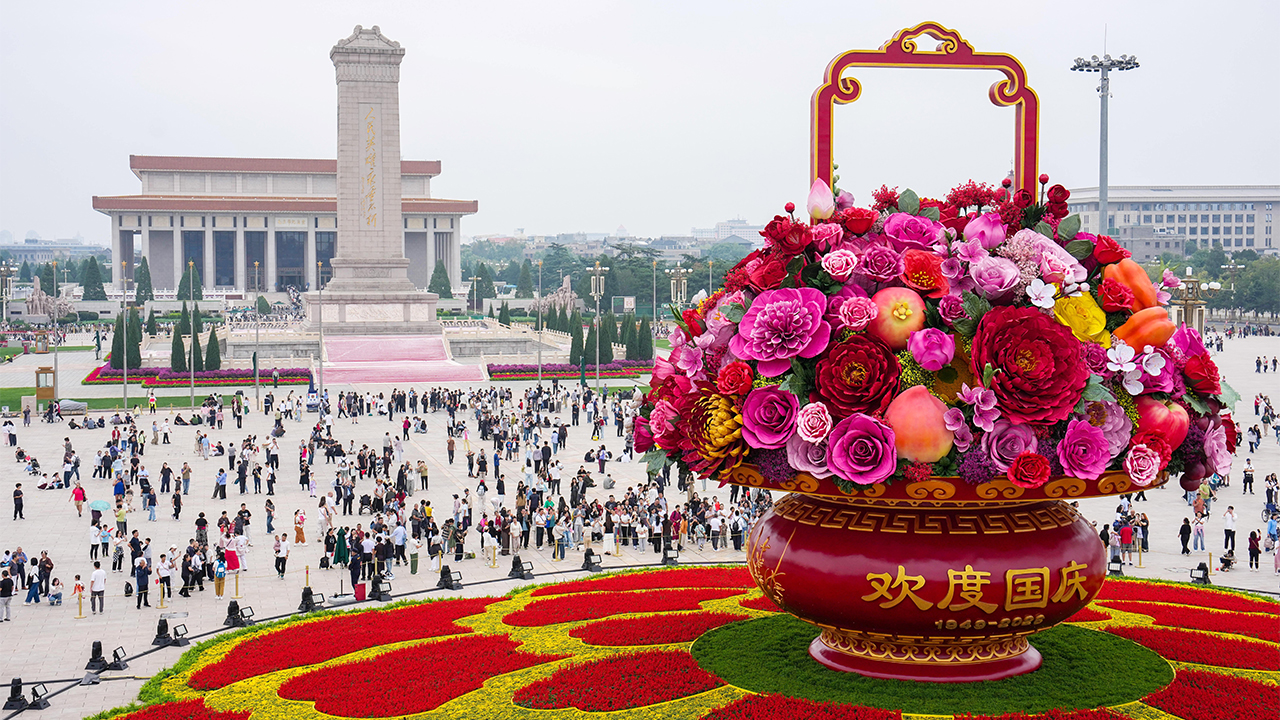
A giant floral basket installation at Tian’anmen Square in Beijing on Sept. 25. Photo by Xinhua
On Oct. 1, 1949, Mao Zedong declared the founding of the People’s Republic of China in Tian’anmen Square, marking the end of decades of conflict and paving the way for a new era in Chinese history.
Today, this historic date is commemorated each year as China’s National Day, a grand celebration with the main event held in Beijing. It features spectacular parades at Tian’anmen Square, where a display showcases the nation’s defense capabilities, alongside cultural performances celebrating the rich heritage of Chinese civilization as it has evolved throughout history. The week starting Oct. 1 is known as Golden Week, a seven-day public holiday for Chinese nationals, during which time they embark on trips across China or abroad, giving a significant boost to the domestic tourism sector.
National Day also serves as a moment to reflect on the nation’s broader achievements. Seventy-seven years on, China has emerged as the world’s second-largest economy. This remarkable achievement reflects decades of strategic policymaking, economic reforms, and sustained investment in national development. Notably, China’s economic rise has been accompanied by significant social progress, with more than 800 million people lifted out of poverty, making it one of the most extensive poverty reduction in human history. The impact of this transformation extends well beyond China’s borders. From an economic perspective, China has become one of the key pillars of global growth and development with its contribution of approximately 19% to global GDP based on PPP, while the economy continued to demonstrate resilience by recording growth of around 5% in 2025.
China’s rise to become a resilient and a global economic powerhouse did not occur overnight. The groundwork was laid during the Mao Zedong era, which established many of the foundations for industrial and social development. Building on this foundation, Deng Xiaoping’s reforms and opening up of the economy ushered in a new phase of economic transformation, enabling China to harness market forces and attract foreign investment.
Moreover, China has become deeply integrated into the global economy, that reflects not only domestic economic progress but also a more shared model of development. It is the world’s largest goods trading nation in 2025, a position it has held for many years. Trade with Belt and Road Initiative (BRI) countries has been a major part of this growth. It has also been noted that China's export structure has transformed remarkably, becoming greener and more technology intensive. China’s steady output of quality, low cost goods continue to underpin the stability of global supply chains.
While China’s manufacturing capacity remains the backbone of its economy, its advances in technological development have been remarkable. Over the past decade, the country has achieved impressive progress in AI and other high tech domains, such as quantum computing and many others. None of these achievements would have been possible without the far-sighted leadership of the Communist Party of China, which has set a clear course for each successive generation of leaders in building a prosperous and a modern country.
When a nation reflects on a journey from being a vast rural society in 1949 to becoming the world’s second-largest economy, the scale of its National Day celebrations carries more than symbolic value. It is not merely a public holiday, but a collective pause to recognize what sustained effort across generations has achieved. Golden Week, in that light, is well earned. A country that has worked at this intensity for several decades allows itself one week each year to travel, to rest, and to see what it has built.
What does this journey offer countries, that are still shaping its own long term direction. China’s experience suggests that the answer has more to do with how consistently a plan is carried through. China’s rise was not the achievement of a single leader or a single term in office, but the product of a direction set early and held steadily. Successive leaderships inherited a strategy, refined it, and passed it on rather than dismantling it. Reforms were sequenced deliberately, tested before being used, and protected from the temptation to reverse course by the patience to wait for results to materialize.
(Naveen Silva is currently working as a researcher in a leading private investment research firm in Sri Lanka. His primary focus is researching broader economic issues, including geopolitical/technological developments, and their implications across various sectors with special focus and interest on related developments in China.)