
 Share
Share


 Print
PrintForum explores path to a zero-carbon future
Writer: Chen Siqi | Editor: Lin Jiayi | From: Original | Updated: 2026-09-23
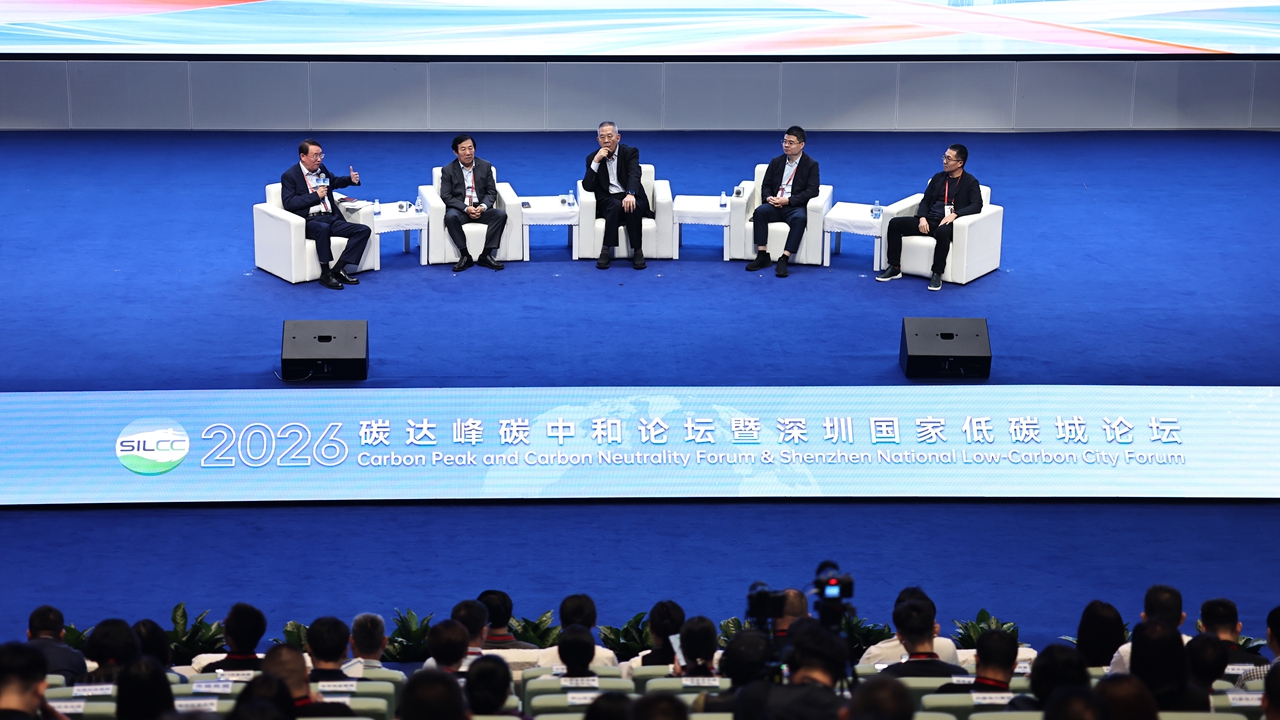
A high-level dialogue at the opening ceremony of the forum. Photos by Liu Xudong
The 2026 Carbon Peak and Carbon Neutrality Forum and Shenzhen National Low-Carbon City Forum opened in Longgang District on Tuesday, bringing together academics, industry leaders and policymakers to explore ways to accelerate the green transition. Held under the theme “Innovate for a Green Economy, Build a Zero-Carbon Urban Future,” the forum is hosted by the Shenzhen Municipal People's Government and co-organized by the Shenzhen Municipal Development and Reform Commission, the Shenzhen Municipal Bureau of Ecology and Environment, and the Longgang District People's Government.
Following a "1+3" mode, the two-day forum features one opening ceremony and 14 events across three fields. Topics range from new energy technologies and artificial intelligence for green development to carbon trading, the circular economy, low-carbon manufacturing, green supply chains and ESG governance. Sessions also include projects seeking investment and partnerships, as well as climate education programs for young people.
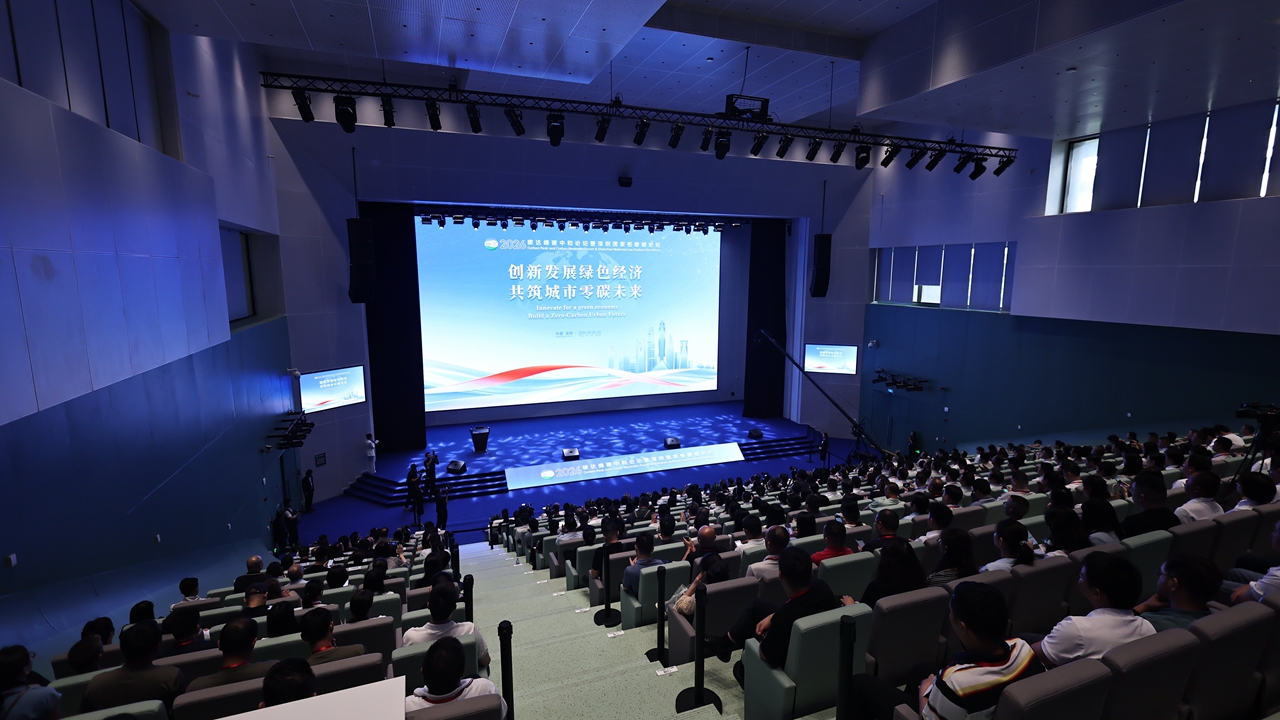
The opening ceremony.
Four major green initiatives unveiled
Four major green and low-carbon initiatives were announced during the opening ceremony.
The “2026 Shenzhen Green and Low-Carbon Development White Paper" reviews the city’s progress during the 14th Five-Year Plan period in areas, including energy conservation, emissions reduction, green industries, the circular economy, green spaces and environmental services. It also outlines what the city describes as a Shenzhen approach to low-carbon transformation in a major metropolis.
Construction of the National Carbon Metrology Center (Shenzhen) was also launched. Approved by the State Administration for Market Regulation, the center will serve as a national-level institution supporting carbon measurement technologies.
Using power batteries as a key area of focus, it will develop a database and three centers covering research, industrial applications and international cooperation, along with nine laboratories specializing in areas such as carbon measurement technology, equipment development, AI and big data, and international certification and technical cooperation.
During the ceremony, 10 urban green and low-carbon projects were also unveiled, including the Shenzhen Energy Environmental Protection Bao’an Energy and Ecological Park, the Shenzhen Electricity Culture and Science Education Base and a citywide carbon-benefit program promoting low-carbon public transport.
Eight companies, including Winner Medical, China International Marine Containers (Group), Dongpeng Beverage and China Overseas Land & Investment, were honored as 2025 Shenzhen ESG Practice Pioneer Enterprise Typical Cases, with their projects presented as examples that could be replicated elsewhere.
Experts call for stronger innovation
Wang Yi, deputy director of the National Expert Committee on Climate Change and a researcher at the Chinese Academy of Sciences, said global efforts to tackle climate change were facing growing challenges as the world approaches the 1.5°C warming threshold.
He said China had continued to play an active role in global climate governance and was expected by many developing countries to contribute further to international efforts.
China’s energy consumption is still expected to grow, Wang said, making it crucial to use renewable energy to meet new demand.
For the first time last year, the increase in China’s renewable power generation exceeded the increase in overall electricity generation, he said, adding that maintaining this momentum would provide solid support for achieving the country’s carbon peak target on schedule.
He called for greater support for local experimentation and innovation, saying Shenzhen should continue to play a leading role in demonstrating approaches to low-carbon development.
Zhai Yongping, a senior carbon-neutrality strategy adviser at Tencent’s strategy and development department, said the company had committed to achieving carbon neutrality across its entire value chain by 2030 at the latest.
Artificial intelligence, he said, is both a major consumer of energy and a potentially powerful tool for improving energy efficiency.
“Bridging the time gap between short-term energy consumption and emissions reductions requires coordinated efforts from all sides,” Zhai said.
Zou Caineng, an academician of the Chinese Academy of Sciences and Chief Expert of the National High-End Think Tank and Chief Expert of New Energy at China National Petroleum Corp. (CNPC), said China was moving towards an integrated energy system combining coal, oil and natural gas with various forms of renewable energy.
China’s renewable energy expansion had grown from a relatively small trend into a major industrial transformation, Zou said. The country accounts for about 60% of global installed solar capacity and 75% of global wind and solar capacity combined, he said.
CNPC established its new energy research institute in Shenzhen in 2021, while an innovation industrial base in Longhua District is expected to be completed by the end of September.

A journalist takes a selfie at the forum’s photo spot.
Dialogue focuses on sustainable growth.
A high-level dialog, hosted by Wang Dong, Professor of Harbin Institute of Technology, Shenzhen and Director of Shenzhen Research Center on Climate Change, examined how China’s cities can pursue low-carbon development while maintaining economic growth.
Dai Yande, a chief expert at the China Energy Research Society, called for a gradual approach that combines phasing out outdated capacity with building new green industries and renewable energy.
Tang Jie, a member of Governing Board of The Chinese University of Hong Kong, Shenzhen, said low-carbon development was compatible with high-quality economic growth rather than a constraint on it.
He cited Shenzhen’s rapid growth in high-end industries and the orderly exit of more energy-intensive sectors, as well as the expansion of new energy vehicles, energy storage and hydrogen energy.
Guo Zhanqiang, secretary-general of the China Association of Circular Economy, called for greater use of recycled materials during the 15th Five-Year Plan period and improvements to traceability systems and mechanisms for converting carbon reductions into measurable benefits.
Sun Zhongwei, chairman and general manager of Hello Tech, said he hoped the forum could help cultivate green-transition companies rooted in Shenzhen, serving the national market and expanding globally.
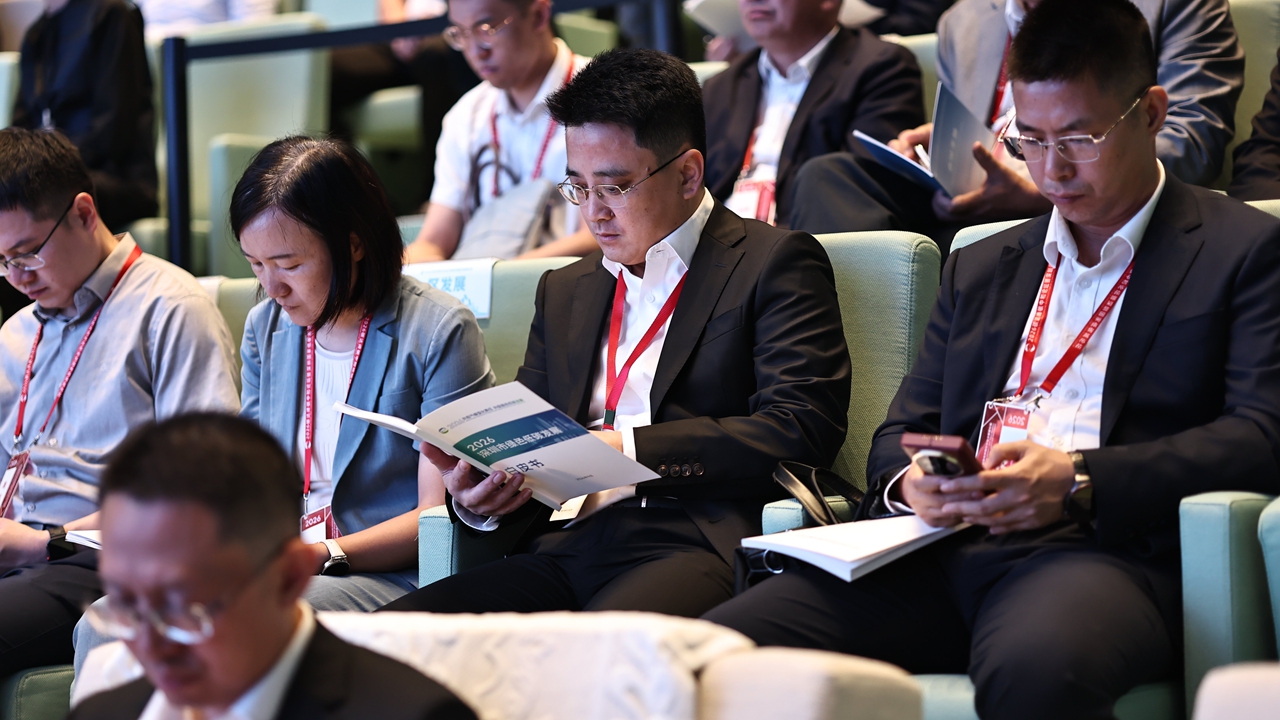
Attendees review forum materials at the opening ceremony. Liu Xudong
Founded in June 2013, the low-carbon city forum has adopted “Jointly shoulder Responsibility of Global Climate Change, Promote Low Carbon Development” as its permanent theme. It has attracted more than 10,000 participants from more than 70 countries and regions over the years, including U.N. officials, government representatives, international organizations, experts, academics and business leaders.