
 Share
Share


 Print
PrintYouth skills, new productivity: Shenzhen students compete on the world stage
Writer: | Editor: Lin Jiayi | From: | Updated: 2026-09-22
A student at Shenzhen Institute of Technology, Qin Xiutao will compete in the industrial design technology event of the 48th WorldSkills Competition, which opens in Shanghai today. The competition is the world’s highest-level and largest vocational skills event.
Qin, a post-2000s contestant from Gaozhou, Guangdong Province, is one of four contestants from Shenzhen. In addition to Qin, Du Meiting and Qiu Shubin will also represent Shenzhen Institute of Technology in graphic design technology and jewelry processing, respectively. Li Wentao will represent Shenzhen Polytechnic University in restaurant service. A total of 71 contestants nationwide were selected for China’s team.
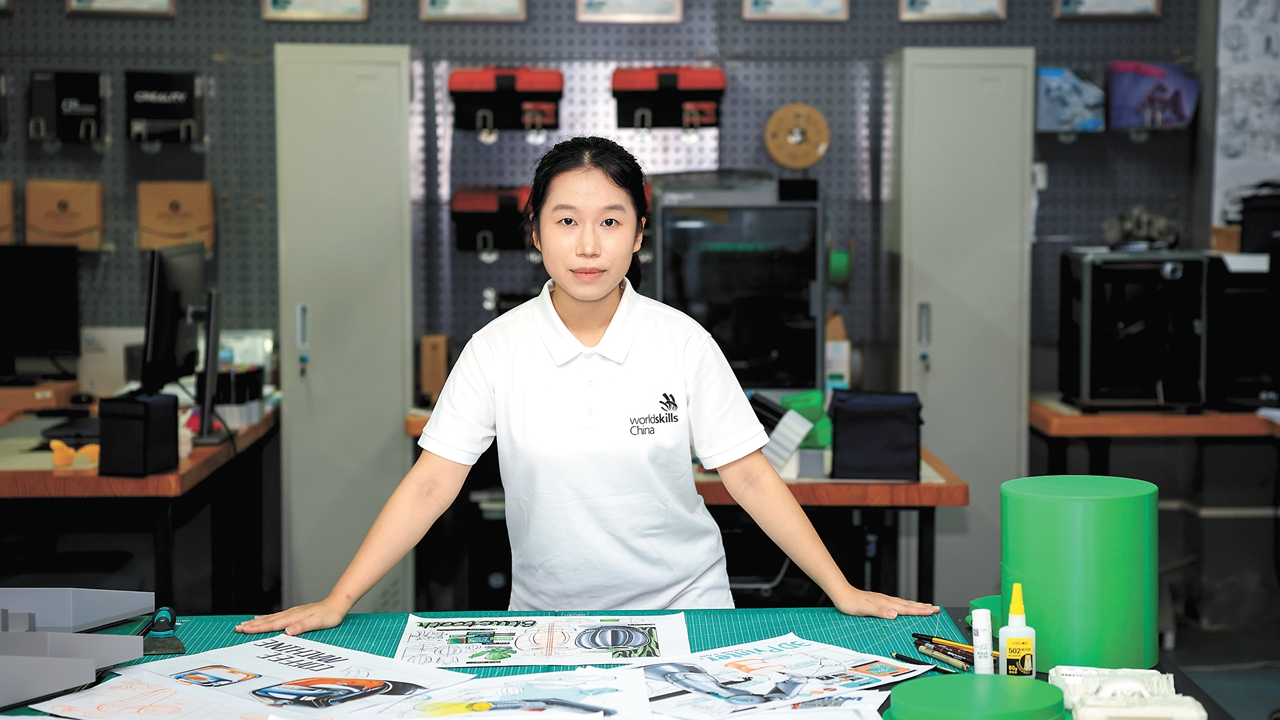
Qin Xiutao poses for a photo at a studio of the Shenzhen Institute of Technology in Shenzhen on Aug. 27. Photos from Xinhua
Skills competition
Qin loved painting from a young age and enjoyed taking things apart and assembling them. After being admitted to the industrial design program at Shenzhen Institute of Technology, she won a gold medal in the industrial design technology event of the second National Skills Competition in 2023 and subsequently became a member of the national training team for the event.
The industrial design technology event tests competitors on the entire product development process, with a total competition time of more than 20 hours. Its question bank covers a wide range of topics, including smart devices, accessible products for people with disabilities and pet supplies.
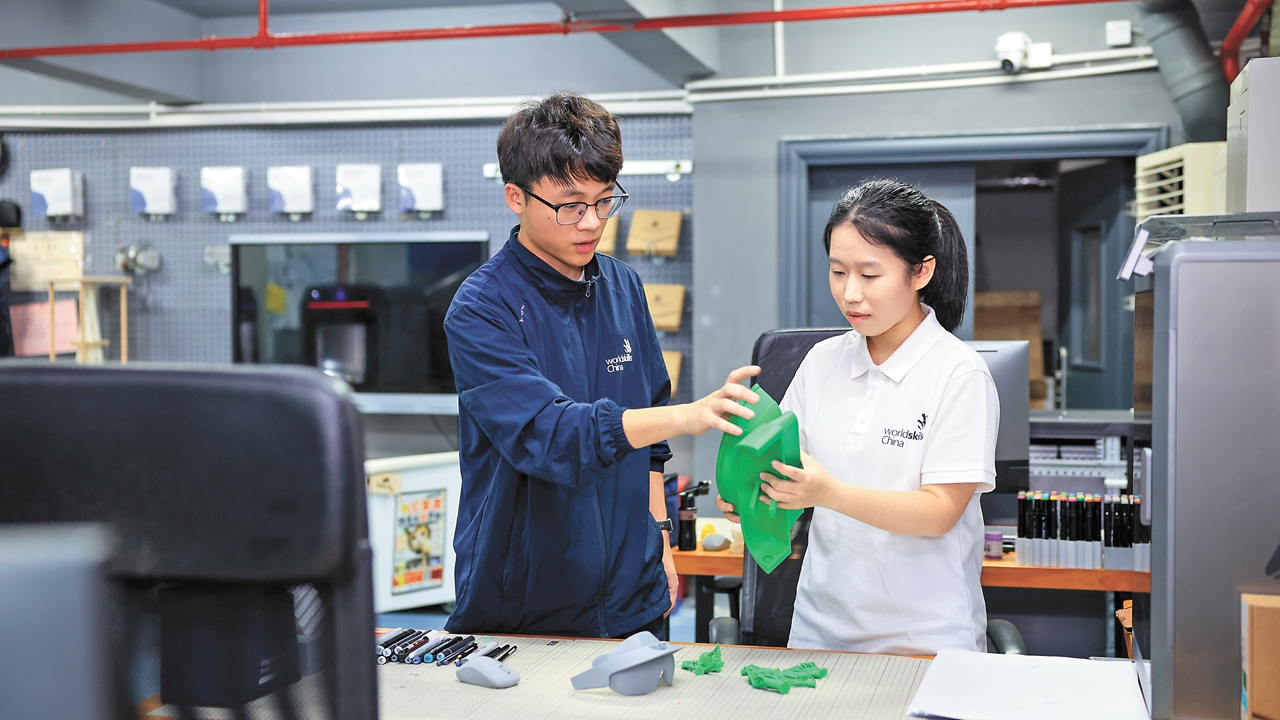
Qin Xiutao (R) trains with coach Zhuo Jiapeng, champion of the industrial design technology event of the 47th WorldSkills Competition, at a studio of the Shenzhen Institute of Technology in Shenzhen on Aug. 27.
During preparation, Qin trains every day according to her plan, honing her design and hands-on skills. She also sets aside time to study the latest products on the market and popular “hit products” favored by consumers, to improve her ability to analyze and design across different topics.
“I will do my utmost to showcase the design ability and craftsmanship spirit of Chinese skilled competitors, exchange with and learn from young contestants around the world, and draw on each other’s strengths,” she said.
Held every two years, the WorldSkills Competition is the world’s largest international gathering of skills talent. It is being held in Shanghai from Sept. 22 to 27 this year, with nearly 70 countries and regions expected to send about 1,400 competitors. Seven new events have been added, including drone systems, smart security, digital interactive media design and software testing.
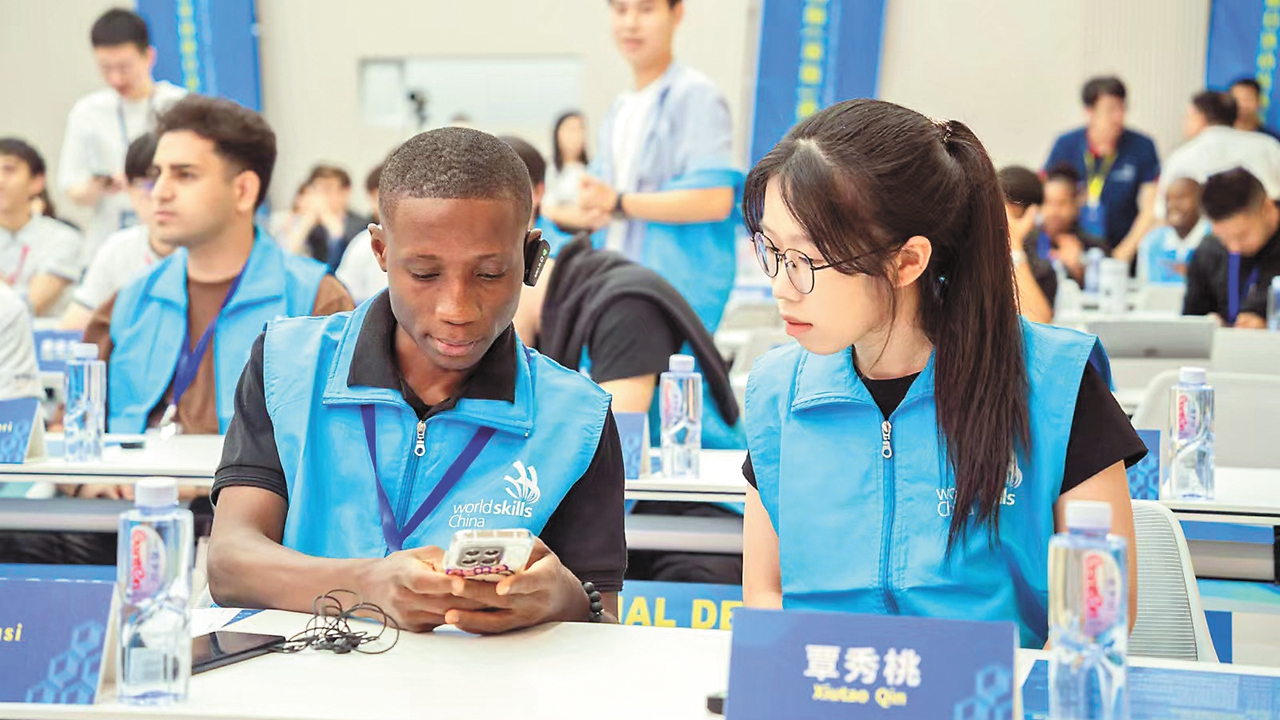
Qin Xiutao (R) interacts with a foreign contestant during the WorldSkills 2024 International (Shenzhen) Invitation Competition in Shenzhen in July 2024.
The Chinese delegation comprises 220 members, including 71 competitors who will participate in all 64 skill categories. The contestants come from 21 provinces, with 49 students and 22 working professionals. Their average age is 21, within the 18-25 age bracket.
A spokesperson for the Chinese delegation said the team will strictly abide by event regulations, compete fairly and with sportsmanship, and strive to demonstrate both skill excellence and a positive image, showcasing the craftsmanship and professionalism of China’s young skilled workers.
Since joining WorldSkills International in 2010, China has taken part in seven previous competitions, amassing 93 gold medals, 41 silver medals, 28 bronze medals and 71 medallions for excellence. It has topped both the gold medal tally and the overall team standings for four consecutive editions.
The competition covers six major categories: manufacturing and engineering technology, information and communication technology, construction and building technology, transportation and logistics, creative arts and fashion, and social and personal services. It features 64 skills, including seven new ones, and focuses primarily on practical work, with no theoretical exams.
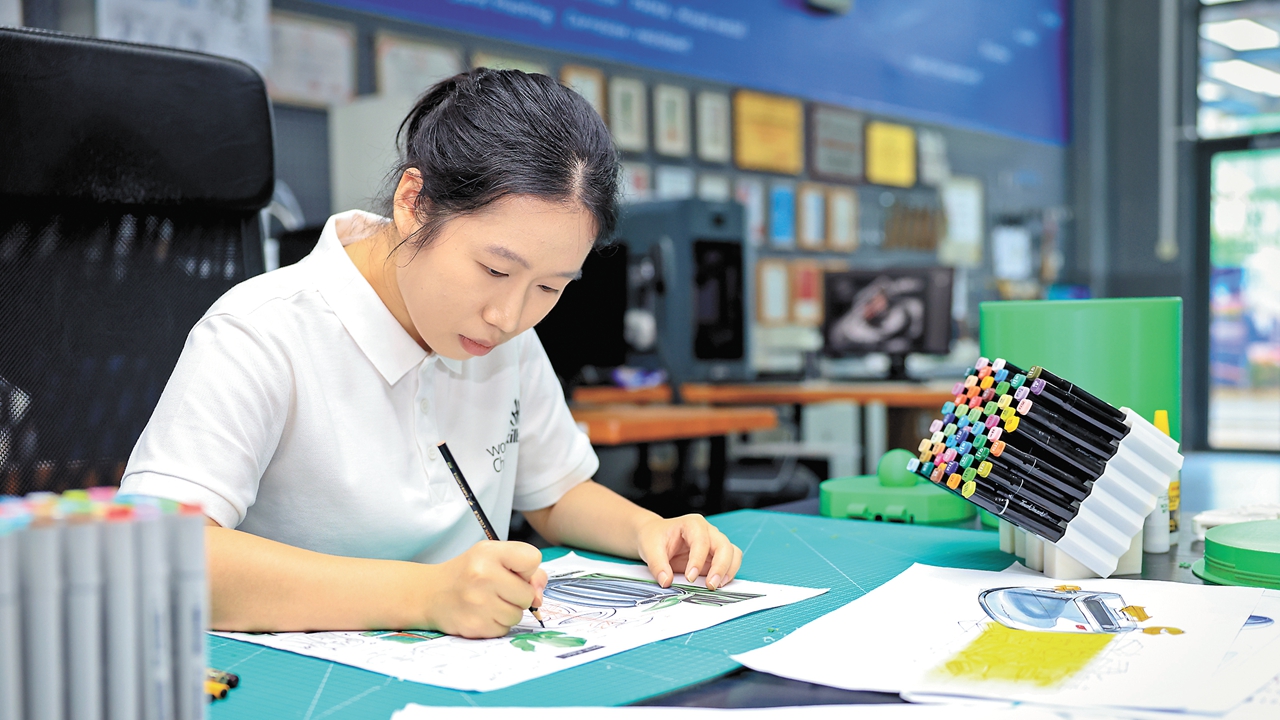
Qin Xiutao works on the blueprint of a product at a studio of the Shenzhen Institute of Technology on Aug. 27.
One of China’s strongest events is CNC milling — a test of industrial precision where the allowable error is just 0.02 millimeters, roughly a quarter of the width of a human hair. China has won gold in this category for five consecutive competitions, every time by a competitor from the same school: Guangdong Machinery Technician College.
Long Weijie, a post-2000s contestant who won at Lyon 2024, was born into a rural family and entered a vocational school after middle school. He struggled in provincial contests and nearly failed early on. But Long kept going, drawing blueprints as early as 6 a.m. and training for 17,000 hours over four years.
In Lyon, his years of hard work paid off as he held his nerve to claim the gold medal. Turning down high-paying job offers afterward, he chose to remain a teacher and coach. In April 2025, Long received the China Youth May Fourth Medal, the youngest awardee last year.
Now the baton has been passed to his younger schoolmate, Li Zhuoping, who will compete in Shanghai this year.
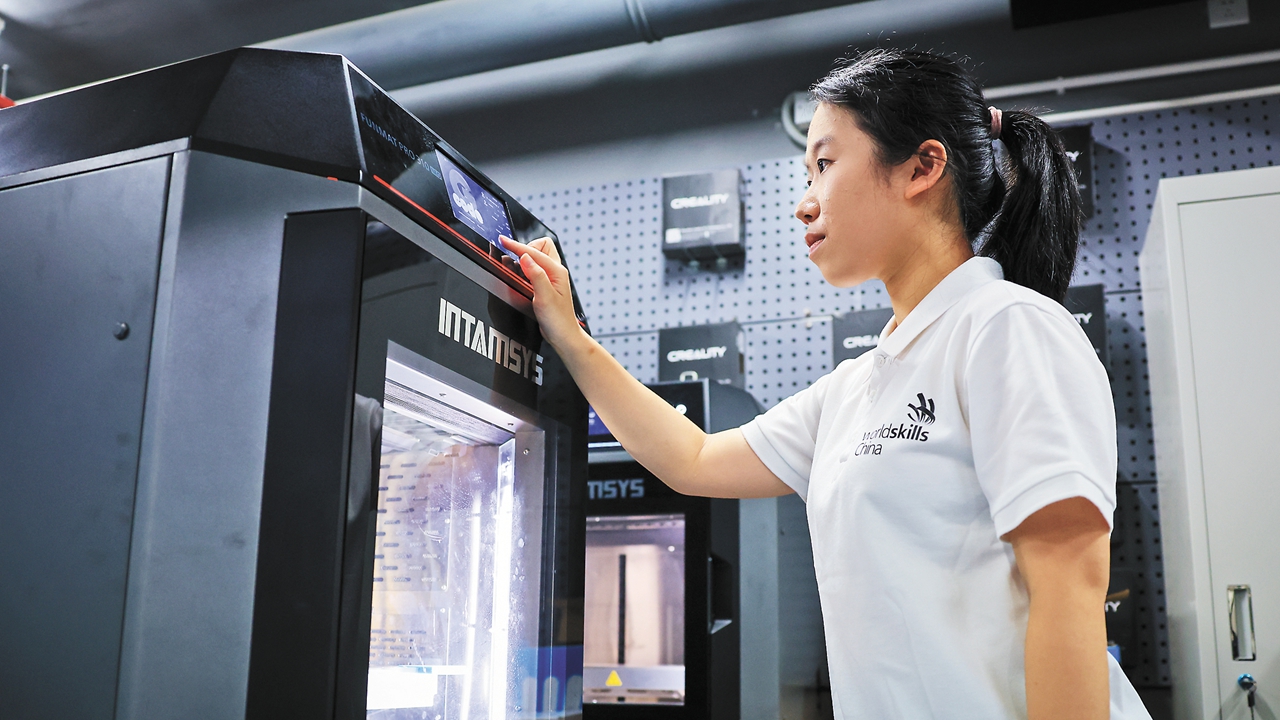
Qin Xiutao operates a 3D printer at a studio of the Shenzhen Institute of Technology on Aug. 27.
Youth Employment
Youth employment remains a top government priority in China. In March, Chinese authorities unveiled a package of policy measures to promote the employment of college graduates and other young groups, calling for efforts to tap the employment potential of leading enterprises and small and medium-sized enterprises that use specialized and sophisticated technologies, particularly in sectors such as advanced manufacturing and modern services.
This document stresses the need to step up job training and implement an internship recruitment plan. It also calls for the development of training programs in emerging fields of new quality productive forces like AI, new energy vehicles and the low-altitude economy.
Beyond traditional jobs, many young people are launching their own ventures. In Hefei, capital of eastern China’s Anhui Province, 26-year-old Min Yuheng leads Zerith, a Hefei-based robotics firm.
Founded in January 2025, the firm was producing 100 humanoid robots a month by December. Now with more than 130 employees and having completed multiple rounds of financing totaling several hundred million yuan, Zerith has placed its wheel-based service robots in airports, malls and hotels across 20 cities.
To encourage even more young company founders, the Chinese Government launched an entrepreneurship competition in Anhui in February this year, featuring four tracks — science, industry, vocational skills and people’s livelihoods — as well as a special youth innovation category. Each track sends 120 projects to the national selection round, and 50 will make it to the finals, with winners receiving funding, workspace and incubation support.
Data from the State Administration for Market Regulation shows that by the end of 2025, 1.73 million young Chinese had started businesses in wholesale and retail, up 8.4% from 2021. Another 213,000 were in scientific research and technical services and 526,000 in culture, sports and entertainment. The number of new livestreaming e-commerce firms and self-employed vendors also surged last year. (SD-Xinhua)