
 Share
Share


 Print
PrintLeju helps launch world's first dedicated SIM card for embodied robots
Writer: Song Yingwen | Editor: Cao Zhen | From: Original | Updated: 2026-09-21
Shenzhen-based Leju Robotics has teamed up with China Telecom Anhui and Huawei to launch what is described as the world’s first SIM card designed specifically for embodied robots, addressing a growing connectivity challenge as humanoid robots move from laboratories into real-world applications.
The SIM card was unveiled Sept. 10 alongside “Jushen Yilian,” China's first dedicated 5G-Advanced service plan for embodied intelligence. The partners also demonstrated a 5G-A network supporting multiple humanoid robots conducting inspections in an industrial park.
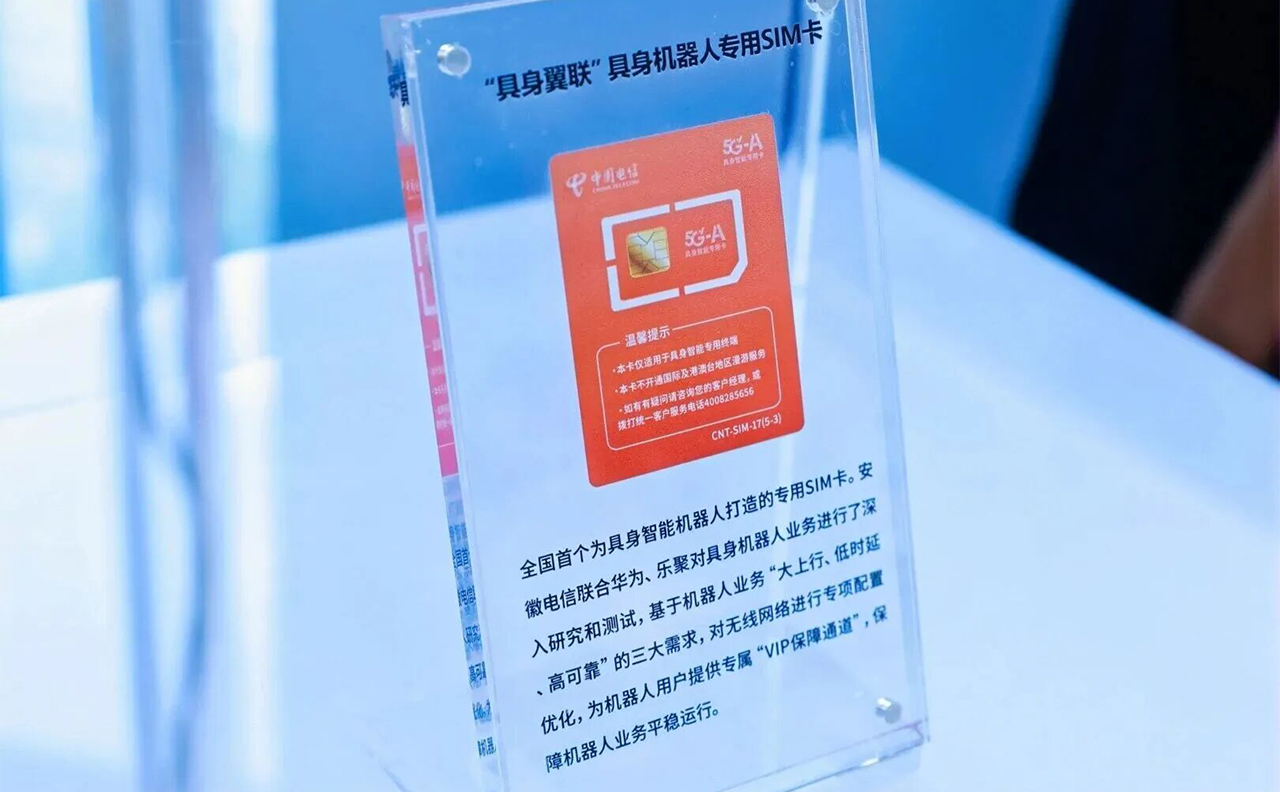
A dedicated 5G-A SIM card designed for embodied robots.
Why does a robot need its own SIM card?
Humanoid robots use mobile networks differently from smartphone users. People typically consume far more data than they upload, whether watching videos, browsing social media or streaming content. Robots, by contrast, can continuously generate images, sensor readings and operational data that need to be transmitted to cloud systems and data platforms.
That means they require strong uplink capacity, low latency and reliable connections when multiple machines are operating simultaneously.
The new 5G-A service plan is designed around those requirements. It offers peak uplink speeds of up to 500 Mbps, latency of no more than 20 milliseconds in 95% of specified scenarios, and priority scheduling for robot-related network traffic.
Two service tiers are available. The standard plan provides peak uplink speeds of 300 Mbps and 200 GB of high-speed uplink data, while the enhanced version offers up to 500 Mbps, 500 GB of high-speed uplink data and dynamic network slicing. Services can also be customized for different applications.
The significance goes beyond giving robots a different data plan. The product treats robots as a distinct category of connected device, with network services designed around the way they generate and transmit data.
From inspection to training data
The technology has already been put to work in a multi-robot inspection demonstration. Multiple Leju Kuavo humanoid robots conducted simultaneous inspections along eight routes, using the 5G-A network to transmit data generated during their work. The data can be sent back to Leju's data platform, where it is processed and labeled before being used for further model training.
This creates a cycle in which robots perform tasks in real-world environments, collect data from those tasks and feed that information back into their AI models.
Such real-world data collection is becoming increasingly important as developers seek to train embodied AI systems outside controlled laboratory environments. For robots operating at scale, the network connecting the machines with cloud and training systems becomes another part of the underlying infrastructure.
Another link in Shenzhen's robotics ecosystem
For Leju, the project extends its role beyond humanoid robot hardware into the infrastructure needed to deploy robots at scale.
The company is among a group of Shenzhen robotics companies working with Huawei’s global embodied intelligence industry innovation center, which brings together capabilities involving robot intelligence, control systems and development tools.
The development also comes as Shenzhen expands support for embodied intelligence. Under the revised Shenzhen Action Plan for Technological Innovation and Industrial Development of Embodied Intelligent Robots (2025-2027), released in June, the city aims to grow related industries to more than 100 billion yuan (US$14 billion) and have more than 1,200 companies in its embodied-intelligence robotics cluster by 2027.
The dedicated SIM card tackles a less visible part of that ecosystem: how growing numbers of robots connect reliably to networks and move the large volumes of data needed for real-world operation and continued AI training.
For humanoid robots, connectivity is increasingly becoming as important as the hardware and intelligence onboard the machine.