
 Share
Share


 Print
PrintSZU hosts seminar to cultivate talent in global internet governance
Writer: Zhang Yu | Editor: Lin Jiayi | From: Original | Updated: 2026-09-17

Participants and organizers pose for a group photo during the Asia Pacific Internet Governance Academy seminar at Shenzhen University. Photos courtesy of SZU
Shenzhen University (SZU) hosted the Asia Pacific Internet Governance Academy (APIGA) seminar from Sept. 11-13, marking the first time the ICANN-affiliated talent development program has been held on the Chinese mainland.
The event brought together 60 young participants from 23 Chinese universities and more than a dozen experts. It was organized by SZU and co-hosted by SZU's Graduate School, College of International Studies, and Institute of Area and International Communication Studies.
APIGA operates under the Internet Corporation for Assigned Names and Numbers, or ICANN, which coordinates the internet’s domain name system.
The seminar featured keynote speeches, expert roundtables and a full simulation of an ICANN international meeting. At the opening ceremony, Chao Naipeng, vice president of SZU, Liu Yong, dean of Graduate School of SZU, and Zhang Jianchuan, ICANN’s senior director of stakeholder engagement for Asia, delivered remarks.
On Saturday morning, researchers including Lang Ping of the Chinese Academy of Social Sciences, Yao Jiankang of the China Internet Network Information Center, and Liu Jinhe of Peking University examined the nature and development of the internet, covering governance concepts, technical architecture and cultural evolution, as well as the impact of geopolitics on internet governance.
In the afternoon, experts including ICANN’s Pitinan Kooarmornpatana, the Trusted Notifier Network’s Alban Kwan, the China Academy of Information and Communications Technology’s Liu Yue, the Internet Society’s Adrian Wan, Beijing Normal University’s Yik Chan Chin and SZU’s Cao Jianfeng discussed multilingual domain names, DNS abuse and intellectual property, the digital divide, AI governance under the U.N. framework, and legal and ethical AI governance.
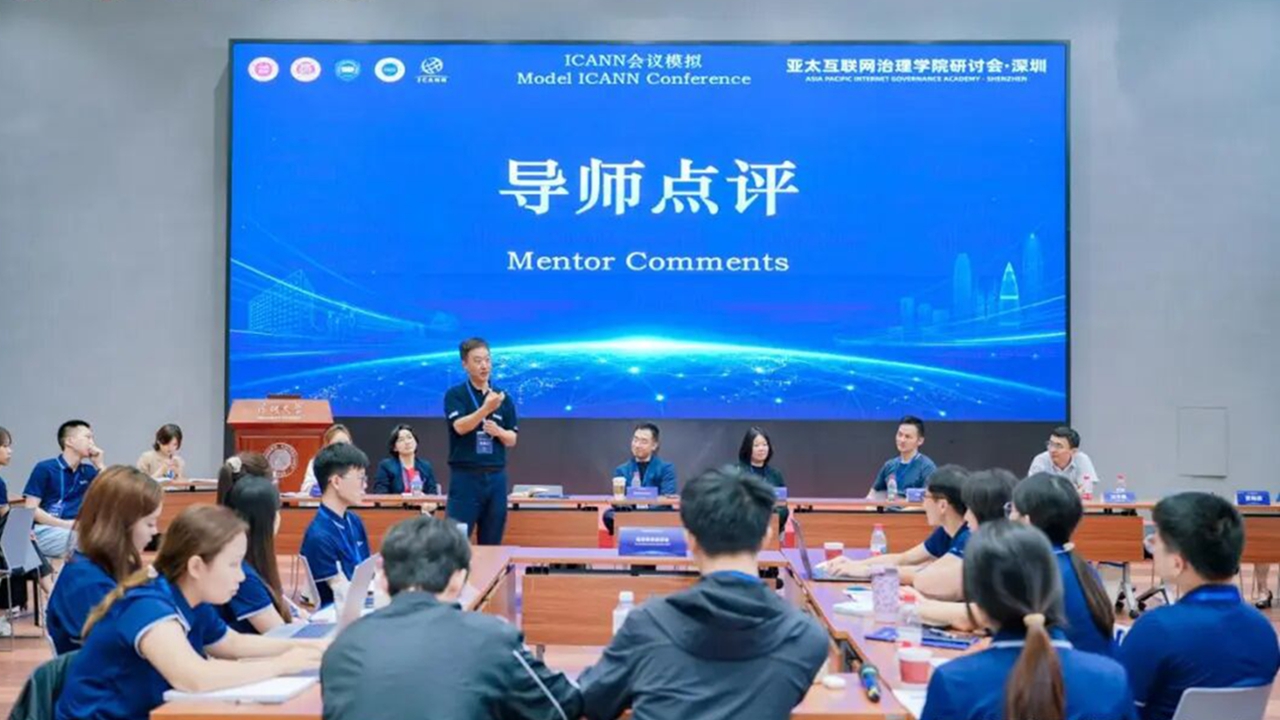
Zhang Jianchuan (C), ICANN’s senior director of stakeholder engagement for Asia, comments during an ICANN simulation session Sunday.
On Sunday, discussions shifted to the transition from internet governance to AI governance. Speakers included Tsinghua University’s Cui Baoguo, Beijing Institute of Technology’s Liu Xiabi, the China Institutes of Contemporary International Relations’ Li Yan, APNIC’s Joyce Chen and SZU’s Yang Le. They addressed AI-era network order, governance challenges, global IP address allocation and social media content governance.
During the afternoon ICANN simulation, participants conducted a policy consultation on the next round of new generic top-level domains, guided by experts from ICANN, APNIC, the Internet Society and the Trusted Notifier Network. Zhang Jianchuan and Jia Luyi, deputy dean of SZU’s College of International Studies, commented on their performance.
At the closing session, Dai Yonghong, dean of SZU’s College of International Studies, and the Institute of Area and International Communication Studies, awarded completion certificates. Students said the training sharpened their policy analysis, cross-cultural communication and negotiation skills.
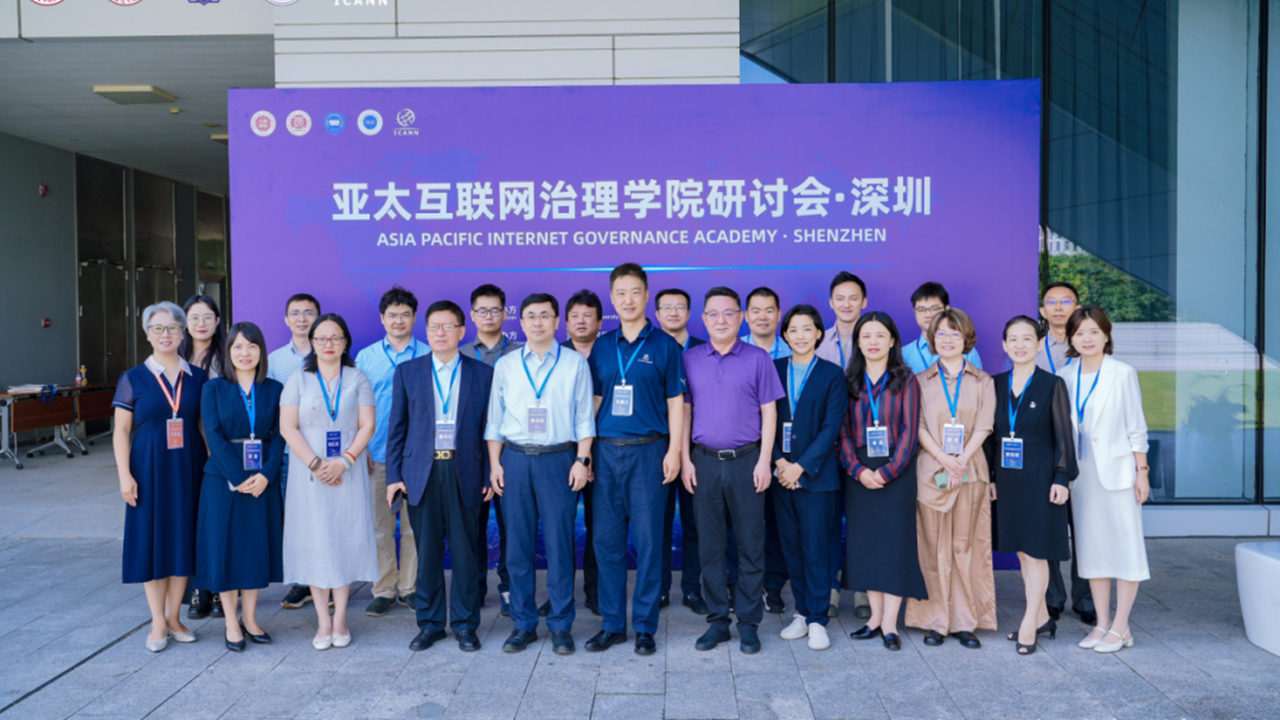
Participants pose for a group photo following the semiar.
Organizers described the event as a rare practical training platform for young people in China on global digital governance. SZU said it will strengthen cooperation with ICANN, the Internet Society and APNIC to promote youth talent development and research in internet and AI governance.