
 Share


 Print
Shenzhen is No. 1 in the world, but the real story is why
Writer: Luigi Gambardella | Editor: Cao Zhen | From: Original | Updated: 2026-09-11
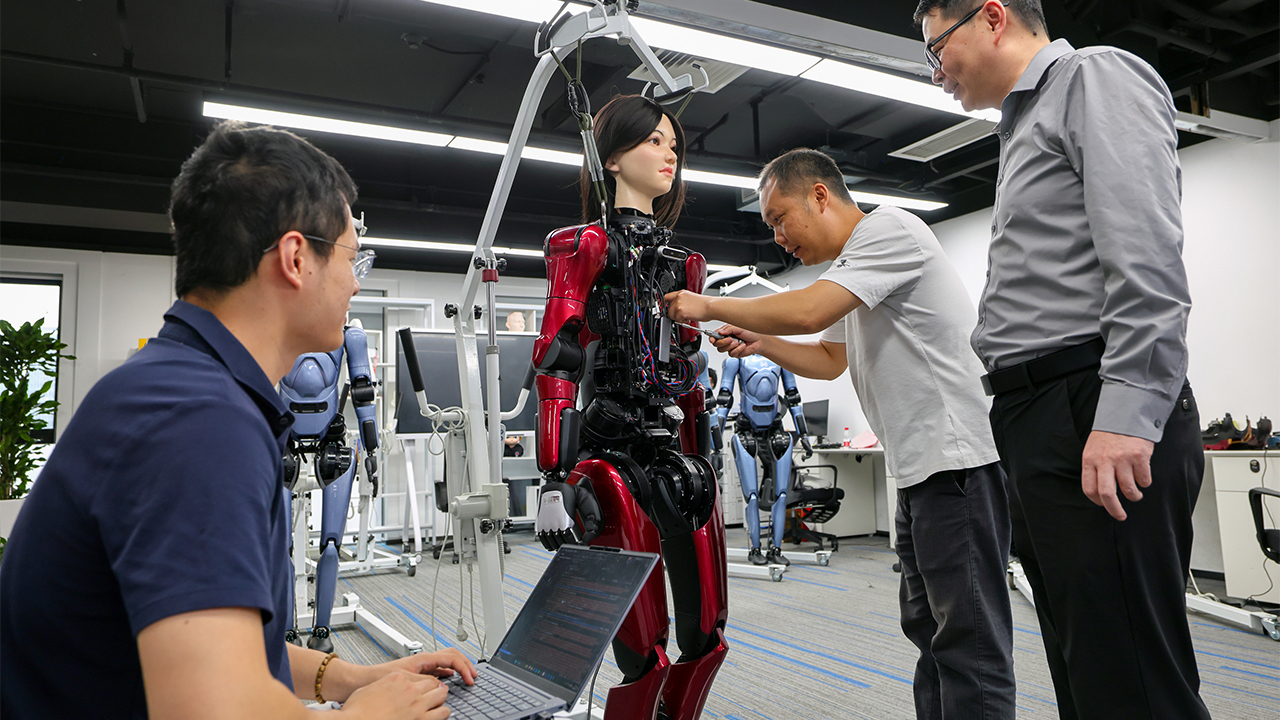
Staff members of Digital Robotics (Shenzhen) Technology Co. Ltd. are testing a humanoid robot. Photo by Zhou Hongsheng
This week, the World Intellectual Property Organization published its 2026 ranking of the world’s leading innovation clusters, and for the second consecutive year Shenzhen-Hong Kong-Guangzhou ranked first, ahead of Tokyo-Yokohama. San Jose-San Francisco, which includes Silicon Valley, now ranks third. China has 25 clusters among the world’s top 100, compared with 20 in the United States.
The result is impressive, but the ranking itself is not the most interesting part of the story. The more important question is what makes this cluster capable of moving from ideas to industrial scale so quickly.
For decades, innovation was associated with a familiar combination of world-class universities, scientific research, venture capital and entrepreneurial talent. Silicon Valley became the most successful expression of that model and, for many years, the benchmark that much of the world tried to reproduce.
Shenzhen has developed something different. Innovation and manufacturing are not treated as separate stages, but as parts of the same process, with research, capital, engineering, components, software, hardware and production interacting continuously rather than sequentially.
The numbers give a sense of scale. Shenzhen now has more than 2,600 artificial intelligence enterprises above the designated statistical threshold, while the revenue of its core AI industry reached about 220 billion yuan in 2025. The city is also pushing aggressively into embodied intelligence, with a municipal action plan targeting more than 1,200 related companies by 2027 alongside advances in AI chips, multimodal perception, motion control, dexterous manipulation and core robotic components.
Yet Shenzhen’s strength is not simply the number of companies it hosts, but the way those companies connect to one another. Within the same metropolitan area, entrepreneurs can find researchers, engineers, software developers, electronics manufacturers, sensors, batteries, telecommunications technologies, robotics components, prototyping capacity and large-scale production. That significantly shortens the path between imagining a product and building it.
Hong Kong adds another critical dimension. Its international financial markets, professional services and connections with global investors provide companies in the Greater Bay Area with access to capital and public markets, complementing Shenzhen’s technology and manufacturing base. The result is a cluster in which research, finance and industrial capacity reinforce one another rather than operating in isolation.
This is particularly visible in robotics. A robot is not simply an AI model with arms and legs; it depends on motors, reducers, actuators, cameras, sensors, batteries, chips, materials, control systems and sophisticated software, all of which must evolve together. Improving a robot therefore requires constant interaction between software and hardware, between the laboratory and the production line.
Having spent considerable time visiting technology and robotics companies in Shenzhen, I have been struck not only by the quality of individual firms, but by how quickly those interactions can take place. A component can be changed, a supplier identified, a prototype redesigned and a new version tested within a remarkably compressed timeframe.
This matters because the next phase of artificial intelligence may look very different from the first. Generative AI encouraged us to think that technological leadership would depend mainly on algorithms, foundation models, data and computing power, while Physical AI changes that equation by bringing intelligence into the physical world, where humanoid robots, autonomous vehicles, drones and smart factories require software to interact continuously with hardware, materials and production.
The factory is therefore no longer simply the place where innovation is manufactured after it has been invented. The factory itself becomes part of the innovation infrastructure.
There is, of course, an important caveat to the WIPO ranking. It measures concentrations of international patent filings, scientific publications and venture capital activity; it does not directly measure commercial success, and the quality and economic value of patents can vary considerably.
But that caveat actually helps explain why Shenzhen is interesting. Its advantage cannot be understood through patent volumes alone. The stronger argument is its ability to translate research and engineering into products, improve those products through repeated iteration and then take them to industrial scale.
This is why the latest WIPO ranking deserves attention far beyond China. We are not simply looking at the rise of one city, but at a broader change in the geography and perhaps even in the definition of innovation.
There is also a lesson here for Europe. Europe still has excellent universities, strong research centers, highly skilled engineers and some of the world’s leading industrial companies, but research, start-up policy, industrial policy and technology policy too often operate in separate worlds.
Perhaps European policymakers should therefore ask a more concrete question than how many billions should be allocated to the next AI program:
How long does it take a company to move from a laboratory prototype to 100 working machines on a factory floor?
If the answer is years in one part of the world and months in another, that difference will eventually matter as much as research budgets, patents or regulation.
Europe often talks about technological sovereignty, but technological sovereignty cannot be created simply by declaring it, nor by regulating technologies developed elsewhere. It depends on the ability to build.
Europe does not need to copy Shenzhen, because economic systems cannot simply be transplanted from one country to another. What Shenzhen does offer is a lesson that is becoming increasingly difficult to ignore: in the years ahead, research, capital and industry will need to move together.
The WIPO ranking gives us the photograph, but the more important story lies behind it. For the past two decades, much of the world assumed that the future would primarily be written in software, while Physical AI may now remind us that the future must also be built.
And in the next technological cycle, leadership may belong not only to those who can imagine the future, but to those who can build it faster.