
 Share
Share


 Print
PrintSZ Daily expands media partnerships ahead of APMF
Writer: Chen Siqi, Jian Zhen | Editor: Lin Jiayi | From: Original | Updated: 2026-09-07
Shenzhen Daily signed a three-year memorandum of understanding (MoU) with Pakistan’s Daily Kasoti and Kasoti Digital on Sept. 4, ahead of the Asia-Pacific Media Forum, to promote media cooperation. Amjad Aziz Malik signed the agreement less than a day after arriving in Shenzhen for the first time.
The deal also prompted expressions of interest from other international media organizations.
Aleksei Urazov, head of international cooperation at Russia’s National Media Group, called for closer ties in global communication. Muhammad Zahir Shah from Pakistan’s BOL TV also proposed mutual reporting and content sharing on behalf of the media. Donovan Martin SR., CEO and editor-in-chief of Canada’s Daily Scrum News, said: “We really need more co-creation.”
Pakistani editor discovers a ‘miracle city’
For Malik, Shenzhen offered a perspective he could not have gained from afar. After spending 48 hours in the city, he wondered why he had waited so long. “You can find everything online, but the scene is something different when I see everything on my own,” he said, describing first-hand reporting as one of the key values of journalism.
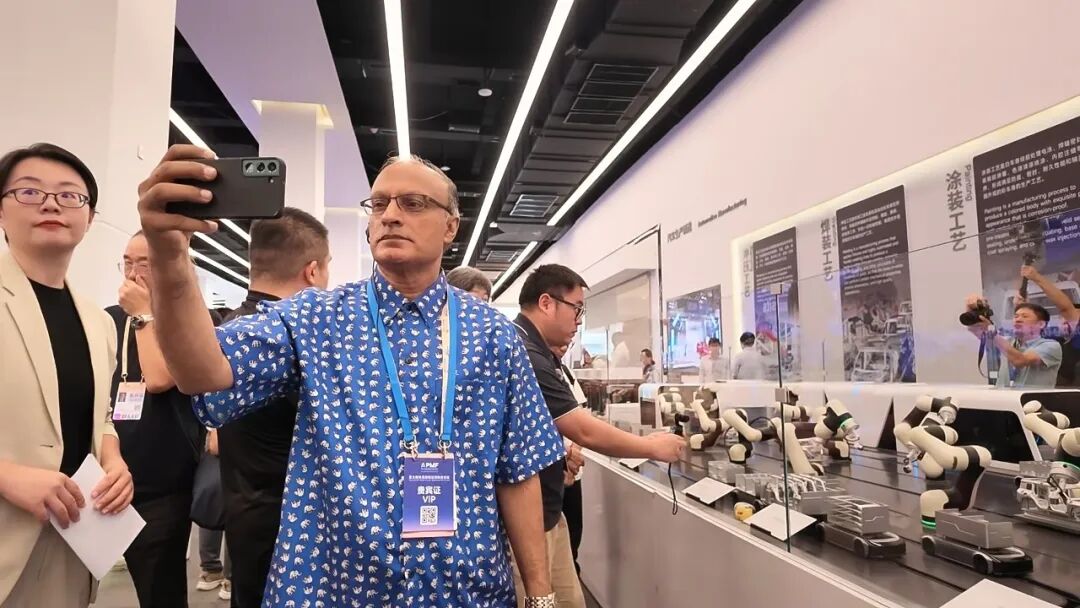
Amjad Aziz Malik takes a picture at BYD’s exhibition hall at the company’s headquarters in Pingshan district. Wang Haolan
A journalist with more than 40 years of experience, Malik began his career as a sports reporter and has witnessed the industry’s transformation from print to television and, more recently, digital media. He believes digital media will shape the future of journalism and said he was impressed by Shenzhen Daily’s ability to combine its print heritage with a digital operation.
Malik also said the China-Pakistan Economic Corridor is entering a new phase and expressed hope that closer media ties could help attract more Shenzhen investment and high-quality supply chains to Pakistan, while also encouraging greater cultural and educational exchanges between the two countries.
‘We are more alike than we think’
“AI saves time, but it can never replace human connection,” Martin from Canada's Daily Scrum News, said.
Martin argued that journalism cannot remain confined to screens. Reporters need to go into the field, meet people and capture the emotions and nuances that algorithms cannot fully convey.

Donovan Martin SR., CEO and editor-in-chief of Canada's Daily Scrum News, poses for a photo with his own special edition of Shenzhen Daily, which was printed at the Asia-Pacific Media Forum in Shenzhen on Sept. 5 Lai Li
He called for media cooperation to move beyond simply republishing each other’s content, suggesting joint interviews, the sharing of original footage and jointly planned features that could allow audiences in different countries to better understand one another through first-hand stories.
From ‘getting to know’ to ‘telling together’
“We still have a lot of room to grow,” Aleksei from Russia’s National Media Group said, adding that when media organizations work together on storytelling, mutual understanding can develop naturally. He stressed that media cooperation should go beyond exchanging content to include co-producing stories for audiences in different countries. Over the past year, he said, he had seen how collaboration among creators from different countries could generate fresh narratives and new ways of seeing one another.
He also encouraged media organizations to look beyond traditional cultural showcases and pay greater attention to the forms of entertainment popular among younger audiences, including video games, short dramas and role-playing. Russia and China each have distinctive animation, film and pop-culture industries, he said, and media partnerships could help introduce these creative works to wider and younger audiences.
The proposed partnerships go beyond simple content sharing.
Shenzhen Daily can draw on its English-language editorial capabilities, multilingual platforms and access to Shenzhen’s industrial and technological sectors, while its international partners can provide local perspectives and distribution networks in their respective markets.
Together, the partners hope to develop stories around issues including green development, the digital economy and technological innovation, bringing these subjects into public discussion across different countries.
What began with one media agreement has opened the door to broader cooperation among news organizations from different countries, echoing the theme of the Asia-Pacific Media Forum: “Building a prosperous Asia-Pacific community: media consensus and action.”