
 Share
Share


 Print
PrintAPMF sub-forum shares insights into Chinese modernization
Writer: Shao Jingfeng | Editor: Lin Jiayi | From: Original | Updated: 2026-09-05
How did a former border town grow into a modern international metropolis in just a few decades? On September 4, the Shenzhen Sub-forum of the Asia-Pacific Media Forum was held.
Gathering in Shenzhen, dozens of media leaders, experts, entrepreneurs and international guests from the Asia-Pacific region conducted in-depth exchanges centered on the theme of “Shenzhen’s stories of Chinese modernization.” The guests attributed Shenzhen’s rapid development to pioneering reform and innovation, joint efforts of countless strivers, inclusive cultural openness, ecological protection and the philosophy of win-win global cooperation. Around 130 Chinese and foreign guests attended the sub-forum.
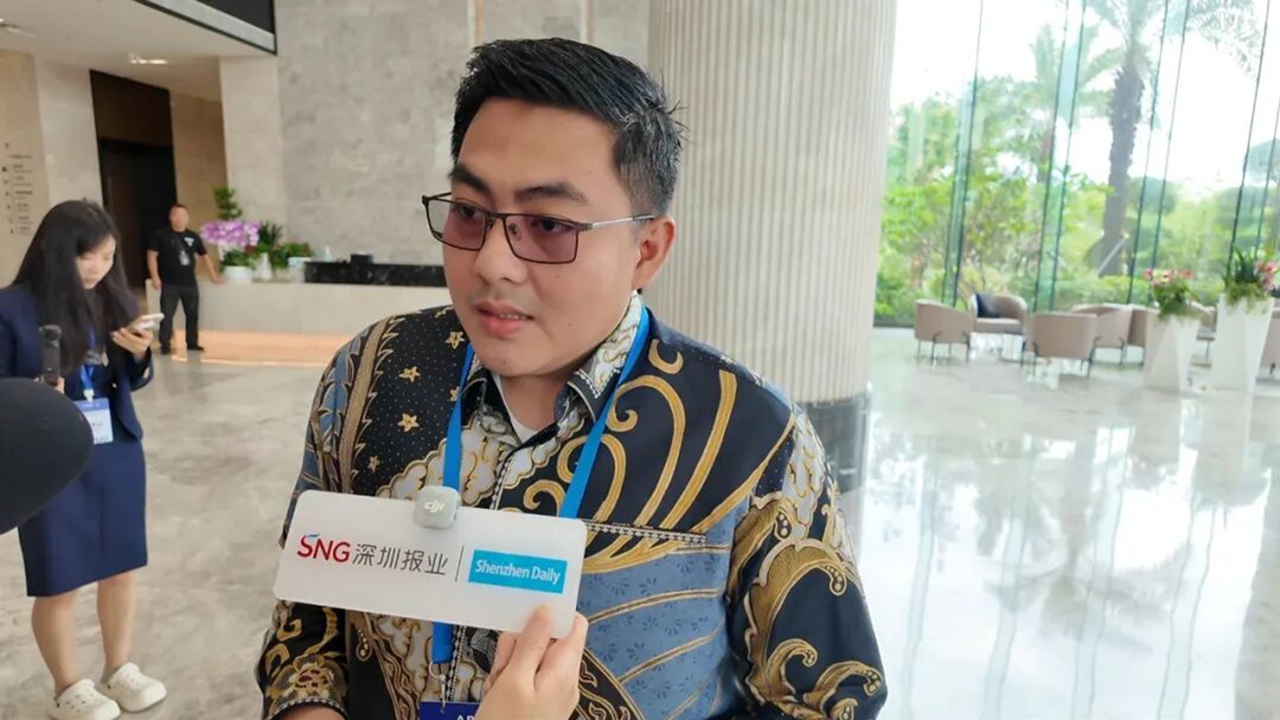
Virgandhi Prayudantoro receives an interview. Jian Zhen
As Director of News at Indonesia’s ANTARA News Agency, Virgandhi Prayudantoro has long paid close attention to China’s development. His on-site visit and participation in the forum have strengthened his belief in win-win cooperation between China and Indonesia.
“I think this is good to China, good to me, to Indonesia, to get collaboration,” he said. He believes that cross-border exchanges and cultural integration can further boost practical cooperation between the two countries and bring tangible benefits to both sides.
“Shenzhen has developed rapidly across many fields, particularly in technology and artificial intelligence. I hope to learn from China and Shenzhen.”
He pointed out that Shenzhen has made remarkable progress in artificial intelligence and other technological fields, developing mature and valuable models of innovation that can serve as an example for countries around the world.
“Indonesia and China have built a strong partnership, and I hope that in the years ahead, the two countries will jointly develop more products and projects, both in Indonesia and elsewhere.”
He stressed that Indonesia and China have maintained a sound, long-term cooperative relationship and expressed hope that the two countries would launch more industrial projects and achieve further breakthroughs in innovation and cooperation in the future.
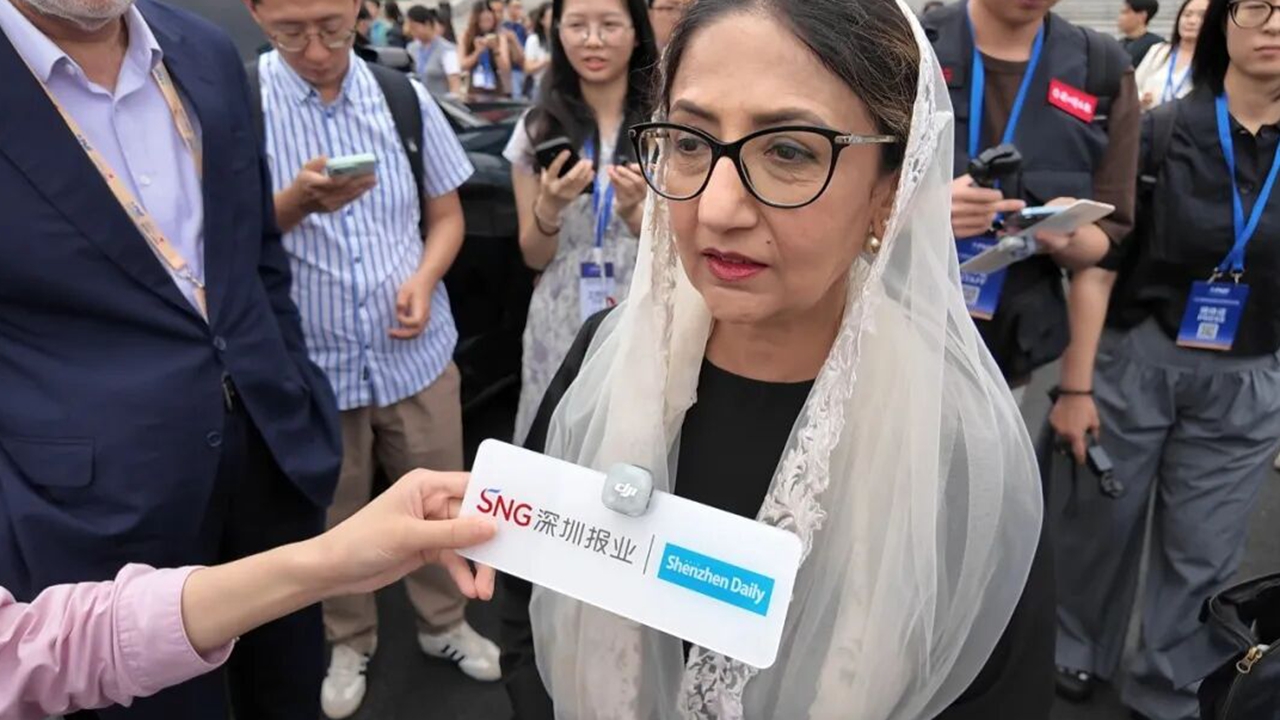
Dr. Shezra Mansab Ali Khan Kharal gives an interview to the media.
Dr. Shezra Mansab Ali Khan Kharal, Minister of State for Climate Change and Environmental Coordination of Pakistan, spoke highly of the overseas layout of Chinese enterprises represented by BYD and ByteDance. She believes that the going-global strategy of Shenzhen innovative enterprises is driving technological progress and industrial upgrading across the Asia-Pacific region.
“BYD has also opened a factory in Pakistan near Karachi, so it's very popular in Pakistan. And now that the models that I'm seeing here, they are very modern, very technologically very advanced and amazing,” she commented. She said new energy vehicles made by Chinese enterprises have won wide market recognition and public praise in Pakistan with advanced technology and superior design.
When talking about the overseas expansion of Chinese enterprises, she gave full recognition to its regional value. “Yes certainly. I think that the way that ByteDance is expanding their business to other regions and especially Asia-Pacific, it's going to be very useful.”
“It's going to provide this new technology to other countries as well, and this advanced technology is going to go to other countries, and BYD is very popular in other countries.” She noted that the outward development of Chinese innovative enterprises realizes cross-border sharing of advanced technologies and helps promote balanced development of the regional economy.

Rebecca Fanning shows a book her wrote about China. Zhang Yu
Veteran American journalist and writer Rebecca Fanning, who has long observed and studied China’s scientific and technological innovation, summarized China’s decade-long sci-tech transformation. She pointed out that China has completed a remarkable “identity revolution” in the global tech arena, with international attitudes undergoing a fundamental shift.
“I think people around the world have come to respect China as a force in technology and its innovation, where before people were very skeptical,” she said.
“Now, today there's some acceptance that China is a competitor, is a challenger.” According to Fanning, China’s innovation strength is no longer ignored or questioned, but widely recognized and affirmed globally.
“That's very different from a decade ago. That's the biggest change.” She emphasized that the shift in global public opinion represents the most historic change in China’s tech development over the past decade.