
 Share
Share


 Print
PrintShenzhen Bay Park 深圳湾公园
Writer: | Editor: | From: | Updated: 2026-08-30
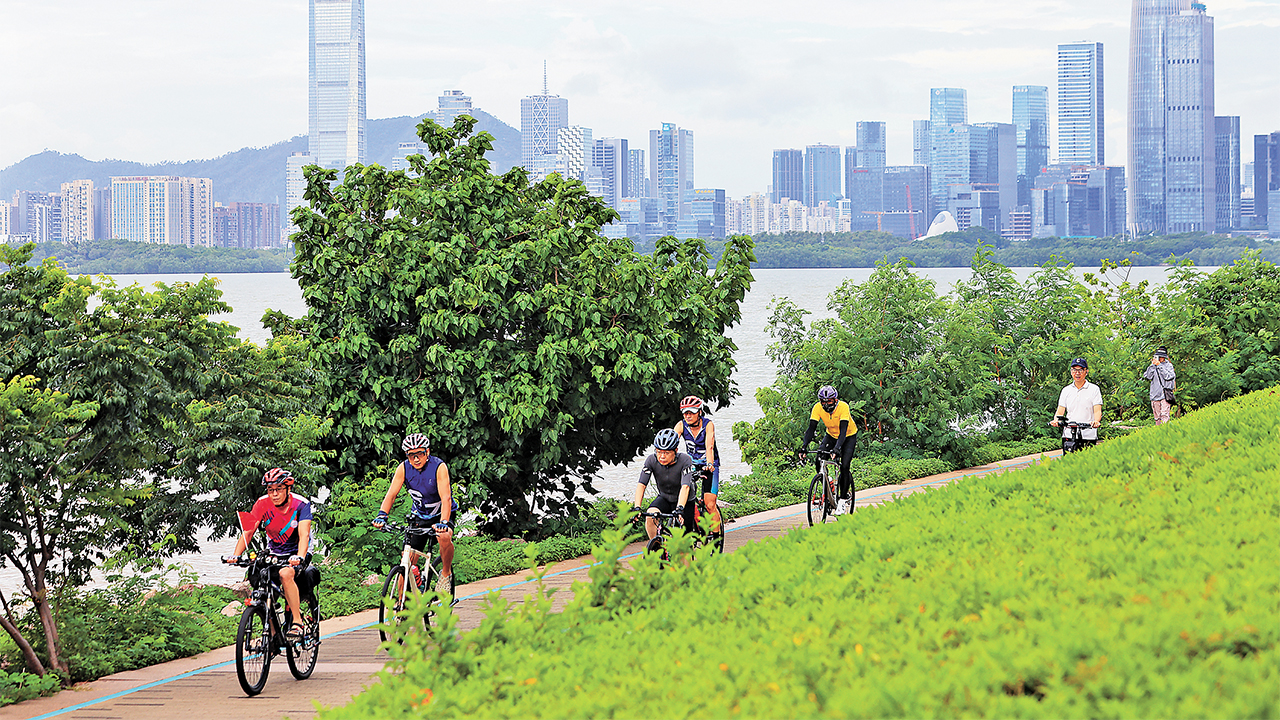
Residents cycle at Shenzhen Bay Park. Photo by Chen Yu
Shenzhen Bay Park is the city’s signature waterfront: a roughly 13-kilometer coastal leisure belt along the southwestern shoreline, facing Hong Kong across the water. It is one of the most remarkable landscapes in the city — a natural wetland in the middle of a major international metropolis. The park grew from two parts: the Mangrove Coastal Ecological Park, opened to the public in December 2000, and the Shenzhen Bay Coastal Leisure Belt, opened in 2011. Together they cover 128.74 hectares, string together 14 themed attractions along walking and cycling routes, and connect seamlessly with Shenzhen Talent Park and the Shahe leisure belt inland.
深圳湾公园是深圳最具标志性的滨海岸线:约13公里长的滨海休闲带,依西南海岸延伸,隔海与香港相望,是这座城市最非凡的景观之一——大都市中的天然湿地。公园由两部分生长而成:2000年12月开放的福田红树林海滨生态园,与2011年开放的深圳湾滨海休闲带,合计面积128.74公顷,沿步行与骑行线路串联14处主题景点,并与内陆的深圳人才公园、沙河休闲带无缝相接。
The ecological park’s origin says a great deal about Shenzhen’s priorities. The site was a mudflat reclaimed from the bay for the construction of Binhai Boulevard; to protect the mangrove forest growing there, the city moved the boulevard 200 meters north of its planned alignment — a small detour for a fast-growing city — and turned the reclaimed land into a park instead.
生态园的由来,很能说明深圳的取舍。这里原是为修建滨海大道从海湾填出的滩涂,为保护其上生长的红树林,城市将滨海大道北移200米——对一座高速生长的城市不过是小小绕行——并把这片填海地改为公园。
Every winter, from roughly November to March, the bay becomes a stage for one of nature’s great journeys. Lying on the East Asian–Australasian Flyway — the migration corridor that runs from Siberia through the Chinese coast to Southeast Asia and Australasia — Shenzhen Bay and its mudflats attract tens of thousands of migratory waterbirds each year: egrets and herons, pied avocets and cormorants among them. The best-known visitor is the black-faced spoonbill, a wetland species listed as Endangered on the IUCN Red List whose global population has recovered from fewer than 300 individuals in the 1990s to about 7,700 by the January 2026 census. The bay’s wetlands form a single ecosystem with the Futian Mangrove National Nature Reserve to the east and Hong Kong’s Mai Po wetlands across the water, making this one of the few places on Earth where internationally threatened species can be watched against a megacity skyline.
每年冬季,大约11月至次年3月,海湾成为自然界伟大旅程之一的舞台。深圳湾地处东亚—澳大利西亚迁飞通道——从西伯利亚经中国海岸到东南亚、大洋洲——其湿地与滩涂每年吸引数以万计的迁徙水鸟:白鹭、苍鹭、反嘴鹬、鸬鹚等。最著名的访客是黑脸琵鹭,IUCN红色名录濒危物种,全球种群从1990年代不足300只恢复至2026年1月普查约7700只。深圳湾湿地与东面的福田红树林国家级自然保护区、隔水的香港米埔共同构成单一生态系统,使这里成为地球上少数能在巨型都市天际线背景下观赏国际濒危物种的地点之一。
Admission is free; opening hours are 6:00-23:00. The simplest arrival is Metro Line 9 to Shenzhen Bay Park Station — the sea appears as you emerge — or Line 11 to Hongshuwan South for the western end.
免门票,开放时间6:00—23:00。最便捷抵达方式为地铁9号线深圳湾公园站——出站即见海——或11号线红树湾南站前往西端。