
 Share
Share


 Print
PrintHuaqiangbei — “China’s No. 1 Electronics Street” 华强北——“中国电子第一街”
Writer: | Editor: | From: | Updated: 2026-08-30
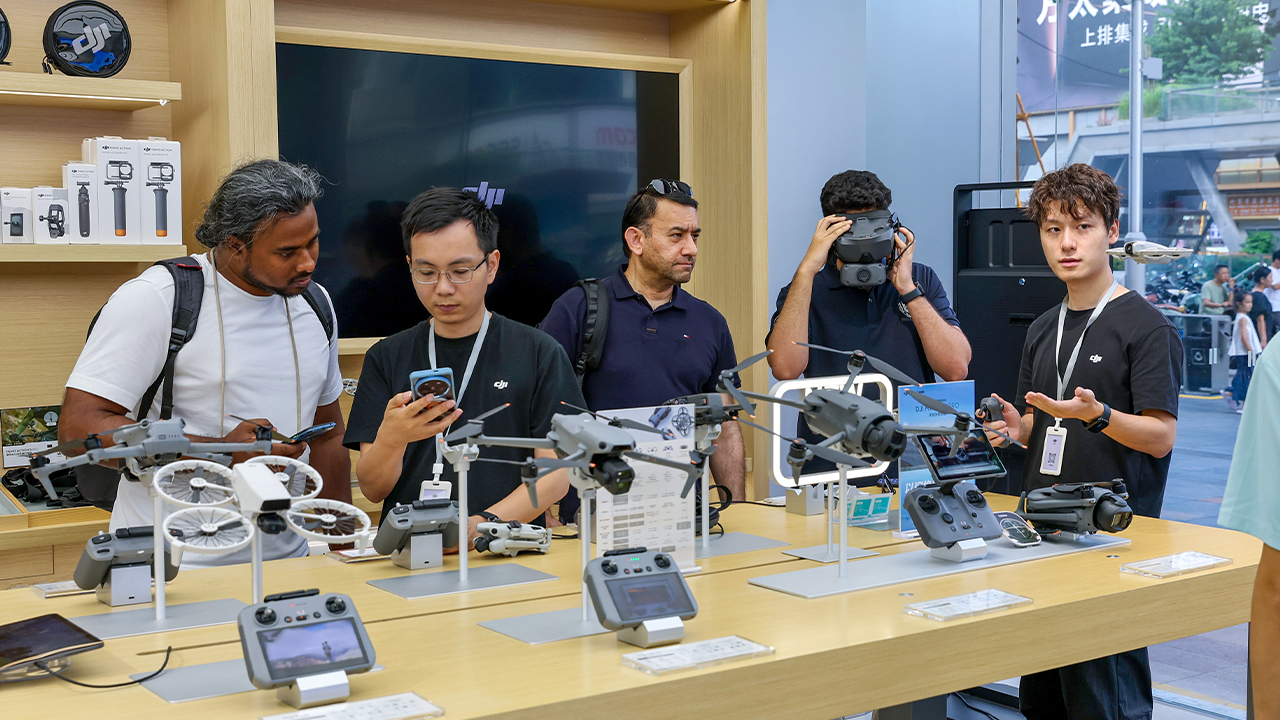
Staffers introduce electronic products to shoppers in Huaqiangbei. Photo by Zhou Hongsheng
Huaqiangbei — “China’s No. 1 Electronics Street” — is a commercial district of roughly 1.5 square kilometers in central Shenzhen, stretching off Shennan Boulevard in Futian District. In its dozens of specialist markets, tens of thousands of stalls sell everything from capacitors, resistors and sensors to drones, robots and the newest smartphones. It is routinely described as the largest electronics marketplace in the world, and for decades it has been the first stop for hardware buyers from every continent.
华强北——“中国电子第一街”——是深圳中心约1.5平方公里的商圈,沿深南大道延伸于福田区。其数十座专业市场、数万个档口售卖从电容、电阻、传感器到无人机、机器人与最新智能手机的各类产品,常被誉为全球最大的电子交易市场,数十年来一直是各大洲硬件买家的第一站。
The name dates from 1979, when military-industrial factories relocated from northern Guangdong and were merged into the Huaqiang Electronics Industry Company — “Huaqiang” means “strong China” — and the district north of Huaqiang Road became Huaqiangbei. In the early 1980s the city designated the area, then the Shangbu Industrial Zone, for electronics and processing trade, and enterprises such as Aihua, Jinghua, Huafa and Huaqiang settled in. The decisive moment came in 1988, when the SEG Group opened the SEG Electronics Market — consciously modelled on Tokyo’s Akihabara — where components could be traded directly between buyer and seller. In October 2008, the China Electronics Association formally conferred the district’s title: “China’s No. 1 Electronics Street.”
地名可追溯至1979年,当年从粤北迁来的军工企业合并组建华强电子工业公司——"华强"意为"强大中国"——华强路以北的片区即华强北。1980年代初,深圳将该区域(时为上步工业区)划定为电子与加工贸易用地,爱华、京华、华发、华强等企业相继入驻。决定性时刻在1988年:赛格集团开设赛格电子市场——有意效仿东京秋叶原——元器件可在买卖双方间直接交易。2008年10月,中国电子商会正式授予"中国电子第一街"称号。
Its early folklore is full of “one-meter counters”: stalls barely a metre wide, rented by newcomers armed with little more than nerve and contacts. Many fortunes were made behind them — more than 50 of the earliest counter-owners in SEG Plaza are reckoned to have become billionaires — and a saying from that era still circulates: “If Huaqiangbei sneezes, the whole country’s electronics market catches a cold.” Several of China’s best-known technology companies were born in or around the district.
早期市井传说满是"一米柜台":档口不过一米宽,租客凭胆识与人脉开张。无数财富在柜台后积累——据说赛格广场最早的一批档主中,出过五十余位亿万富翁——那个年代还流传一句话:"华强北一打喷嚏,全国电子市场都感冒。"中国若干最知名的科技公司,就诞生于这一片区或其周边。
What makes the area matter today is not retail but ecosystem. Within a relatively small area, one can find components, technologies, suppliers and manufacturing services covering much of the electronics value chain. An idea can quickly become a prototype; a prototype can then move toward mass production. “Design in the morning, prototype in the afternoon, mass production the next day, shipped overseas within a week” is the local shorthand for that speed, which has made Huaqiangbei an important global centre for hardware innovation. In the 2000s the district rode the wave of “shanzhai” phones — cheap, wildly inventive handsets that found markets across the developing world — and when smartphones swept that market away, it upgraded rather than declined, moving up the value chain from copying to creating.
让这一片区至今重要的不是零售,而是生态。在相对集中的空间里,可找到覆盖电子产业链大部分环节的元器件、技术、供应商与制造服务:一个想法可迅速成为样机,样机再走向量产。“上午设计、下午打样、次日量产、一周出海”是这种速度的当地概括,也正是它让华强北成为全球硬件创新的重要中心。2000年代,这里乘"山寨"手机之潮——廉价而极具创造力的手机行销发展中世界;当智能手机席卷市场,它不是衰落而是升级,从模仿走向创造,沿价值链攀升。