
 Share
Share


 Print
PrintShenzhen Bay Super Headquarters Base 深圳湾超级总部基地
Writer: | Editor: | From: | Updated: 2026-08-30
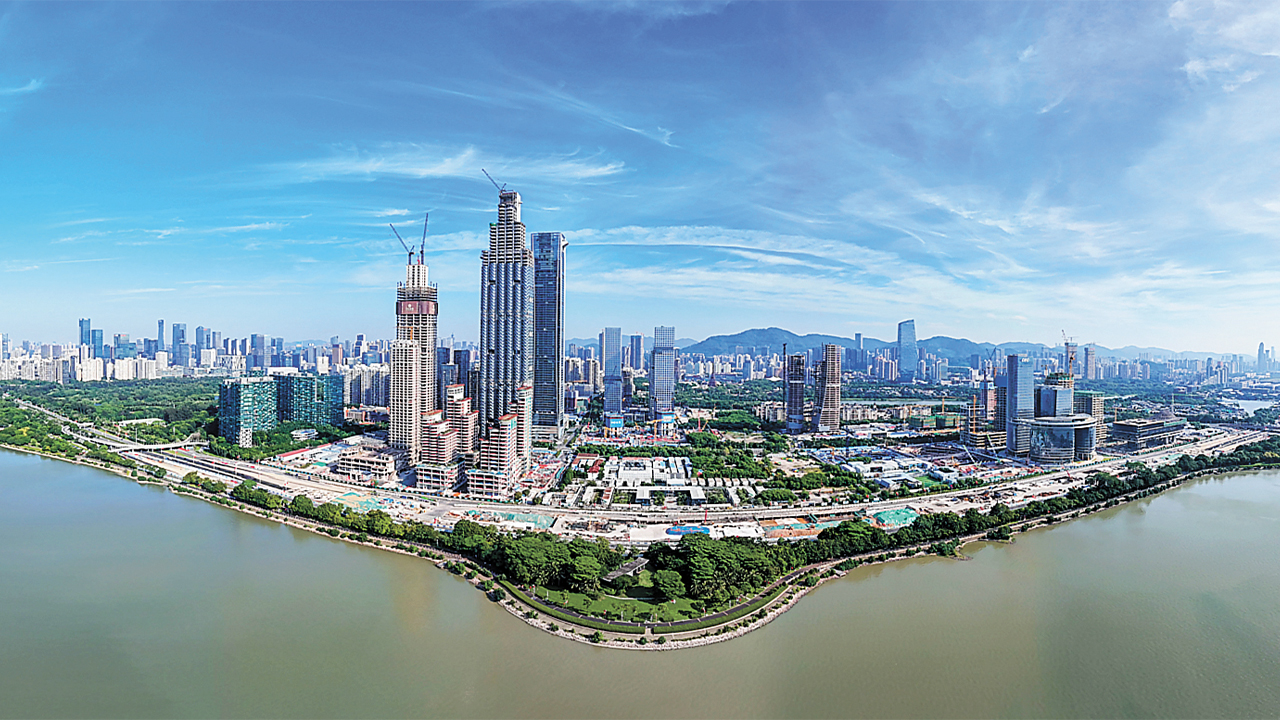
Shenzhen Bay Super Headquarters Base. Photo from Xinhua
The Shenzhen Bay Super Headquarters Base occupies about 117 hectares of arguably the most valuable waterfront land in southern China: a coastal strip in Nanshan District flanked by the OCT Wetland to the east, the Shahe Golf Course to the west and the 15-kilometer Shenzhen Bay coastline to the south, facing Hong Kong across the water. Its planned total floor area is about 5.2 million square meters, designed for a working population of roughly 250,000 — a density of ambition as much as of people.
深圳湾超级总部基地占地约117公顷,占据着华南或许最具价值的滨水地段:南山区的滨海带状区域,东邻华侨城湿地,西接沙河高尔夫球场,南临15公里深圳湾海岸线,隔海与香港相望。规划总建筑面积约520万平方米,承载约25万就业人口——这既是密度的雄心,也是人的密度。
The mission is written into the name: to gather the headquarters of leading Chinese and multinational companies into one deliberately planned cluster — in the city’s own words, a global headquarters agglomeration zone and a “world-class coastal reception room.” By early 2026, some 19 corporate headquarters had settled, opened or topped out — among them China Merchants Bank’s global headquarters, JD.com, ZTE, DJI, China Electronics, Digital China, OPPO and TCL’s display arm CSOT.
使命写进了名字:将中国及跨国领军企业的总部聚于一个统一规划的集群——用城市自己的话说,全球总部集聚区、"世界级滨海会客厅"。截至2026年初,约19家企业总部已落地、开业或封顶,包括招商银行全球总部、京东、中兴通讯、大疆、中国电子、神州数码、OPPO及TCL旗下显示公司CSOT。
Beneath the skyline is one of China’s most transit-dense hubs. Metro Lines 2, 9 and 11 already converge here, with further metro lines and an intercity railway planned — a “six-line, six-station” interchange knitted directly into the district’s below-grade public realm.
天际线之下是中国轨交密度最高的枢纽之一。地铁2、9、11号线已在此交汇,另有更多地铁线路与城际铁路规划——"六线六站"换乘直接织入片区地下公共空间。
Yet the plan’s most striking feature is what it reserves for nature. A central green valley runs through the district from the OCT wetland down to the bay, deliberately aligned as a corridor for migratory birds on the East Asian-Australasian Flyway that passes each winter. Planners summarise the philosophy bluntly: physical height is not the point; the fusion of humanity and nature is. Even as 400-meter towers rise, the design target is a district where green space and sea remain minutes away on foot.
而规划最引人注目之处,是它留给自然的部分。一条中央绿谷从华侨城湿地贯穿片区直抵海湾,刻意对齐为东亚—澳大利西亚候鸟迁飞通道的廊道,每年冬天候鸟经此而过。规划者一句话点明理念:物理高度不是目的,天人合一方是。即便400米高楼拔地而起,设计目标是让绿地与大海始终步行可达。
For all its singularity, the base illustrates a citywide habit. Shenzhen has developed more than 1,300 parks and thousands of kilometers of greenways, and even in some of its most valuable urban areas it keeps making room for greenery. Economic development and public space are treated here as complements, not rivals — and this district is, in effect, the densest test of that proposition.
尽管独树一帜,超总基地折射的是一种城市习惯。深圳已建成1300多座公园、数千公里绿道,即便在最值钱的城市地段,也始终为绿意留白。在这里,经济发展与公共空间被视为互补而非对立——而这个片区,正是这一命题密度最高的试验场。