
 Share
Share


 Print
PrintRecord-scale anchorages completed for Shiziyang Bridge
Writer: Song Yingwen | Editor: Zhang Chanwen | From: Shenzhen Daily | Updated: 2026-08-20
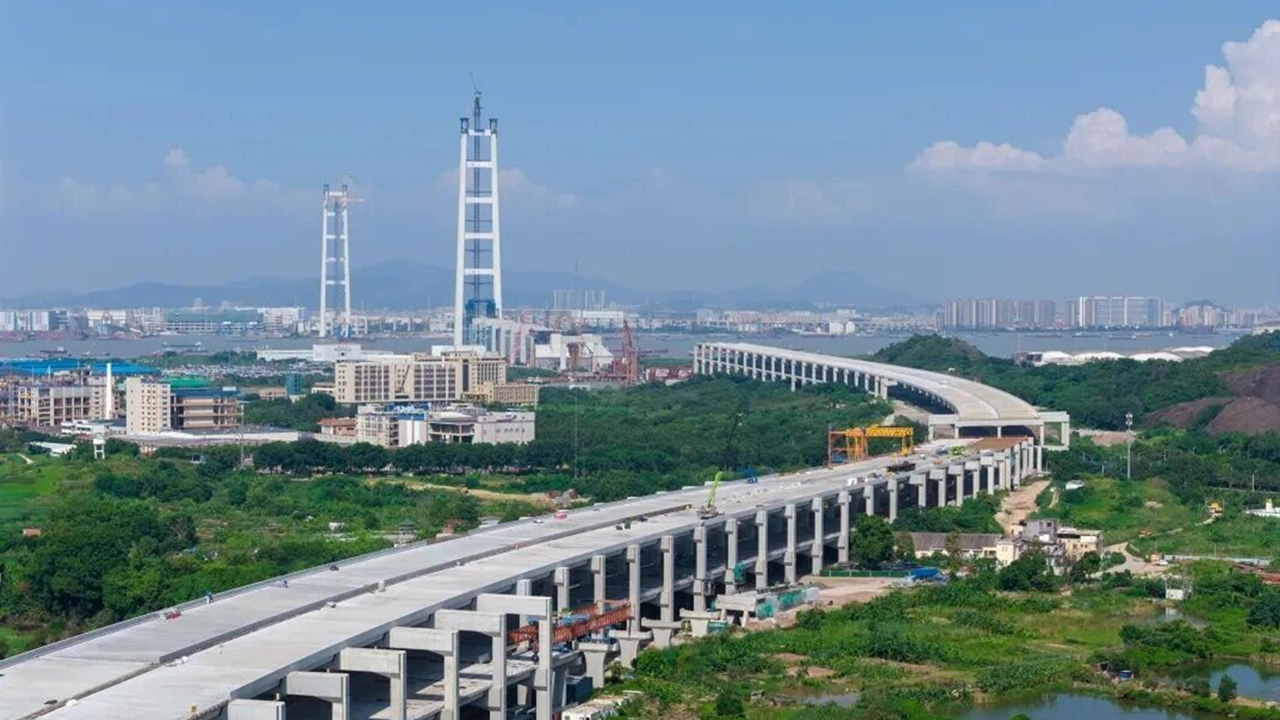
Approach roads and towers of the Shiziyang Bridge take shape as construction advances on the double-deck highway crossing. Photos courtesy of Guangdong Transportation Group
Construction of the main structures of the Shiziyang Bridge’s two anchorages has been completed, marking a major step forward for a new Pearl River crossing in the Guangdong-Hong Kong-Macao Greater Bay Area.
The bridge will cross the river in a single 2,180-meter span and carry 16 lanes on two decks. Once completed, it is expected to set five world records among double-deck suspension bridges for its main span, tower height, anchorage foundations, main-cable diameter and number of lanes, according to Guangdong Transportation Group.
The bridge is the centerpiece of the 35-kilometer Shiziyang Link, which will connect Guangzhou’s Nansha District with Shatian and Humen in Dongguan. The highway is expected to open in 2029.
Although the link will not enter Shenzhen directly, it will connect with expressways around Humen that serve the city. It is expected to give Shenzhen passenger and freight traffic another route to Nansha, Zhongshan, Jiangmen and other destinations west of the Pearl River.
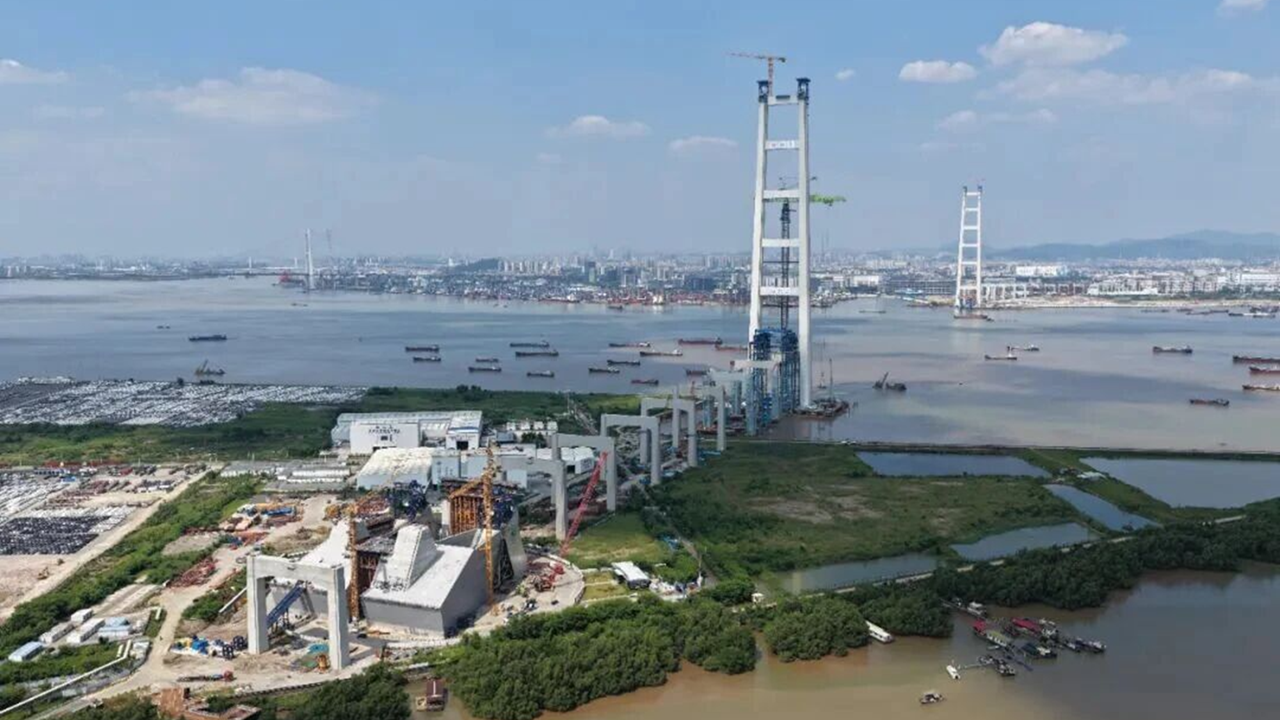
The Shiziyang Bridge under construction across the Pearl River estuary, with an anchorage structure in the foreground.
The anchorages are massive concrete structures that secure the bridge’s main cables. Located on opposite sides of the estuary, each has a foundation about 130 meters across and up to 36 meters deep. Together, they are designed to resist more than 200,000 metric tons of tension from the cables.
Their scale sets a world record for comparable suspension bridge anchorage projects, the group said. Each required about 550,000 cubic meters of concrete and weighs approximately 1.4 million metric tons.
Building the western anchorage on Nansha’s Shazai Island was particularly challenging because of its soft, waterlogged soil. Engineers installed about 2,000 sensors and created a digital model to monitor ground movement and structural changes in real time. The foundation pit’s maximum deformation was kept within 15 millimeters, according to the project team.
Crews are now installing temporary elevated walkways used to build the main cables. Main-cable installation is scheduled for completion in 2027.
The Shiziyang Link will join the Hong Kong-Zhuhai-Macao Bridge, Shenzhen-Zhongshan Link, Nansha Bridge and Humen Bridge in expanding road connections across the Pearl River estuary.