
 Share
Share


 Print
PrintThe global EV evolution: China's rise in the EV race
Writer: Naveen Silva | Editor: Cao Zhen | From: Original | Updated: 2026-08-12
The oil crisis of the 1970s taught the world a hard lesson about depending too much on oil. More than half a century later, as war in the Middle East once again pushes crude prices higher and fossil fuels remain the biggest polluter of the world, that lesson is being relearned and this time China is writing the answer.
This piece traces the evolution of the global EV market, past, present, and future with a particular focus on China’s emergence as the industry’s leading force.
The history of electric vehicles dates back to the 19th century, with Robert Anderson developing the first crude electric vehicle in around 1832 according to the U.S. Department of Energy.
Over the years, it became evident that electric vehicles faced less difficulties associated with steam or gasoline engines. They were quiet, convenient to operate, and quickly gained popularity in urban areas for short trips, particularly among women. Recognizing this rising demand, inventors at that time, put more effort in improving electric vehicle technology. According to sources from the U.S. Department of Energy, Henry Ford even collaborated with Thomas Edison in an attempt to develop a low cost electric car. However, it was Ford’s own gasoline powered models that won the market. By 1912, a gasoline car cost around US$650 against roughly US$1,750 for an electric one. The math was simple, and for the next several decades, the internal combustion engine ruled the road.
Transition begins
As vehicle demand rose dramatically during the mid 20th century, the convenience of automobiles came with hidden costs. Heavy reliance on oil soon revealed its far reaching implications becoming especially clear during the 1973 and 1979 oil crises. With global supplies restricted, prices skyrocketed, sending shockwaves through economies worldwide and exposing the vulnerabilities of an oil dependent system. As a result, several attempts were made to revive the dream of the electric vehicle. During the 1970s, scientists began exploring the concept of a battery capable of recharging efficiently within a short period of time. Yet it was not until the late 20th century, with the advent of the rechargeable lithium ion battery, that the vision of a practical electric car finally became a reality once again.
Since then, the global focus has increasingly turned toward developing more electric vehicles. However, it was China, that made the transition to cleaner energy a key pillar of its economic agenda, embedding sustainability into nearly every aspect of its growth strategy.
Shaping the economic narrative toward a greener future
In 2025, electric vehicles accounted for one in every four new cars sold globally, with sales surpassing 20 million units worldwide as per International Energy Agency (IEA).
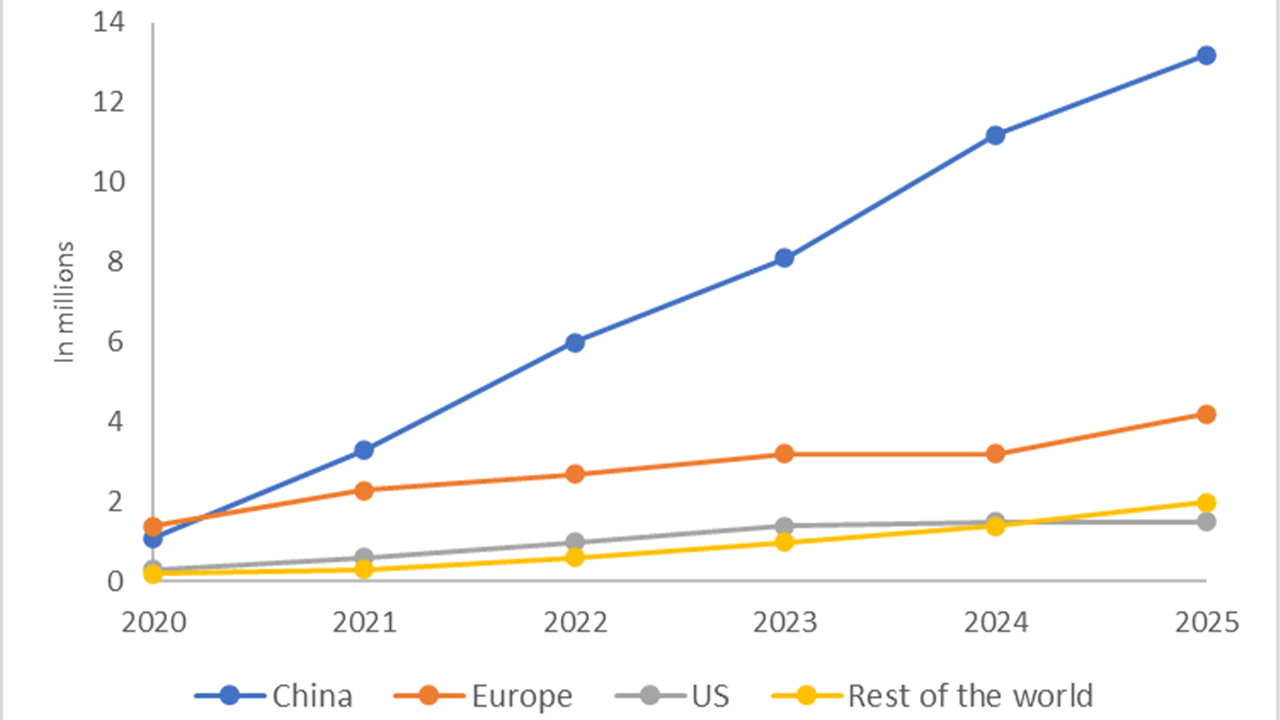
Global electric car sales trend from 2020 to 2025. (Source: IEA)
The graph above illustrates the steady rise in global electric car sales from 2020 to 2025, highlighting China’s dominant position at the top of the market by 2025. This reflects a combination of factors, including strong domestic demand, extensive supply chain integration, technological development, policy support and sustained investment by Chinese companies. Accordingly, ~5% of the global car fleet is now electrified, a shift that displaced an estimated 1.2 million barrels of oil per day in 2025.
China’s dominance
China’s five year plans, first introduced in 1953 shortly after the founding of the People’s Republic of China, have served as the nation’s roadmap for sustained economic and social development. These plans have consistently guided policy priorities, driving inclusive progress and shaping China’s long-term achievements. In that journey, China’s 12th five year plan marked a turning point by giving greater prominence to the development of pure electric vehicles.
This dominance has not come overnight, it is the result of the step by step approach it adopted. In its early adoption cycle, government policies played a key role in driving Chinese consumer momentum. In 2009, the government launched the “Ten Cities, Thousand Vehicles” initiative, a nationwide push to jump start the electric vehicle industry. The program's goal was straightforward, use large scale pilots across ten cities as a proving ground for EVs, surfacing and resolving the technology and safety issues standing in the way of wider adoption. Initially, the policy targeted government vehicle fleets, later expanding to consumers. In 2010, China introduced a pilot subsidy programme for private purchases, providing subsidies up to 60,000 yuan for battery electric vehicles, and RMB 50,000 for plug-in hybrid vehicles.
Moreover, in 2012, the State Council unveiled its Development Plan for the energy saving and new energy vehicle industry for the period 2012 to 2020. These policy measures, together with technological progress, industrial development, supply chain advantages and market expansion, have contributed to China becoming the world’s largest hub for electric vehicle manufacturing.
As China's domestic EV market matures, Chinese companies are increasingly expanding their global presence through investments in overseas markets. According to Atlas Public Policy, a data and policy research firm tracking clean energy investment, Chinese companies announced US$101 billion investments between 2019 and 2025, while US companies made just over US$38 billion during the same period. Of total Chinese investments in advanced economies, Europe became the top destination for Chinese FDI in 2025. Of this total FDI, the automotive sector accounted for ~45%, and of these total automotive investments, EV supply chain investments accounted for ~93%. Hungary became the largest recipient of Chinese FDI, followed by Germany in the past couple of years.
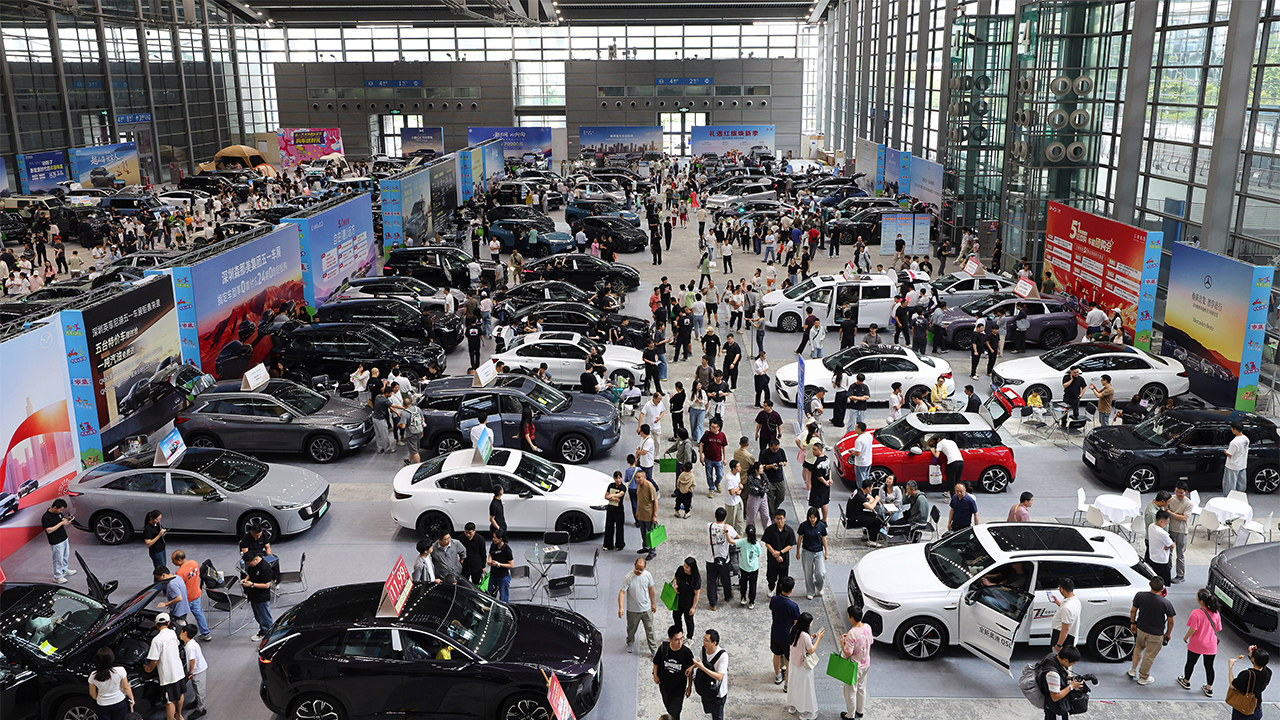
A glance at a car expo in Shenzhen in May 2026. Photo by Zhou Hongsheng
Batteries: A key competitive advantage
Batteries are an essential component in achieving global EV growth, powering high tech manufacturing, data centers, and various other sectors. Today’s battery market is largely shaped by two dominant lithium-ion chemistries, lithium iron phosphate (LFP) and nickel-manganese-cobalt oxide (NMC), each offering distinct tradeoffs in cost, safety, and performance. While Western countries mainly rely on NMC batteries, China has heavily invested in developing and refining LFP technology, which is significantly cheaper than NMC batteries.
Globally, one of the key challenges countries face and one that is set to become an even greater obstacle in the production of EVs is the shortage of lithium. According to studies, lithium supply cannot keep pace with the rapidly rising demand, creating a significant bottleneck for the industry. However, Chinese companies are projected to have ownership interests in assets accounting for around 39% of global lithium extraction by 2030. This is achieved as their stake expands relative to Australia, whose share of extraction stood at about 43% in 2020 but is projected to decline to 25% by 2030. The decline is primarily driven by the rapid growth of lithium extraction in Africa, marking a significant regional shift in supply.
Of this growth in the African region, with very few exceptions, it has been primarily financed by Chinese capital, with Chinese ownership positions extending and advancing beyond its domestic production base. Moreover, Chinese firms hold significant ownership stakes in Australian and Argentine assets.
In another major move, in July 2026, China opened its lithium carbonate futures and options on the Guangzhou Futures Exchange (GFEX) to overseas traders, enabling GFEX to play a key role in global lithium pricing. This move also increases the use of the yuan in international transactions. This is one of the wisest strategic moves, as GFEX now attracts large sums of global liquidity, with the yuan set to play a key role in critical minerals. This trend suggests a gradual shift away from the U.S. dollars traditional dominance in raw material pricing, with the yuan increasingly positioned to influence the pricing of future generation energy assets.
Sodium-ion batteries are now emerging as a further contender, moving beyond the NMC vs. LFP debate to offer greater diversity in both battery chemistry and supply chains. China introduced one of the world’s first commercially available sodium-ion battery electric vehicles in 2023, though the technology’s roots trace back further. Moreover, the first sodium-ion battery storage system was installed in China as early as 2019. Nevertheless, the technology still has considerable ground to cover before achieving widespread commercialization.
What comes next?
According to the IEA, electric vehicles are projected to make up nearly half of global car sales by 2035, driven by supportive policies and shifting price dynamics that are reshaping the market. In the years to come, China appears poised to emerge as the face of the global automotive industry. This trajectory indicates China’s position in the EV sector will only strengthen in the years ahead, a shift that could ultimately support the broader push for a cleaner, greener planet.
(Naveen Silva is currently working as a researcher in a leading private investment research firm in Sri Lanka. His primary focus is researching broader economic issues, including geopolitical developments, and sustainability matters, and their implications across various sectors with special focus and interest on related developments in China.)