
 Share
Share


 Print
PrintDobot's bionic dinosaurs debut at SZ Natural History Museum
Writer: Li Dan | Editor: Cao Zhen | From: Original | Updated: 2026-07-31
The Shenzhen Natural History Museum in Pingshan District opened to the public on July 28. On display are 7,461 authentic specimens, 338 replicas, and 194 other exhibits, offering a sweeping window into the natural world.
“Of the 7,461 specimens, these two are ‘alive,’” a staff member said while introducing the hyper-realistic bionic dinosaurs developed by Dobot Robotics. Lifelike and fully interactive, they quickly became the star attraction on opening day.
Beyond their visible skin textures and even faintly pulsating subcutaneous veins, what truly sets the two “dinosaurs” apart is their “brain.”
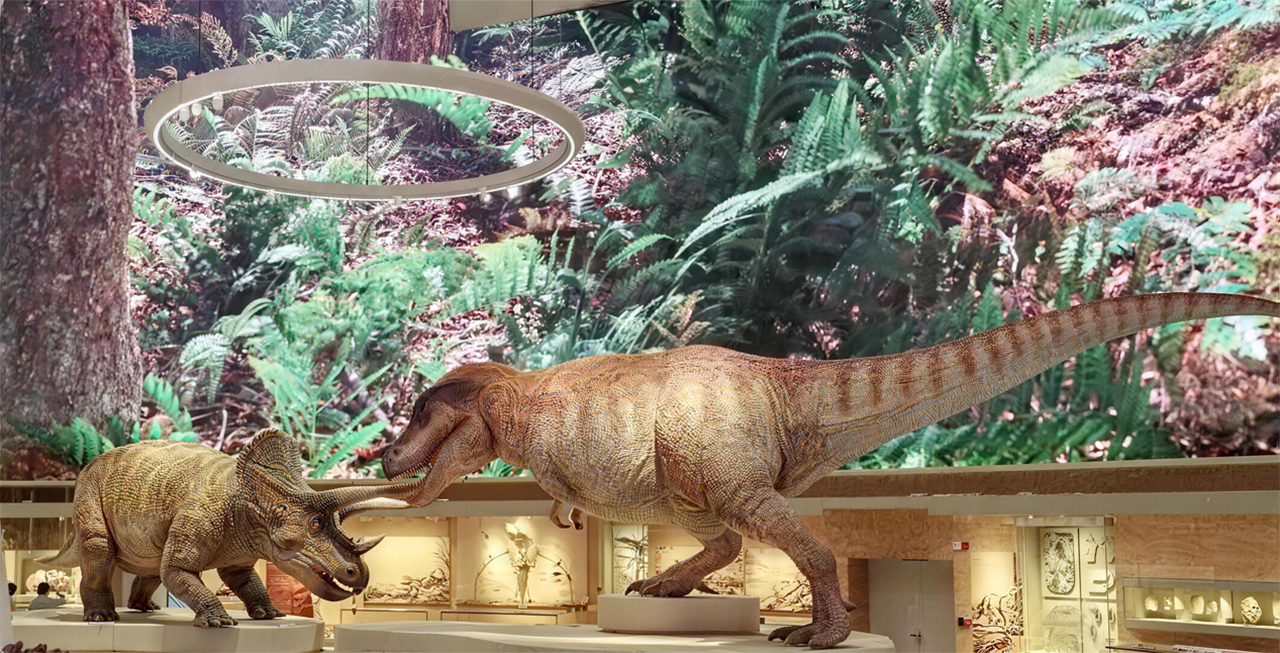
The two hyper-realistic bionic dinosaurs developed by Dobot Robotics are on display at the Shenzhen Natural History Museum in Pingshan District. Photo from Shekou News
When visitors approach, the T. rex alertly turns its head, its pupils contracting with changing light as a low warning growl rumbles from its throat. The Triceratops adjusts its posture in response to its surroundings and even makes eye contact with its companion. They breathe, blink, and show signs of fatigue. Their lifelike behavior left visitors feeling as though they had been transported back 65 million years to the Jurassic Period.
Families gathered around the dinosaur displays, marveling at the wonders of technology. “We had only seen such realistic dinosaurs in movies,” one visitor remarked. “This is a vivid lesson in both biology and technology for kids.”
Unlike traditional mechanical dinosaurs that follow preset scripts and looped movements, these bionic dinosaurs are powered by embodied intelligence, enabling them to perceive, understand, decide, and act. Every head turn, every growl, and every posture adjustment is not a rehearsed routine but an autonomous response based on the immediate environment.
This is not Dobot’s first foray into bionic creatures. The company has previously delivered projects including a mobile Chinese ceratopsian at China Dinosaur Park in Changshu, Jiangsu Province, and a juvenile dragon in the “Zero Incubator” at Shanghai’s Bund Sightseeing Tunnel, exploring the integration of robotics into cultural tourism and science education.
Currently, Dobot’s product portfolio spans four tracks: collaborative robots, humanoid robots, multi-legged robots, and hyper-realistic bionic creatures.