
 Share
Share


 Print
PrintShenzhen Transsion, 'king of mobile phones in Africa,' projects 45% net profit jump despite shrinking shipments
Writer: Yang Yunfei | Editor: Lin Qiuying | From: Original | Updated: 2026-07-30
Tecno, Infinix, and iTel are among the bestselling smart phone brands in Africa, yet they remain virtually unknown in their home country of China, where they have never been sold.
All three brands are manufactured by Shenzhen Transsion Holdings Co., a company that built its fortune by focusing exclusively on Africa before expanding into other emerging regions, such as Latin America, India, Eastern Europe, and Southeast Asia.
Widely known as the "king of mobile phones in Africa" due to its dominant market share on the continent, Shenzhen Transsion was founded in the southern Chinese tech hub of Shenzhen in 2013 by Zhu Zhaojiang, a former sales manager at Bird Mobile — a pioneer in China’s early mobile handset industry.
The firm has since evolved into a major provider of smart devices and mobile internet services dedicated solely to emerging markets. This strategy sharply distinguishes it from domestic rivals like Huawei, Xiaomi, OPPO, and Vivo, all of whom have huge user bases within China.

Shenzhen Transsion set its sights on overseas markets from the very beginning. For more than a decade, it made its money by exclusively selling its mobile phones in Africa. Analysts attribute its success to localized marketing and a deep understanding of regional consumer needs.
The firm has accurately captured the needs of African consumers by introducing phones with features to solve numerous issues faced by African telecom operators, such as making dual-SIM card phones and developing camera calibration technology optimized for darker skin tones.
It has also introduced a proprietary selfie algorithm specifically designed for African users, which uses teeth and eyes for exposure positioning to deliver a natural "chocolate skin tone."
These thoughtful and considerate innovations quickly won the hearts of African consumers, cementing Shenzhen Transsion’s status as Africa's dominant mobile brand.
Robust financial recovery projected
The firm, which lists shares on the tech-heavy STAR Market of the Shanghai Stock Exchange, said in a regulatory filing July 19 that it projects a robust financial recovery for the first half of 2026, driven by strategic pricing adjustments and disciplined inventory management.
It anticipates its net profit for the six months ending June 30, 2026, tosurge 44.82% year on year to 1.76 billion yuan (US$243 million). Revenue is expected to climb 22.63% to 35.66 billion yuan compared with the same period last year.
Management attributed this strong performance to a successful pricing strategy implemented to offset rising memory chip costs, which have heavily pressured product costs and gross margins.
Although fierce market competition led to a decline in smart phone unit shipments, a significant increase in the average selling price more than compensated for the volume drop, boosting both revenue and profitability. Meanwhile, because of historical inventory cycles, the impact of cost increases lagged slightly, resulting in a marked improvement in gross margins.
Headwinds highlighted in Hong Kong IPO filing
This upbeat profit forecast comes one month after Shenzhen Transsion filed an updated initial public offering (IPO) prospectus with the Hong Kong stock exchange for a secondary listing aimed at attracting international investors.
The revised filing is significantly streamlined at 459 pages, 82 pages shorter than the draft disclosed in December 2025, and incorporates audited financial results for the full year 2025. The updated data show a challenging year marked by a sharp downturn in profitability, shrinking shipments, and mounting patent litigation.
The updated prospectus, which details Shenzhen Transsion's performance from 2023 to 2025, shows a clear reversal of its historical growth trajectory.
In 2025, revenue fell 4.54% year on year to 65.59 billion yuan, while net profit plummeted 53.46% to 2.61 billion yuan, dragging the gross margin down to a three-year low of 18.70%.
This marks a stark contrast to 2023, when the firm pulled in 62.30 billion yuan in revenue, 5.59 billion yuan in net profit, and a gross margin of 23.20%. Although revenue rose 10.30% year on year to 68.72 billion yuan in 2024, net profit growth had already flattened at 5.60 billion yuan, with the gross margin beginning its decline to 20.90%.
This downturn was foreshadowed in the first half of 2025, when net profit fell to 1.24 billion yuan from 2.86 billion yuan in the same period of 2024. The full-year results confirmed that the margin squeeze was structural rather than seasonal, driven by persistent supply chain pressures and intensifying competition.
Supply chain pressures and rising competition
Shenzhen Transsion attributed its 2025 profit decline to rising upstream component costs — particularly memory chips — and aggressive downstream competition. For a brand built on affordability and penetration into lower-tier markets, passing these costs onto price-sensitive consumers has proven difficult.
The smart phone division remains Shenzhen Transsion's core business, accounting for 83.60% of total revenue in 2025 (54.82 billionyuan, down 5.32% from 2024). Meanwhile, cost rigidities grew, with the sales cost ratio climbing from 79.10% to 81.30%, further compressing margins.
Device shipments dropped 16% year on year, falling from roughly 201 million units in 2024 to approximately 169 million in 2025. This contraction suggests that domestic competitors like Xiaomi, OPPO, and Realme are successfully challenging Shenzhen Transsion's market share in Africa and South Asia.
To mitigate the shipment drop, Shenzhen Transsion raised its average selling price by 10.24% to 345.80 yuan in 2025, up from 313.70 yuan in 2024. While this pricing adjustment cushioned the revenue decline, analysts warn it could weaken the company's core value proposition as it enters price brackets heavily defended by its main rivals.
Macroeconomic and legal challenges
Shenzhen Transsion's downturn in shipments also reflects broader global macroeconomic headwinds. Emerging markets in Africa and Southeast Asia continue to struggle with high inflation, currency volatility, and weakened consumer purchasing power, which have collectively lengthened device replacement cycles.
Meanwhile, the depreciation of local currencies in key markets, including Nigeria, Kenya, and Ethiopia, against the U.S. dollar has weighed on the company’s yuan-denominated financial results.
Beyond financial pressures, Shenzhen Transsion is also is engaged in major intellectual property disputes. The prospectus details eight active lawsuits against the firm, seven of which were filed between 2025 and 2026 across Europe, Thailand, and the Philippines.
Despite these challenges, Shenzhen Transsion said that its planned allocation of IPO proceeds remains unchanged, with funds dedicated to artificial intelligence R&D, brand building, and the expansion of its mobile internet and IoT ecosystems.
Market outlook and analyst perspectives
Zhong Xiaolei, an analyst at London-based market research firm Omdia, said that Shenzhen Transsion faces substantial challenges. The sharp surge in component prices, particularly memory chips, has pressured shipments, especially given thefirm’s heavy reliance on the low-margin budget and entry-tier segments.
However, Zhong noted that Shenzhen Transsion has not actively scaled back its shipment targets and continues to benefit from resilient demand across African retail channels. The company now faces a delicate balancing act to maintain its market scale without further eroding profitability.
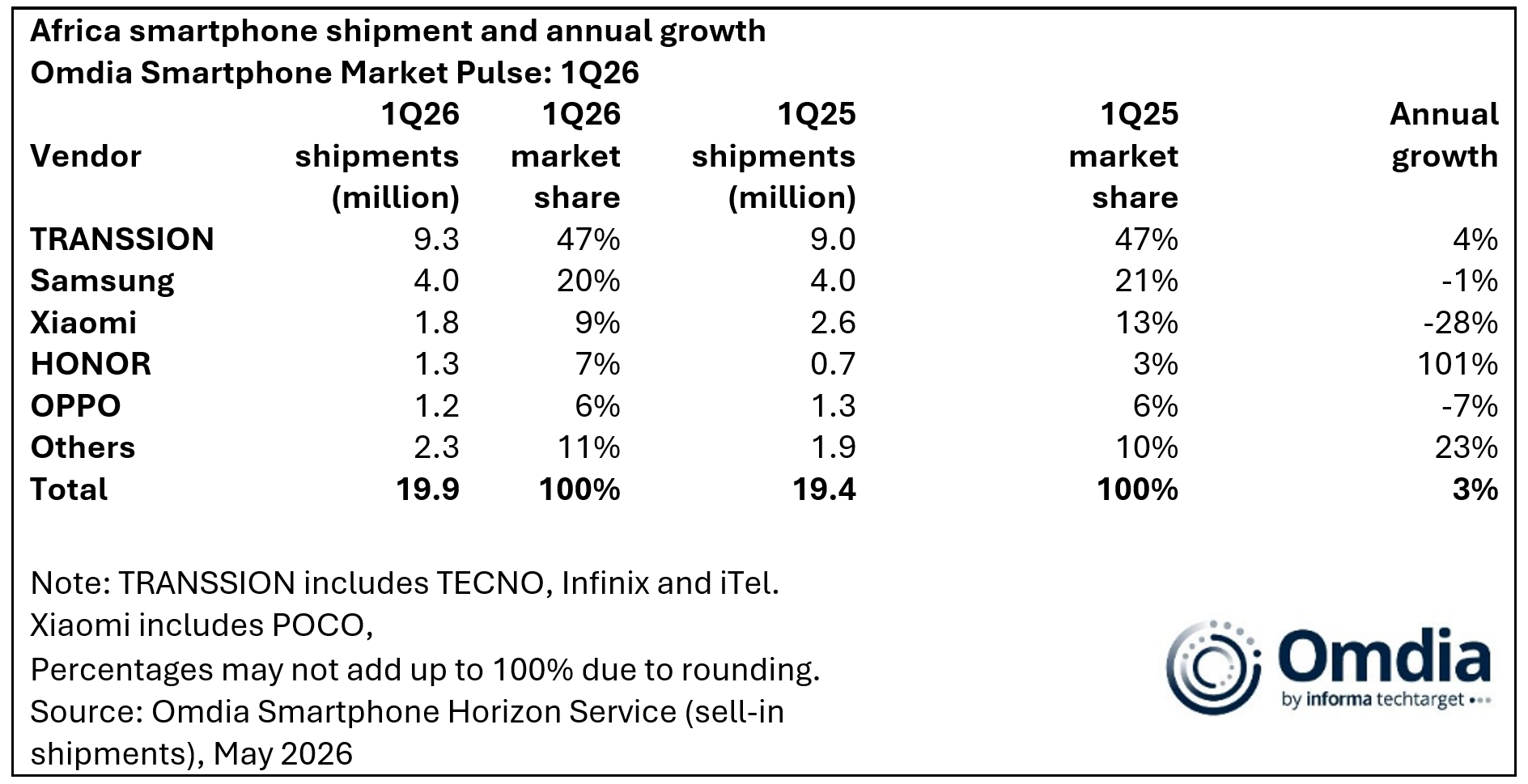
According to a May 26 Omdia report, Africa’s smart phone shipments grew 3% year on year to 19.9 million units in the first quarter of 2026, supported by new product launches and inventory frontloading by top vendors.
The report shows that Shenzhen Transsion retained its top spot with a 47% market share and 4% year-on-year growth, driven by disciplined inventory management and solid sales of affordable models such as the Tecno Pop 10 and Spark 40C 4G.
In contrast, Shenzhen Transsion’s cross-town rival Honor Device Co., which was spun off as an independent business from Huawei Technologies in 2020, saw the strongest annual growth at 101%, capturing 7% of the African market.
However,the broader African smart phone market is bracing for a downturn. Omdia projects that shipments across the continent will contract by 28% overall in 2026, as rising memory chip prices, elevated supply chain costs, and weakened consumer purchasing power squeeze the critical sub-US$200 segment.
“Africa's ultra-affordable smart phone market is entering a structurally more challenging phase in 2026 as margin compression strains entry-tier device economics to a breaking point," wrote Manish Pravinkumar, principal analyst at Omdia, in the report.
Hou Lin, an analyst at Omdia, said that consumer purchasing power in emerging markets has peaked, dragging Africa and other developing regions into a downward cycle. He added that a meaningful recovery is unlikely to materialize until surging component costs begin to ease.
For Shenzhen Transsion, which relies heavily on these entry-level segments, maintaining growth momentum will become increasingly difficult as the overall market continues to shrink, Hou said.