
 Share
Share


 Print
PrintTobias Frieser: Serving as a bridge between Chinese and EU companies
Writer: Debra Li | Editor: Lin Qiuying | From: Original | Updated: 2026-06-29
Serving as a bridge between Chinese and EU companies
Tobias Frieser, founder of L&B International and German head of the China Europe Business Association, is quite fond of his Chinese name "Tuo Bin (拓斌)," which was suggested by a friend.
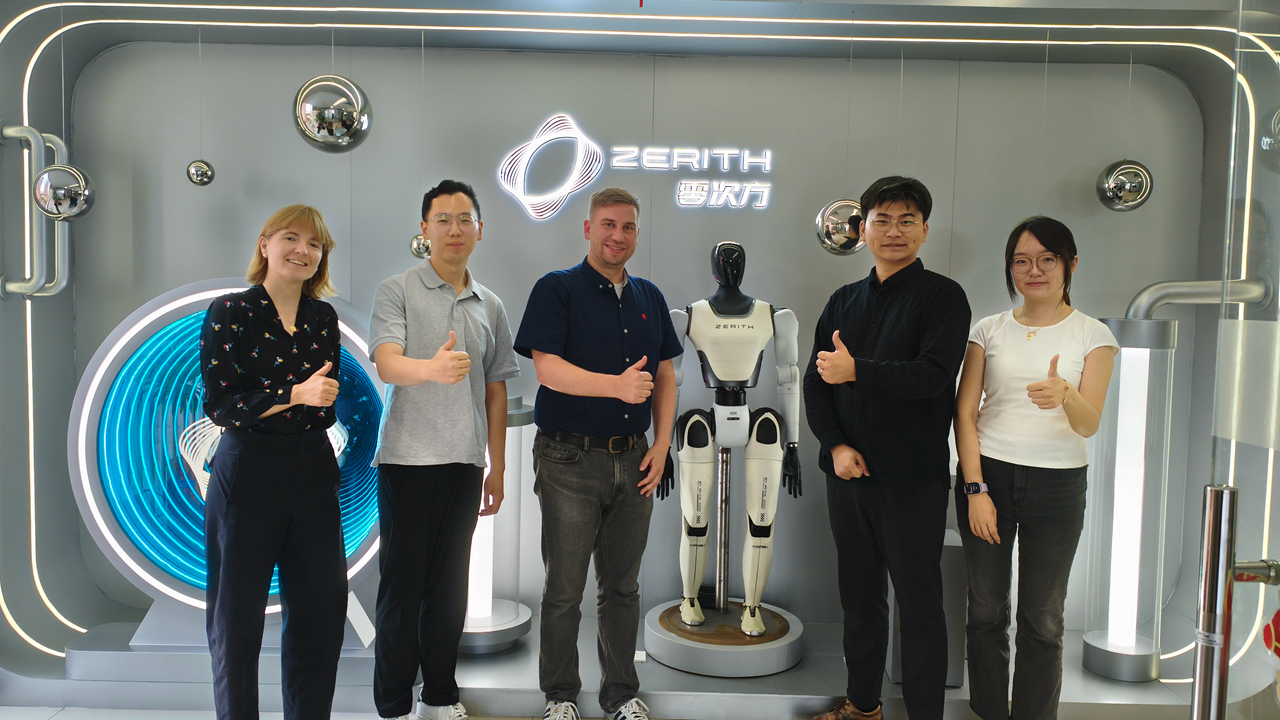
Tobias Frieser (C) poses for a photo with colleagues and clients at the Shenzhen Office of Zerith Robotics in May 2026. Courtesy of the interviewee
"Tuo" means "to expand, to explore, to pioneer" — implying vision, enterprise, and the courage to break new ground; while "Bin" describes someone who is both capable in action and elegant in character, he explained.
Born in Wiesbaden, Germany, Frieser studied civil engineering for his bachelor's degree and hydraulic engineering for his master's. He worked on a port construction project before joining Volkswagen in Wolfsburg, where he was responsible for building factories around the world. He later worked at Gotion High-Tech, a leading lithium battery manufacturer controlled by Volkswagen. Seeing the market opportunities brought by deepening China-Europe cooperation, he founded L&B to help Chinese companies go global and German companies enter China.
"I spend about half my time in Europe and half in China every year, and I come to Shenzhen quite often," he said.
Futian, changing with each passing day
Futian's first impression on him was the astonishing speed of its construction.
"I am not only speaking about the skyline. I am always impressed by the speed and quality of design of everything underground — the things you can't see, but keep a city alive, like water, electricity, and rail transit," he said.
"From the very beginning of planning and construction, you have to take into account the city's development for decades to come."
In his impression, Futian is always in a state of change, constantly adapting to practical needs while keeping up with trends in architectural aesthetics.
Why don't we simply build rationally — which is usually more cost-effective? Why do we invest in aesthetics?
Frieser believes architectural style is a fascinating language.
"On the one hand, it demonstrates what architecture and engineering are capable of achieving; on the other hand, it's an expression of the client, who wants to show what he or his company stands for. Stories can be told," he said.
His favorite building material is exposed concrete, because gray, structurally chaotic concrete is given structure, shape, and order by the architect, acquiring its own style.
"The different styles of buildings in Futian show the dimension of different expectations and visions of their owners. It also shows how diverse, creative, and full of energy Futian is."
The "fast" and "slow" of industrial development
Having been deeply involved in factory construction in both Germany and China, Frieser believes there is much the two countries can learn from each other.
"In Germany we create everything according to a clear project plan, based on regulations and norms. Sometimes this slows down a process. Design is a top priority, if only because of legal requirements. In this regard, I would very much like to see Germany take a cue from China on how to prioritize speed without neglecting engineering and design," he said.
"It's much more about understanding processes and, above all, decision-making in China. Because what we can learn from the construction sector — especially in Futian — can be adapted to all industries. I share this new understanding of China every day in Germany."
German companies also have valuable lessons for their Chinese counterparts. Frieser gave the example of the automobile industry.
"For one thing, the European automotive industry dates back to the time when the automobile was invented. For many years, Germany set the standard for the manufacture of cars with internal combustion engines. Even today, the Wolfsburg plant is one of the most modern factories in Germany, despite being 100 years old. This is because adjustments are constantly being made, and great emphasis is placed on maintenance. I think Chinese automakers still have things to learn in this area — especially when it comes to managing existing facilities and maintenance."
Meanwhile, China has an edge in the electric vehicle industry.
"An electric vehicle requires far fewer workers during assembly. The trend toward 'dark factories' is becoming increasingly prevalent. Some factories are already operating basically without workers, and China has demonstrated what a modern EV plant can look like, setting new standards," he said.
"Fundamentally, the challenge remains unchanged: How far into the future can I plan? How can I build in a more modular way? I think Germany and China can develop a lot together in this area, each drawing on their own experience."
Localization and strategic partnership
For companies looking to "go global," Frieser believes "localization" is an issue that shouldn't be overlooked. Both Germany and China have gained substantial experience in this area, specifically in understanding what it takes to adapt a successful concept to a new market.
While exploring overseas markets, companies need to understand how their concept can work in light of local laws, standards, and regulations. Localization deserves close attention, especially in the early stages, he said.
Take the energy sector, for example. China is the undisputed leader when it comes to battery storage, battery manufacturing, and recycling. However, when it comes to overseas expansion, China is still in its infancy, especially with regard to Europe.
While Frieser predicts a huge opportunity in the field of battery recycling in Europe over the next few decades, he also sees a major challenge for Chinese firms.
"Many position themselves as export companies rather than industrial partners. If European companies understand that they have a true partner in their Chinese counterpart, projects can be designed jointly in an efficient and sustainable manner. But this still requires a great deal of mutual understanding," he said.
Frieser then gave the example of selling Chinese electric cars to Europe.
"Why aren't as many Chinese cars selling in Europe as one might expect? The product is good, the price is attractive, and the design is appealing," he said.
"The problem lies in the system. Who can say today that they'll still be in the market 10 years from now? A new industry creates new companies, new innovations, and new products. But competition drives a natural selection process. If a customer in Europe doesn't know whether the car they've purchased will still be serviceable in 2, 5, or 10 years — or whether replacement parts will be available — they'll hesitate."
He thinks the same applies to robotics: clients can't help but wonder — many companies are emerging, but which ones are sustainable?
With a better understanding of the local market, Chinese companies need to go beyond sales and offer long-term solutions.
As the APEC summit will be held in Shenzhen in November, Frieser offers the following advice to Shenzhen companies:
"Be prepared and show the world that you are ready. Understand the demand and interests of overseas companies. Show your capabilities, especially in a global context."
He also recommends that Chinese companies visit Europe and start building bonds with local firms. "Local understanding is more than market research; it is about networks and trust," he said.