
 Share
Share


 Print
PrintShenzhen-developed LineShine crowned world's fastest supercomputer
Writer: Song Yingwen | Editor: Lin Qiuying | From: Shenzhen Daily | Updated: 2026-06-25
A supercomputer developed in Shenzhen has been ranked the world's fastest, returning China to the top of the global supercomputing rankings for the first time in nine years.
The LineShine supercomputer, operated by the National Supercomputing Center in Shenzhen, achieved a sustained Linpack performance of 2.198 exaflops, according to the latest TOP500 ranking released Monday at the International Supercomputing Conference (ISC 2026) in Hamburg, Germany.
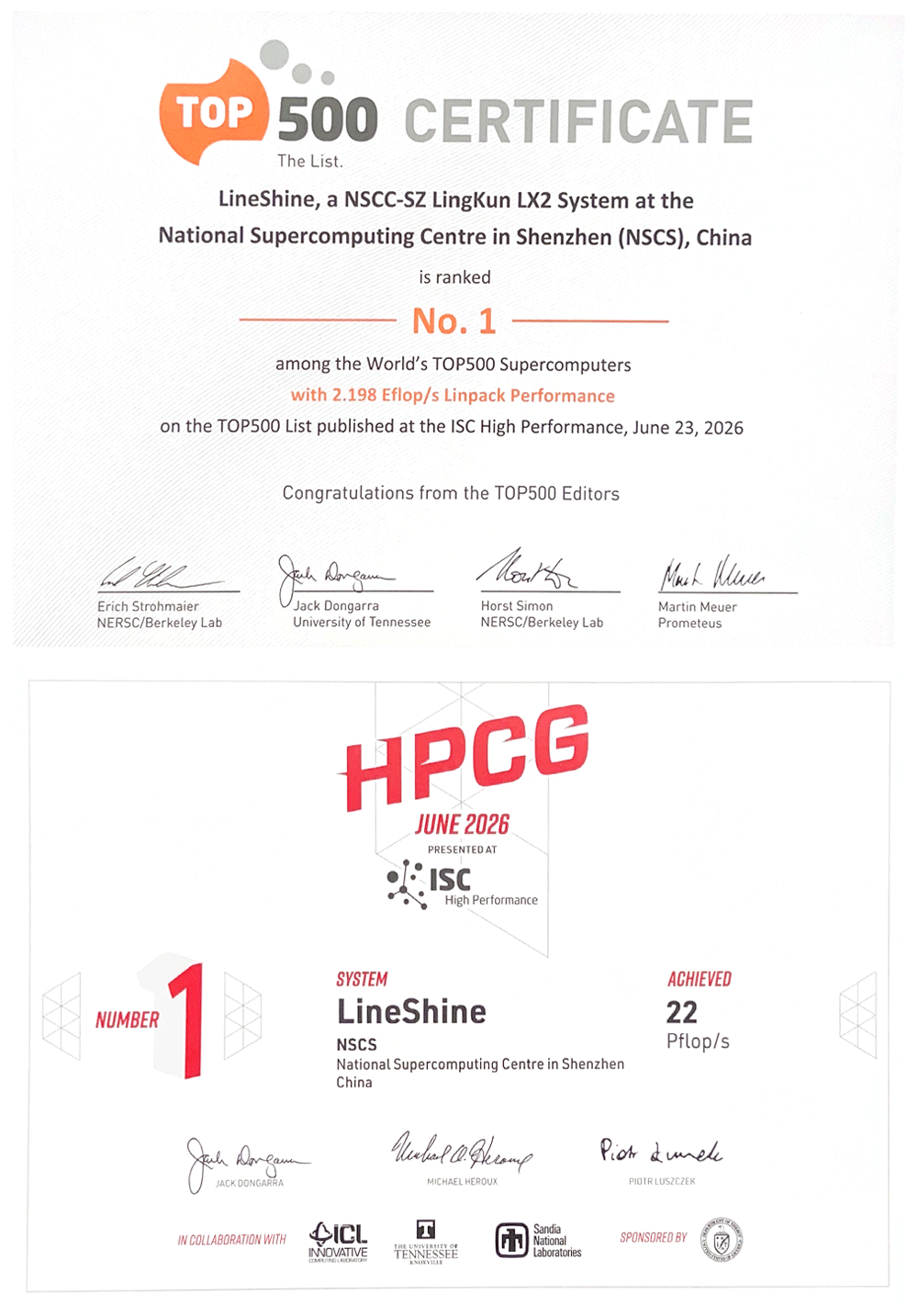
A TOP500 certificate recognizes Shenzhen-developed LineShine as the world's fastest supercomputer. Released at ISC 2026 in Hamburg, the ranking marks China's return to the top of the global supercomputing list after nine years. Photos courtesy of National Supercomputing Center in Shenzhen
The result makes LineShine the first supercomputer to exceed 2 exaflops in sustained performance, placing it ahead of leading systems in the United States and Europe.
Designed as a next-generation platform for scientific and engineering artificial intelligence computing, LineShine is built around the domestically developed LingKun LX2 processor and introduces an "Online Acceleration" architecture that integrates high-performance computing and AI workloads within a CPU-based system.
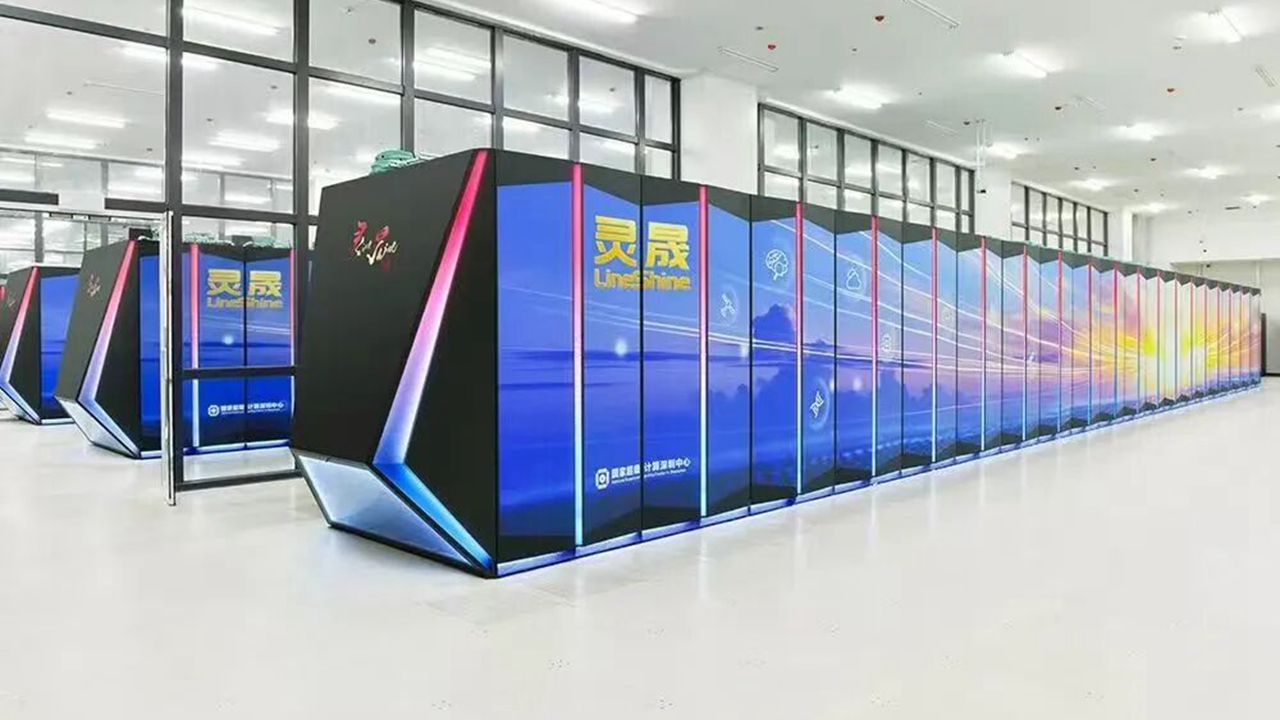 The LineShine supercomputer is seen at the National Supercomputing Center in Shenzhen.
According to the National Supercomputing Center in Shenzhen, the system combines proprietary processors, high-bandwidth memory, high-speed interconnect technology and a full-stack software ecosystem developed in China.
At the chip level, the LX2 processor incorporates mixed-precision computing and matrix acceleration capabilities while integrating domestic high-bandwidth memory technology, boosting memory bandwidth by up to ten times compared with conventional CPU systems.
The system's proprietary interconnect network supports clusters of up to 100,000 nodes, while its storage architecture is designed to scale to exascale-class computing environments.
LineShine also features fully liquid-cooled computing cabinets and delivers an energy-efficiency rating of 51 gigaflops per watt, setting a new benchmark for sustainable high-performance computing, according to the center.
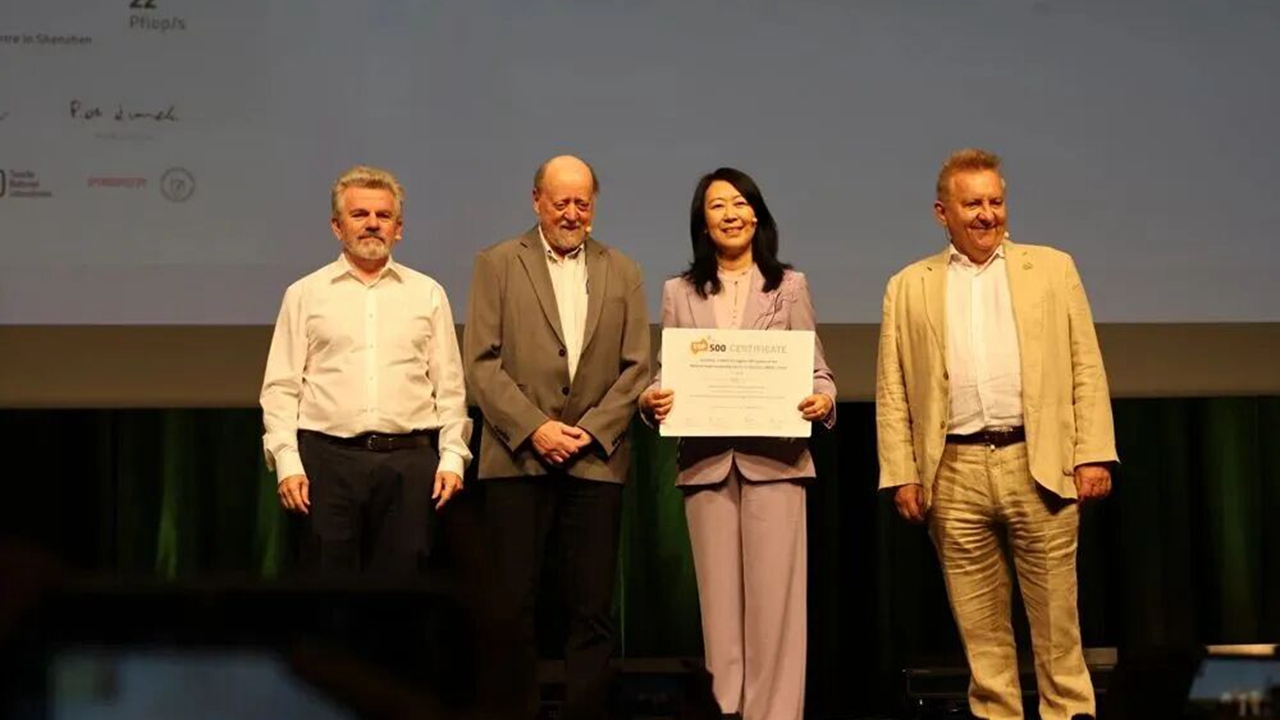
Lu Yutong (2nd R), chief designer of the LineShine supercomputer and director of the National Supercomputing Center in Shenzhen, receives a TOP500 certificate during ISC 2026 in Hamburg, Germany, on June 23.
Lu Yutong, chief designer of the LineShine system and director of the National Supercomputing Center in Shenzhen, said the project reflects a growing convergence between supercomputing and artificial intelligence.
Since its deployment, LineShine has supported research in atmospheric and ocean sciences, engineering simulation, materials science, drug discovery, brain science and AI applications, including large-model inference.
The center said the system has achieved an average parallel scaling efficiency of 84.4% and can operate efficiently across more than 10 million processing cores.
The achievement highlights Shenzhen's role as one of China's leading innovation hubs and underscores the city's growing influence in advanced computing, a technology increasingly seen as critical for scientific research, industrial innovation and the development of artificial intelligence.