
 Share
Share


 Print
PrintShenzhen accelerates decarbonization efforts with 2026 Energy Conservation Week initiatives
Writer: Wei Jie | Editor: Lin Qiuying | From: Original | Updated: 2026-06-23
Shenzhen has been urged to leverage its innovation strengths to lead breakthroughs in carbon budget management and carbon evaluation for major projects, providing a replicable model for high-quality green development nationwide.
The call to action came from Kang Yanbing, deputy director of the Energy Research Institute of the National Development and Reform Commission at the Key Sector Energy Saving and Carbon Reduction Promotion Meeting hosted by Shenzhen at the New Generation Industrial Park in Futian District recently.
Kang praised Shenzhen’s pioneering efforts and noted that carbon emission indicators will serve as a primary guide for China's green transformation starting in the next five-year cycle.
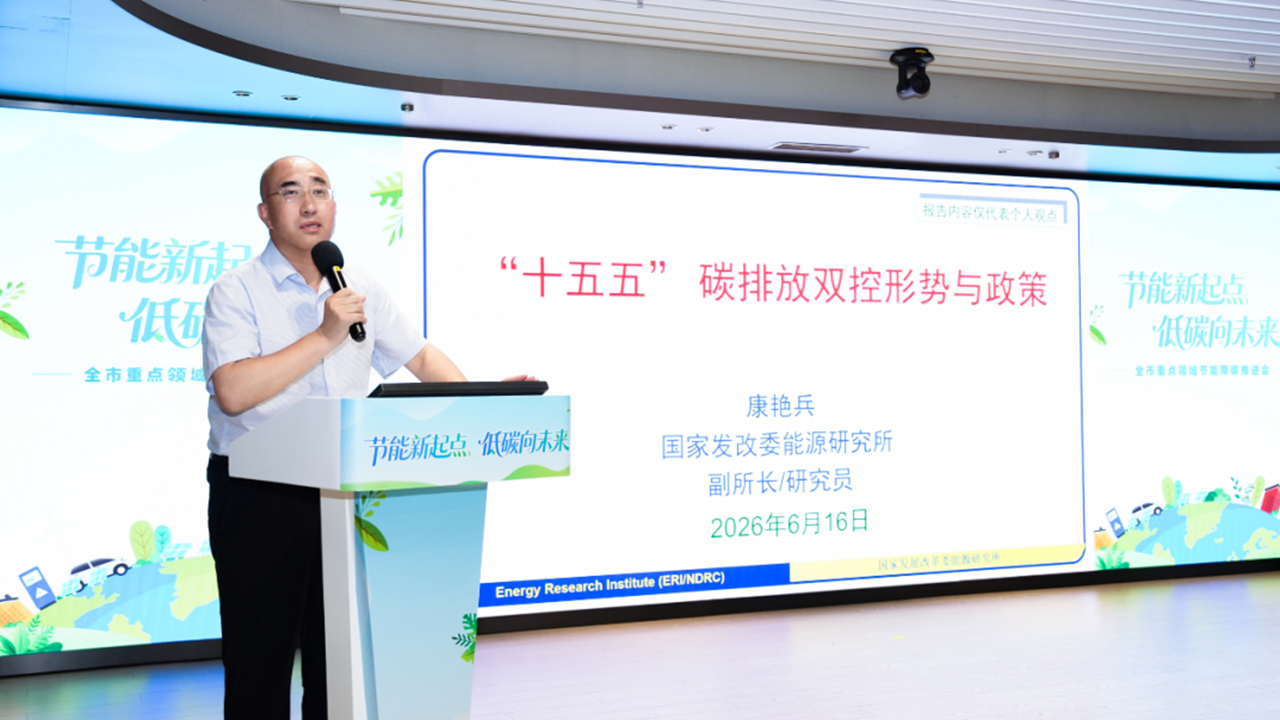 Kang Yanbing, deputy director of the Energy Research Institute under China's National Development and Reform Commission, speaks at an energy-saving and carbon-reduction promotion meeting in Shenzhen. Photos courtesy of event organizer
The event, which included a concurrent ESG Practical Training Session, brought together representatives from major energy-consuming enterprises, listed companies, State-owned enterprises, and government authorities to explore new pathways for energy efficiency and environmental, social, and governance (ESG) compliance.
The meeting focused on the national transition from dual control of energy consumption to dual control of carbon emissions, a pivotal shift during the upcoming 15th Five-Year Plan period. Zhang Bao, director of the Green Development Division of the Shenzhen Municipal Development and Reform Commission, highlighted that the city has consistently prioritized energy efficiency across the power, industrial, construction, and transportation sectors, maintaining a leading national position in energy and carbon intensity reduction.
A highlight of the session was the collective commitment from industry leaders. Nine prominent companies across the energy, transportation, industrial, and data center sectors — including Shenzhen Energy, Shenzhen Gas, Shenzhen Metro, SF Holding, Avary Holding, Foxconn, BYD, SZZT Electronics Co., Ltd, and GDS Holdings Ltd — jointly signed a proposal for corporate energy saving and carbon reduction. These industry giants pledged to fulfill their primary responsibilities by accelerating technological upgrades and refining carbon management systems to set a benchmark for their respective industries.
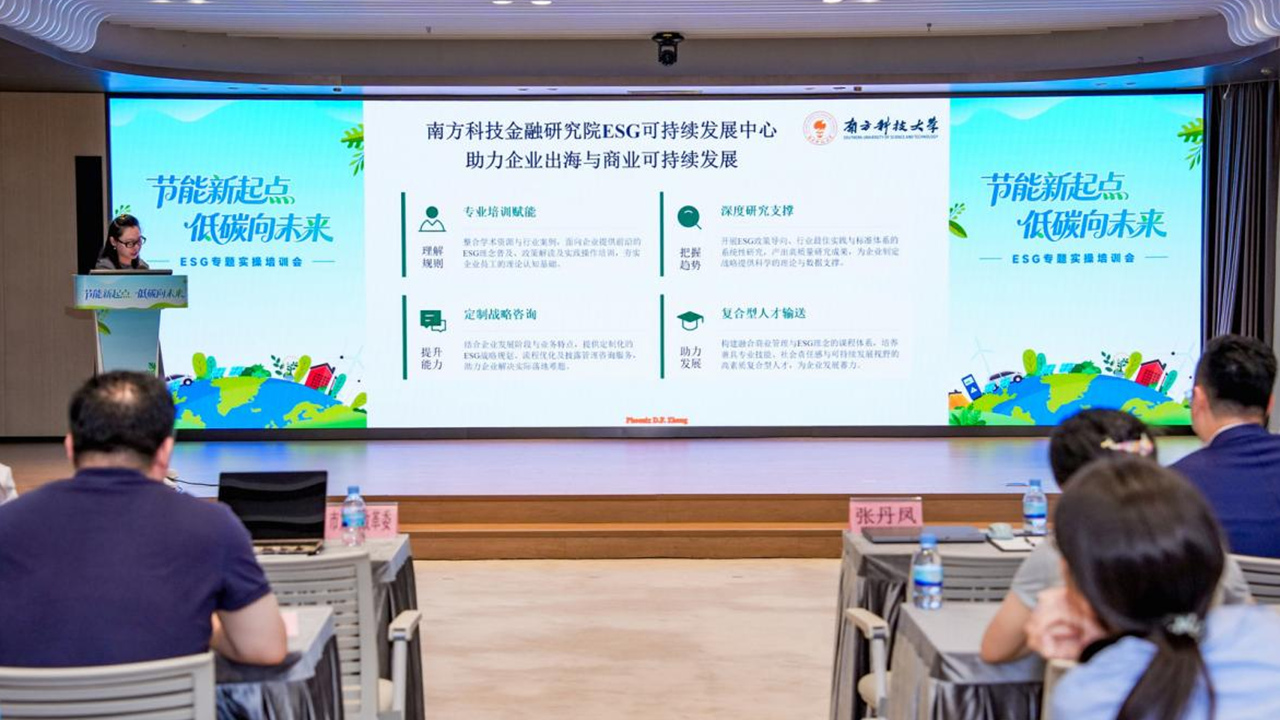
Zhang Danfeng, director of the ESG Sustainable Development Center at Shenzhen-based Southern University of Science and Technology, delivers a speech at the ESG training session in Shenzhen. The event focused on sustainable development strategies, international compliance requirements, and pathways to achieving China's carbon reduction goals.
The concurrent ESG training session addressed the growing need for international compliance and sustainable development. Zhang Danfeng, director of the ESG Sustainable Development Center at Shenzhen-based Southern University of Science and Technology, provided a deep dive into how ESG strategies facilitate corporate global expansion. She analyzed the shift in global trade from price competition to ESG value leadership, specifically interpreting the impacts of the Carbon Border Adjustment Mechanism (CBAM) and the Corporate Sustainability Reporting Directive (CSRD) on Chinese exporters.
To provide practical insights, several enterprises shared successful case studies. Sunwoda presented its "Battery Passport" digital platform and results from its Global Battery Alliance pilot program; Tencent discussed its CarbonX program and green computing initiatives; and China Resources Land showcased its comprehensive low-carbon management system covering the entire lifecycle of the design, construction, and operation of zero-energy buildings. These activities underscore Shenzhen's commitment to fostering a collaborative ecosystem for a low-carbon future.