
 Share
Share


 Print
PrintShenzhen launches citywide language improvement campaign ahead of APEC meeting
Writer: Zhang Chanwen | Editor: Zhang Chanwen | From: Shenzhen Daily | Updated: 2026-06-16
Video by Wang Haolan
A citywide language improvement campaign has been launched this month to enhance Shenzhen’s international profile ahead of the upcoming APEC meeting. Organized by the Organization Department of the CPC Shenzhen Municipal Committee, the “City Language Watch” initiative will run from June to November.
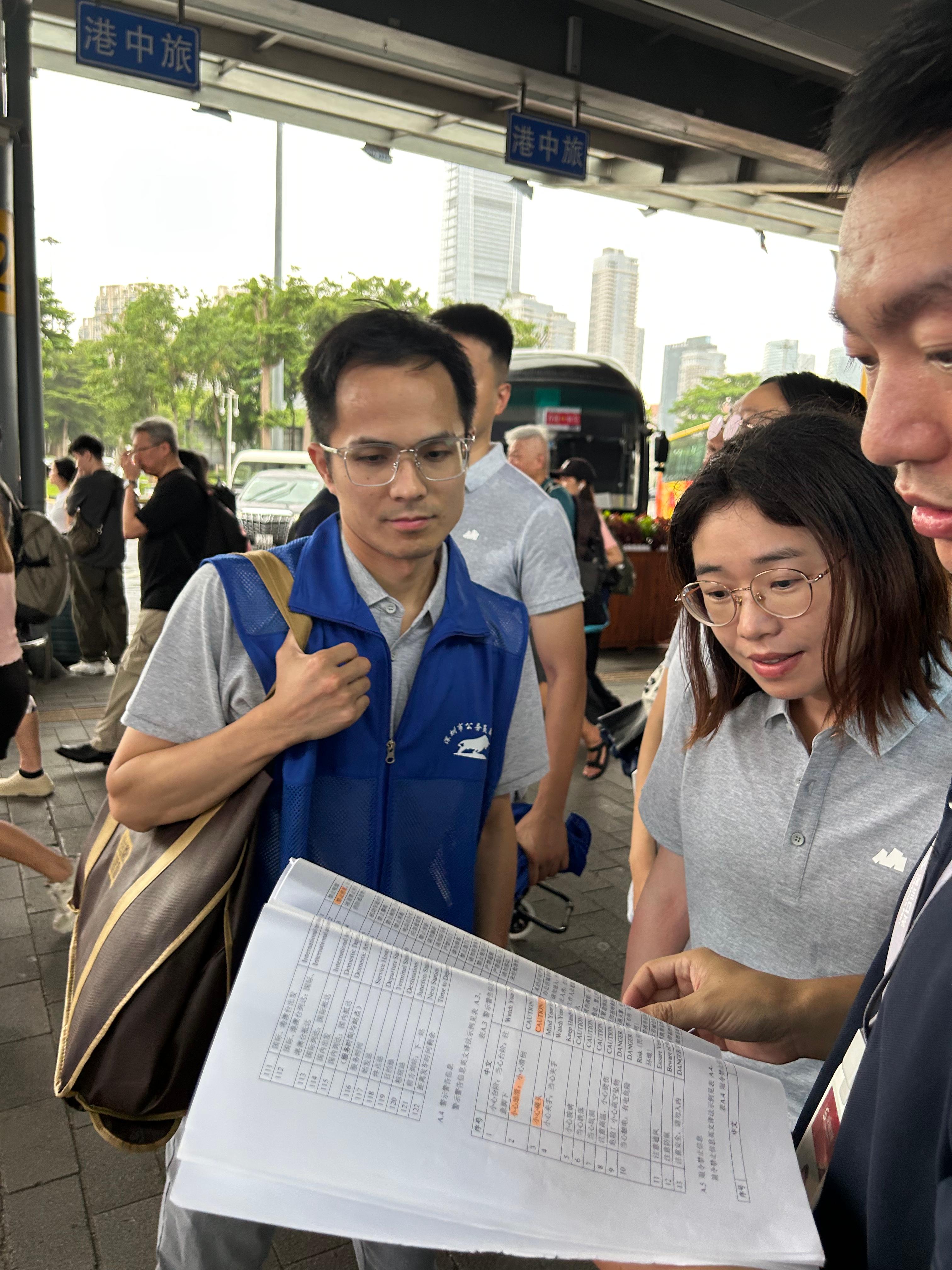
A team of civil servants examine public signage for errors at Shenzhen Bay Port on Sunday. Photos courtesy of event organizer
On June 14, a team of civil servants kicked off the campaign with an inspection tour of Huanggang Port, Shenzhen Bay Port, and Shenzhen Bao’an International Airport. Wearing blue vests, the team examined public signage for errors such as inaccurate translations, missing English signs, and incomplete information. Within just two hours, they identified more than 30 types of language mistakes.
“Shenzhen is an international city, and ports and airports are often the first stop for visitors,” said Wang Heng, an official from Futian Subdistrict. “Ensuring accurate signage is essential to improving our international language environment.”
In addition to signage inspections, civil servants in Futian District recently took on roles as English-speaking shopping assistants in Huaqiangbei, helping overseas buyers experience and order AI-related products.

Civil servants help overseas buyers experience and order AI-related products at Global AI Application Scenarios Center in Huaqiangbei.
Looking ahead, multilingual service stations will be established at the airport, ports, railway stations, major metro transfer hubs, and around APEC venues. These stations will provide interpretation, directions, and emergency assistance in multiple languages by civil servants.
Foreign-language services will also be available at 147 government service centers across the city, supported by 210 smart multilingual translation devices. The first batch of 454 multilingual government professionals — proficient in English, Japanese, French, Russian, Spanish, and Korean, with some offering bilingual capabilities — is now ready to deliver high-quality language support.