
 Share
Share


 Print
PrintAPEC's choice of SZ is optimal
Writer: Li Jing | Editor: Lin Qiuying | From: Shenzhen Daily | Updated: 2026-06-11
Mathematics serves as the core force driving human civilization and the primary lever for modern science and technology. For Efim Zelmanov, Fields Medalist and professor at Southern University of Science and Technology (SUSTech), it is also a full-time passion.
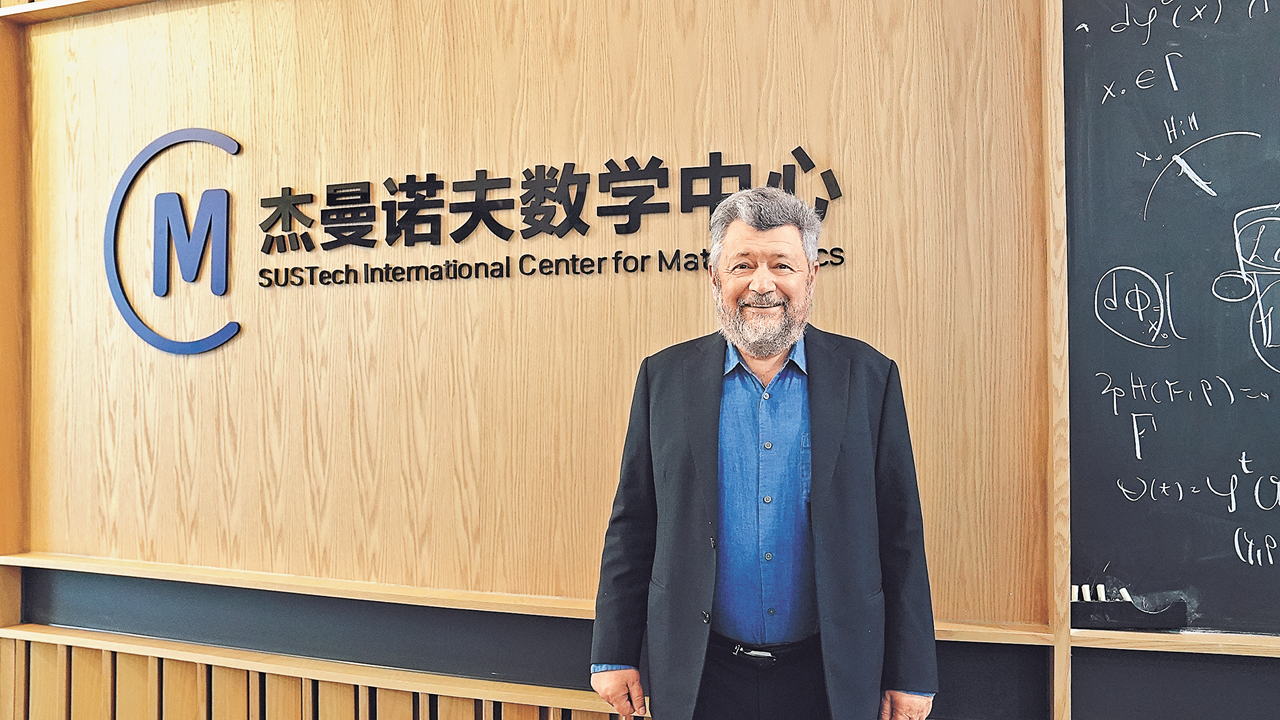
Efim Zelmanov, Fields Medalist and professor at SUSTech, poses for a photo in his office. Li Jianwen
His office on the SUSTech campus is often lit before 8 a.m. Even in his 70s, the world-renowned mathematician maintains a demanding schedule, working more than 10 hours a day. “I feel comfortable when I work,” he said with a smile. “I cannot imagine a retired life sitting at home watching TV.”
Zelmanov’s decision to leave the University of California (UC) for SUSTech four years ago was driven by a desire for impact. He likens UC to a massive ship moving on a fixed course, while SUSTech offers him the chance to create change personally. Today, he is three times busier than he was in the U.S. “That’s Shenzhen speed,” he said. “I have never regretted joining SUSTech — not for a single second.”
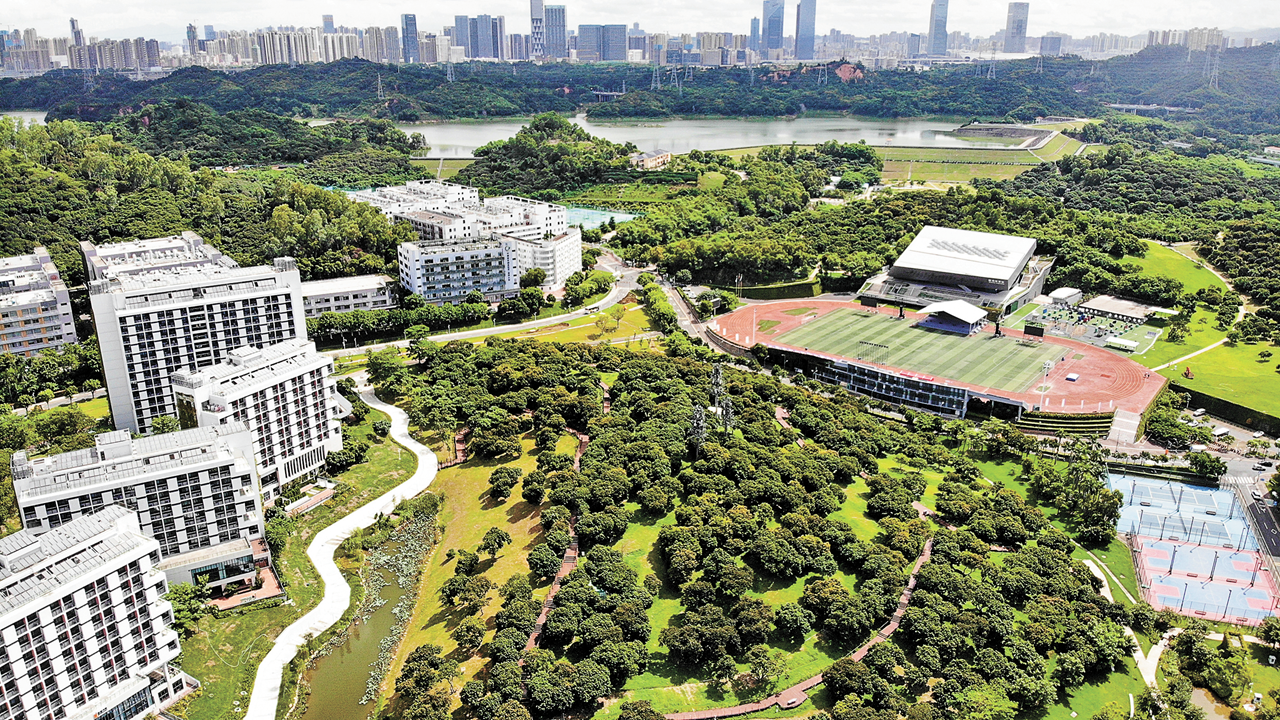
An aerial view of SUSTech. File photo
His office at the SUSTech International Center for Mathematics features walls lined with blackboards covered in formulas and desks stacked with handwritten manuscripts. While he has visited many institutions around the world, he noted that the research support in Shenzhen is the strongest he has ever encountered. This deep commitment from both the university and government agencies transformed his initial plan of short annual visits into full-time dedication.
Under Zelmanov’s leadership, the center has recruited world-class talent and established divisions in pure mathematics, computational mathematics, and probability. By December 2025, the center had published over 460 papers, with a clear mission to place Shenzhen on the world’s mathematical map.
Zelmanov is also known for his legendary teaching style, requiring 30-minute one-on-one oral exams for undergraduates to truly gauge their understanding and character.
Though he describes himself as an introvert by nature, he considers himself an extrovert in the realm of mathematical research.
Beyond campus, Zelmanov regularly visits local high schools to engage with future scholars. “With many new universities emerging across Guangdong, it is vital that we focus on high school students,” he stated. “We must connect with these students — potential future recruits for SUSTech — well before they begin enrollment.”
Zelmanov regards top-tier universities as the heart of a research ecosystem that attracts and retains talent for the city. “While SUSTech is young, it is an excellent institution striving for global prominence,” he said. “Such universities draw exceptional students who, after graduation, can stay and contribute to the city’s growth and innovation.”
Despite the rise of AI, Zelmanov remains unfazed, asserting that while AI is a powerful tool, it will never replace mathematicians. Instead, he believes AI is creating more jobs for the field, as algorithms will always require the deep understanding and foundational theories that only human logic can provide.
To describe SUSTech’s trajectory, he turns to a mathematical metaphor: the derivative. “Our absolute value — our size and history — may be smaller than that of established universities, but our derivative, the rate of change, is higher. That is our most important parameter.”
As Shenzhen prepares to host the APEC meeting, Zelmanov sees the city as the perfect choice, given its leadership in clean energy, the smart economy, and technology. He hopes the event will foster the international cooperation that his center strives to advance.
To the next generation, he offers two pieces of advice: learn to make independent decisions and have the courage to forge new paths to solve the problems his generation has left behind.
“Listen to all good advice, but ultimately make your own decision and take responsibility for yourself,” he said. “Our generation has left many unsolved problems for the next. To solve them, young scholars must use different approaches.”