
 Share
Share


 Print
PrintGuangming Science City accelerates research-industry integration
Writer: Windy Shao | Editor: Lin Qiuying | From: Original | Updated: 2026-06-01
The Guangming Science City is seeking to take a leading role in Shenzhen’s bid to become a global innovation powerhouse under the city's newly released 15th Five-Year Plan.
On May 29, the science city hosted a high-level matchmaking conference themed “Strengthening Fundamental Research, Empowering Innovation Through Scientific Infrastructure.” The event showcased the latest achievements in the construction, operation, and collaborative utilization of its major scientific facilities.
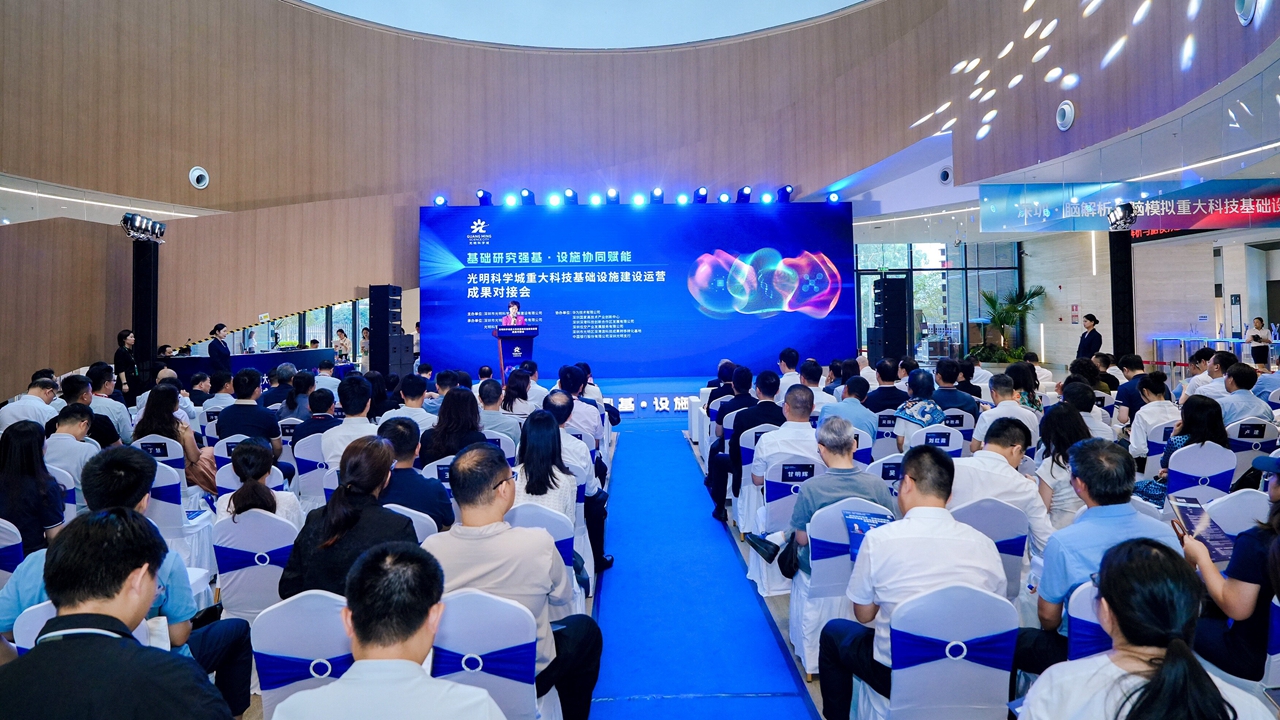
A panoramic view of the event. Photos courtesy of the event organizers
Organized by Shenzhen Guangming Science City Development and Construction Co., Ltd, the event attracted more than 130 representatives from over 50 organizations, including government agencies, research institutes, universities, enterprises, and financial institutions.
In his opening remarks, Qiu Guizhong, chairman of SGSCDCC, said the company, the primary platform for the investment, construction, and operation of the Guangming Science City’s major facilities, is pivoting toward a new phase focused on operational output and market-oriented innovation.
A series of agreements signed during the event underscored the Guangming Science City's integrated “investment-construction-operation” model.
The company inked operational management agreements with the Shenzhen Institutes of Advanced Technology and the Southern University of Science and Technology for facilities dedicated to synthetic biology, brain mapping and simulation, and materials genomics.
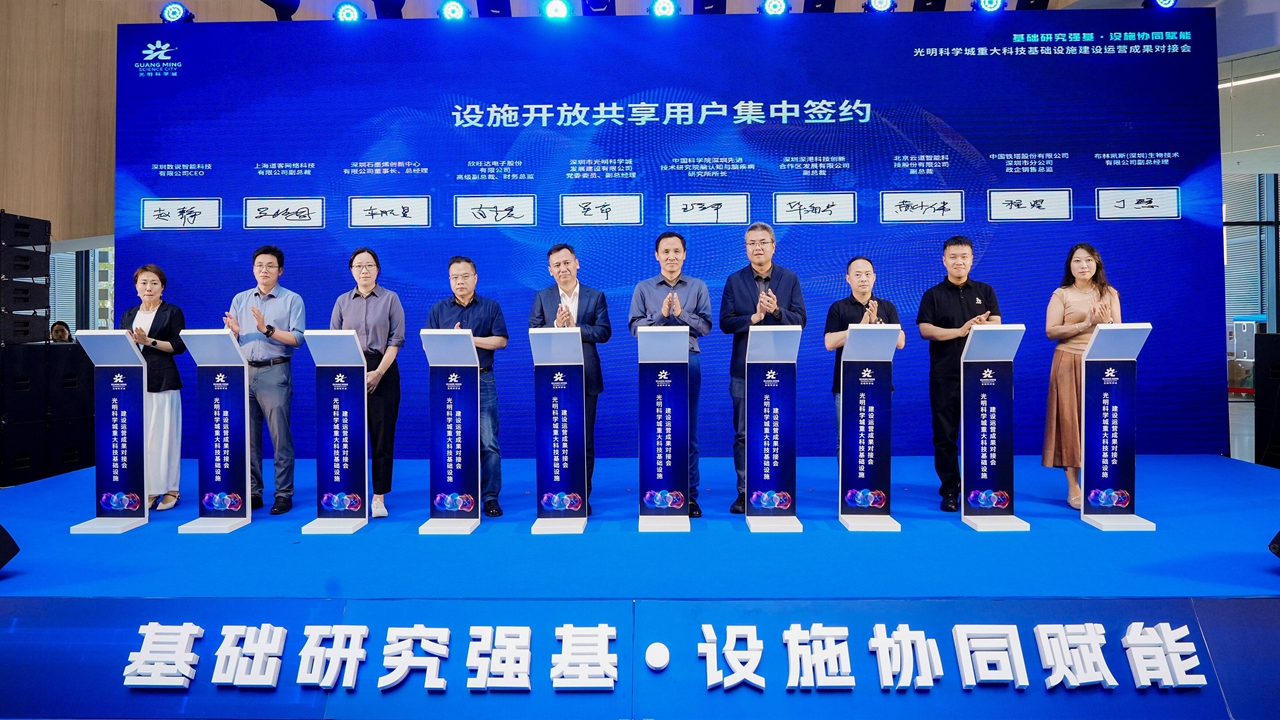
A group signing ceremony for facility open-access users.
New contracts were signed to accelerate the construction of the Shenzhen Free Electron Laser facility and the development of a special-environment materials research platform.
A strategic partnership with the China Spallation Neutron Source Science Center was also established. This collaboration facilitates shared access to neutron spectroscopy resources and boost cooperation between Shenzhen and Dongguan in major scientific infrastructure development.
The event also marked the official launch of a 5-billion-yuan, 30-year long-term special loan provided by China Everbright Bank's Shenzhen branch. The financing package is specifically designed to support the construction and future operation of the free electron laser facility.
Meanwhile, cooperation memorandums signed with industry partners including Huawei Technologies and Shenzhen Shenye Biotechnology Group. These agreements aim to deepen the integration of synthetic biology with AI and advanced computing, targeting growth in sustainable agriculture, pet healthcare, marine aquaculture, and talent development.
To facilitate faster movement of scientific materials between Shenzhen and Hong Kong, SGSCDCC also signed an agreement to develop a low-altitude logistics corridor linking the Hetao cooperation zone and the Guangming Science City, supporting cross-border research collaboration.
The conference concluded with two major achievements: the official inauguration of the Materials Genome Facility User Committee — completing a network of user committees for all three operational large-scale scientific facilities in the Guangming Science City — and the release of the first Major Scientific Infrastructure Service Handbook, providing standardized guidance on facility access and industry cooperation.

A roundtable discussion session.
A high-level roundtable featuring leading scientists, industry executives, and academic leaders explored how large-scale scientific facilities can better bridge fundamental research and industrial innovation.
Participants agreed that breakthroughs in core technologies increasingly depend on advances in basic research and access to world-class scientific instruments.