
 Share
Share


 Print
PrintHuaqiangbei, where innovation happens
Writer: Xu Jiyue | Editor: Cao Zhen | From: Original | Updated: 2026-05-19
On May 17, Luigi Gambardella, a renowned Italian economist and president of ChinaEU, led a delegation of Italian executives to Huaqiangbei, which is dubbed “China’s hardware Silicon Valley,” and sat down for an exclusive interview for the Dialogue with Huaqiangbei.
The discussion covered a broad spectrum of topics, including the evolution of the AI industry, global hardware innovation, and collaborative opportunities for youth entrepreneurship.
The interview itself was conducted in true “Huaqiangbei style.” Participants used one of Huaqiangbei’s flagship “AI Eight Steeds” products — an AI translation device — for real-time communication.
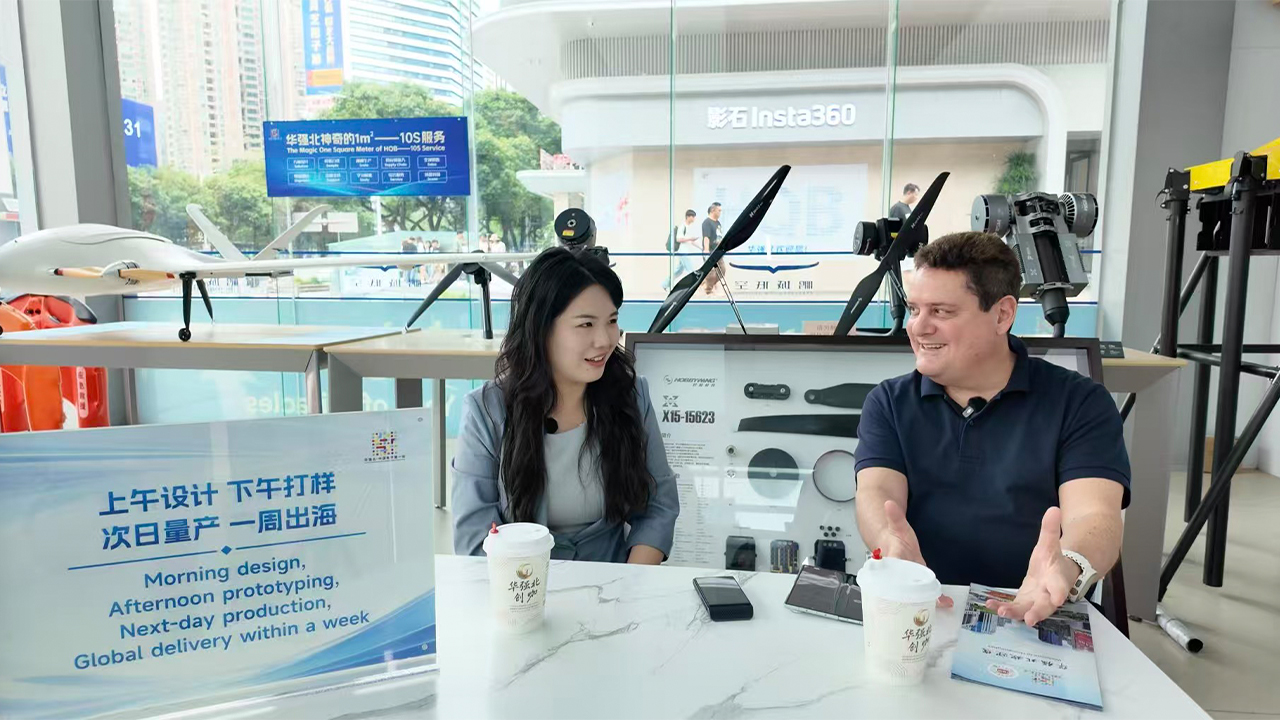
Luigi Gambardella (R), president of ChinaEU, speaks during an interview in Huaqiangbei on May 17. Photos courtesy of Huaqiangbei Subdistrict
“It’s always very interesting to be here ... this is the place where things happen,” Gambardella said when asked about his impressions of returning to Huaqiangbei.
After experiencing Huaqiangbei’s AI hardware ecosystem, entrepreneurial atmosphere, and globally connected supply chain firsthand, he once again emphasized: “If you want to understand the direction, if you want to understand the changes that will be in the market, you have to come here.”
Built on speed and quality
When asked to describe Huaqiangbei in one word, Gambardella’s answer was simple: “Fast.”
Having visited Huaqiangbei many times before, Gambardella toured several representative innovation sites during this trip, including the Global AI Application Scenario Center, Huaqiang Electronics World, and the Futian Wings Drone Exhibition Hall.
He experienced a range of the latest AI hardware products developed and sold in Huaqiangbei, including AI translators, smart glasses and robots.
During the interview, the host mentioned Huaqiangbei’s well-known slogan: “Design in the morning, prototype in the afternoon, mass production the next day, and global delivery within a week.” Gambardella said the slogan “precisely describes what happens here every day.”
Beyond speed, however, he highlighted another keyword: “Quality.” “Today, Chinese companies and Chinese entrepreneurs are continuously improving quality while also building their own Chinese brands,” he said.
He admitted that every visit to Huaqiangbei brings new discoveries. “It’s super fascinating. Every time I come here I learn. I never finish to learn. There are always new products and services.” he said.
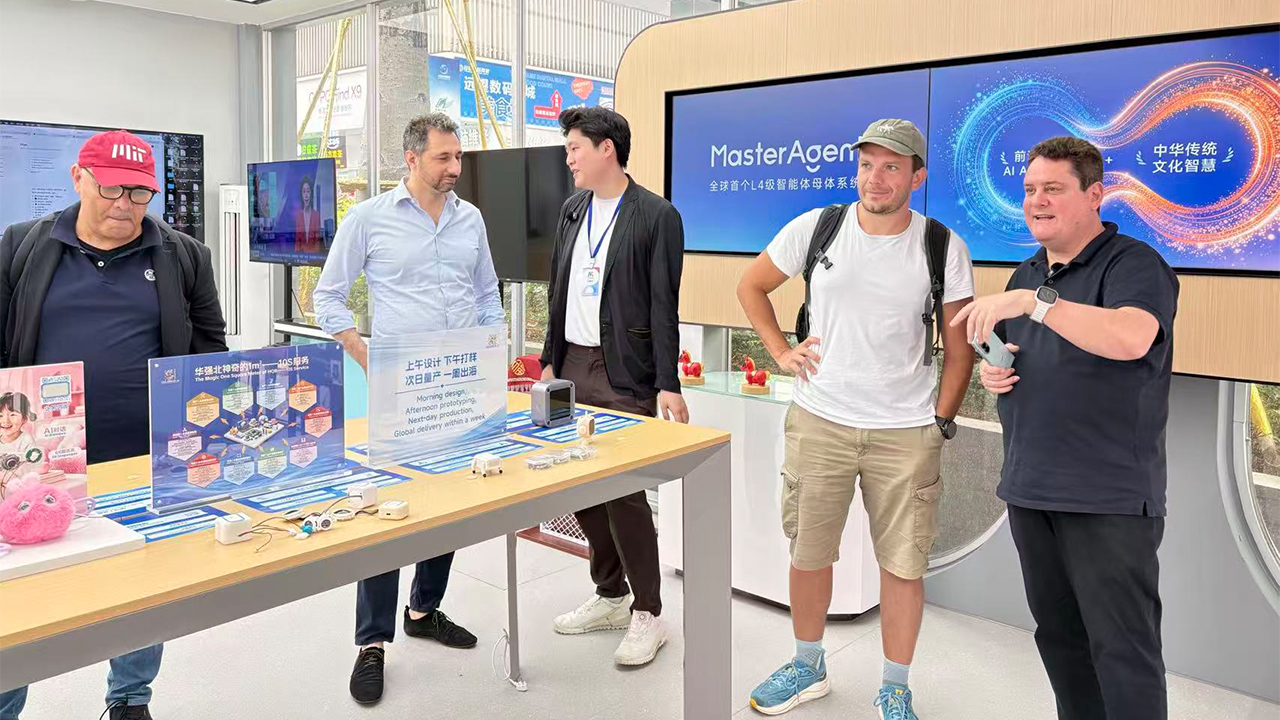
Luigi Gambardella (R) visits an AI innovation showroom with international entrepreneurs and incubators active in Huaqiangbei during a tour highlighting Huaqiangbei’s rapid prototyping ecosystem and international startup collaboration.
Toward a ‘permanent CES’
Gambardella noted that Shenzhen’s influence on the global consumer electronics industry is already clearly reflected at international exhibitions such as the Consumer Electronics Show (CES) in the U.S.
“It’s not only that many Shenzhen companies participate in the CES,” he said. “More importantly, many products showcased by international companies are actually manufactured in Shenzhen.”
In his view, without Shenzhen, the CES would not be what it is today.
The host explained that Huaqiangbei is working toward becoming a “never-ending CES,” as the market continuously brings together cutting-edge AI products from around the world. Global buyers can come here to find the newest products, the fastest supply chains, and the latest market trends.
Gambardella agreed.“The CES only lasts a few days at the beginning of January in Las Vegas ... here [the market] is permanent.”
Connecting young innovators across borders
He also expected Huaqiangbei to attract more young international entrepreneurs in the future. During his visit, Gambardella paid particular attention to the large number of young entrepreneurs in Huaqiangbei. “I especially hope to promote cooperation between young European and Chinese entrepreneurs,” he said.
The interview also covered Huaqiangbei’s burgeoning “One Person Company (OPC)” ecosystem initiative. The host explained that Huaqiangbei has been actively supporting OPC entrepreneurship this year, helping creators rapidly turn ideas into products by leveraging the local supply chain ecosystem.
Gambardella described this as “a very interesting new model.” “Governments should support such innovative concepts and provide more room for them to grow,” he said. “Perhaps one day, we will even see companies fully autonomous and driven by AI.”
“I really like the concept of ‘co-creation,’” he added. “Young Chinese and European entrepreneurs should be encouraged to work together, start businesses together, conduct research together, market together, and sell products globally together.”
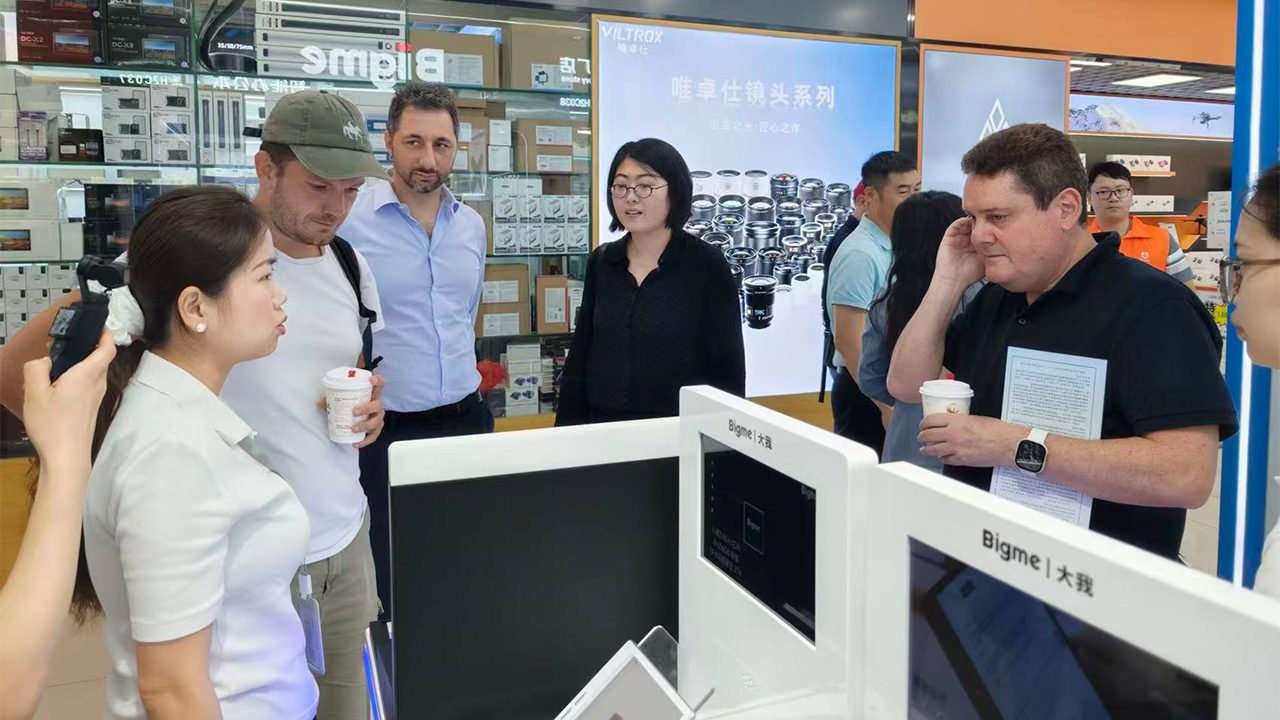
Luigi Gambardella (R) and members of an Italian business delegation visit electronics vendors in Huaqiangbei, during a tour focused on AI hardware and supply-chain innovation.
Building a global AI innovation hub
Gambardella has closely followed AI industry development and published numerous articles on the subject. When asked for suggestions regarding Huaqiangbei’s ambition to become a global AI innovation hub, he emphasized that the key lies in openness and diversity.
He suggested attracting more international talent and encouraging people from different cultural and professional backgrounds to participate. “Only through the exchange of diverse ideas can globally competitive innovation emerge,” he said.
Regarding the future of AI, Gambardella acknowledged that there are many debates and concerns worldwide, but said he prefers to remain optimistic.
In his view, AI is fundamentally a tool that enhances human capability. “I always like to use this example,” he said. “For me, AI is like an exoskeleton for athletes. It helps us become more efficient, faster, and better informed, enabling us to work and live better.”
He also offered advice for young people: “You must learn how to use AI.” At the same time, he stressed that all AI technologies should ultimately serve people. “Let’s always focus on people… this technology is meant to serve people.” he said.
When discussing similarities between Huaqiangbei and European cities, Gambardella said it is difficult to find a perfect equivalent, though he sees similarities with the entrepreneurial cultures of the Netherlands and Italy.
“The Netherlands has many young entrepreneurs who strongly embrace technology, while Italy is highly creative,” he said. “And in the AI era, creativity is the most important thing.”
Toward the end of the interview, the host introduced several international entrepreneurs and incubators active in Huaqiangbei. Among them is a Dutch entrepreneur who has spent over a decade in the area and founded “Trouble Maker,” an international incubator dedicated to connecting overseas hardware startups with China’s supply chain resources.
Gambardella praised this international ecosystem as highly significant. “You should think to create a sort of community, where people can stay in touch and continue networking,” he said, noting that many visitors leave Huaqiangbei deeply impressed after their first experience.