
 Share
Share


 Print
PrintIn Shenzhen, AI is already physical — and Italy cannot afford to wait
Writer: Luigi Gambardella | Editor: Lin Qiuying | From: Original | Updated: 2026-05-19
In Shenzhen, artificial intelligence is no longer something you watch on a screen. It moves, lifts, assembles, inspects and learns.
Walking through the city these past days with a delegation of Italian entrepreneurs, I saw robots that learn from demonstration, production lines that adapt in real time to shifting manufacturing requirements, and clusters where code becomes a physical product at a speed for which much of European industry is not yet prepared.
Video by Zhen Jianhong
This is what we at ChinaEU mean by Physical AI: intelligence that has moved from the cloud to the factory floor, from the screen to the machine. It is also the reason why the roundtable we May 18 convened — "New Frontiers for Industrial AI: Italy–Shenzhen Cooperation" — is not a one-off event, but the opening of a long-term industrial platform.
The timing was no coincidence. On the same day, Premier Li Qiang inspected the Beijing Humanoid Robot Innovation Center and Xiaomi Automobile Technology, calling for an innovation-driven, application-oriented approach and the comprehensive integration of AI across manufacturing — invoking President Xi Jinping's directive on new quality productive forces and a modern industrial system. The signal from the highest level is unambiguous: China is treating Physical AI as the central project of its current industrial cycle.
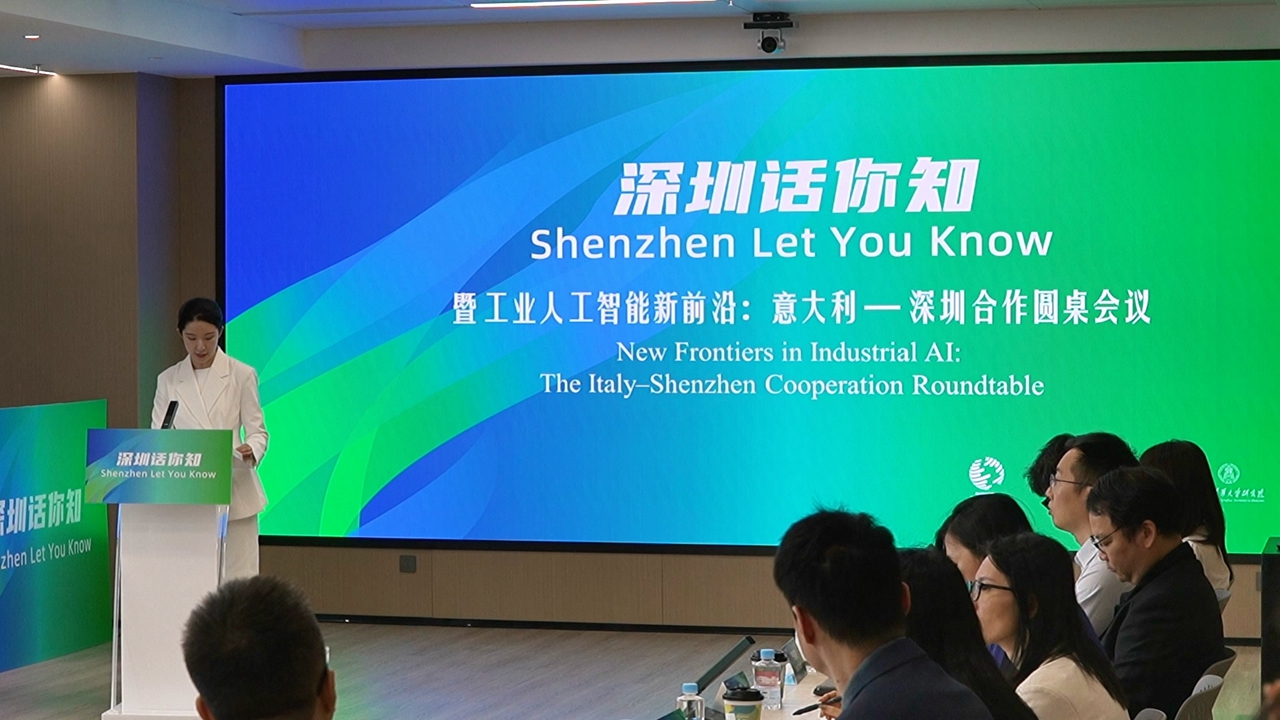
A scene at the 2026 “Shenzhen Let You Know” event and the “New Frontiers in Industrial AI: Italian-Shenzhen Cooperation Roundtable” held in Shenzhen yesterday. Photos by Zhen Jianhong
The next phase of artificial intelligence will not be decided by who builds the largest language model. It will be decided by who can apply intelligence to factories, supply chains, products and human work. That is the frontier that matters for industry — and especially for a country like Italy, the second-largest manufacturer in Europe and the world's eighth, whose economic strength is rooted in manufacturing, engineering and industrial specialization.
Italian industry has been slower to move than this moment requires. Our craftsmanship and engineering tradition are extraordinary assets, but they have sometimes encouraged a gradualist approach to technological change. In the age of AI, gradualism is becoming a strategic liability.
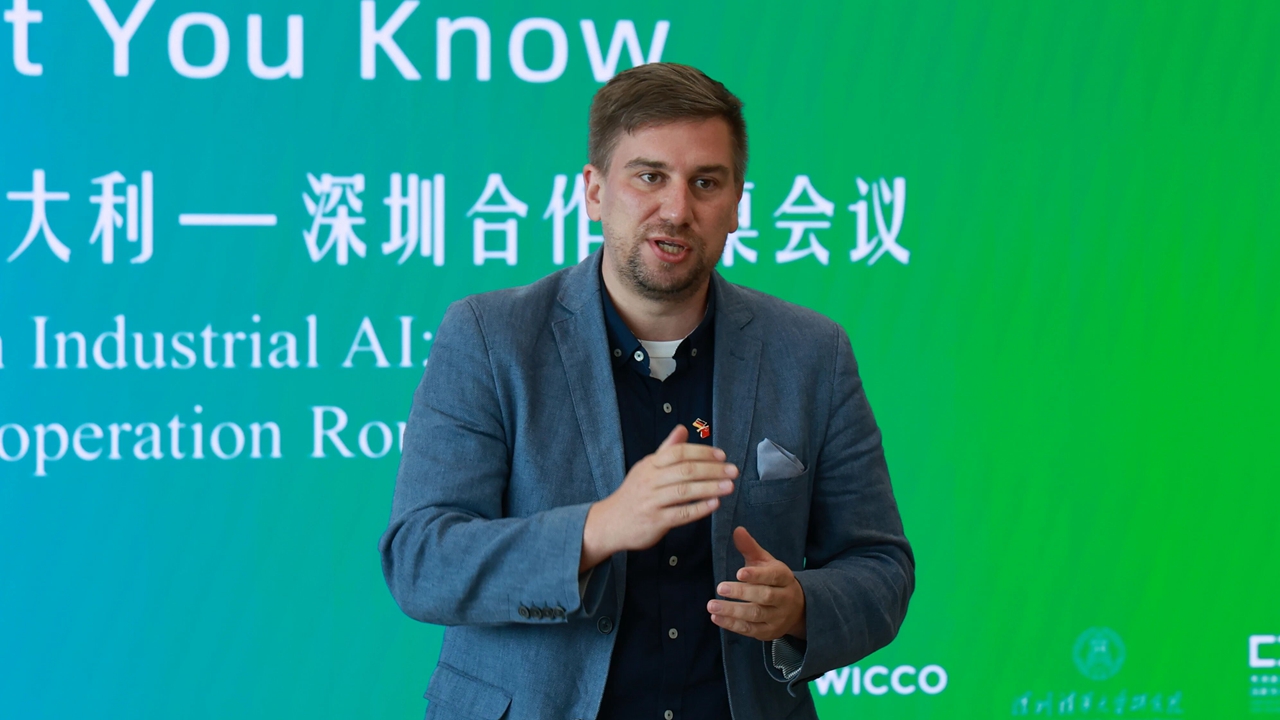
An Italian corporate representative speaks at the roundtable.
And yet here is the point I most want Italian readers to grasp: the same characteristics that expose Italian industry today are precisely what could make it one of the largest beneficiaries of the Physical AI revolution tomorrow — provided we move now. Physical AI does not create value in the abstract. It creates value where it meets real manufacturing, complex products, specialized supply chains and an engineering workforce. Italy already has all of this. Unlike economies that must first build an industrial base in order to apply AI to it, Italy needs only to upgrade a base that is already among the most sophisticated in the world.
Consider where AI delivers its highest marginal value: production lines that require constant adjustment, machinery that handles variable materials, mass customization, predictive maintenance of complex equipment, quality control with tight tolerances. These are not generic problems. They are Italian problems — and Italian strengths.
The industrial districts of Lombardy, Veneto, Emilia-Romagna and the Marche are exactly the kind of dense, specialized ecosystems in which Physical AI applications can be tested, refined and scaled. Few countries have an industrial geography this favorable to the technology now arriving. The window to convert that latent advantage into a real one is, however, narrow.

Luigi Gambardella (C), president of ChinaEU, listens attentively as a speaker delivers a speech at the roundtable.
The question, then, is no longer whether Italian companies should adopt AI. It is how quickly we can apply it — and with whom.
Shenzhen is one of the best places in the world to answer that question, because here innovation is not separated from production. Hardware, software, AI, robotics, research institutes and supply chains sit in the same ecosystem. An idea becomes a prototype quickly, a prototype becomes a product quickly and if it works, it scales.
Shenzhen's robotics industry alone reached 242.6 billion yuan — more than US$33 billion — in 2025, up 20.56% year on year, a trajectory that today aligns precisely with the national priorities reaffirmed by Premier Li Qiang.
Italy and Shenzhen should not try to imitate each other. They should connect their strengths. Shenzhen brings speed, scale, hardware intensity and supply-chain depth. Italy brings industrial specialization, design, quality, and a deep understanding of European industrial customers and the regulatory environment they operate in. Different strengths — but together, extremely powerful.
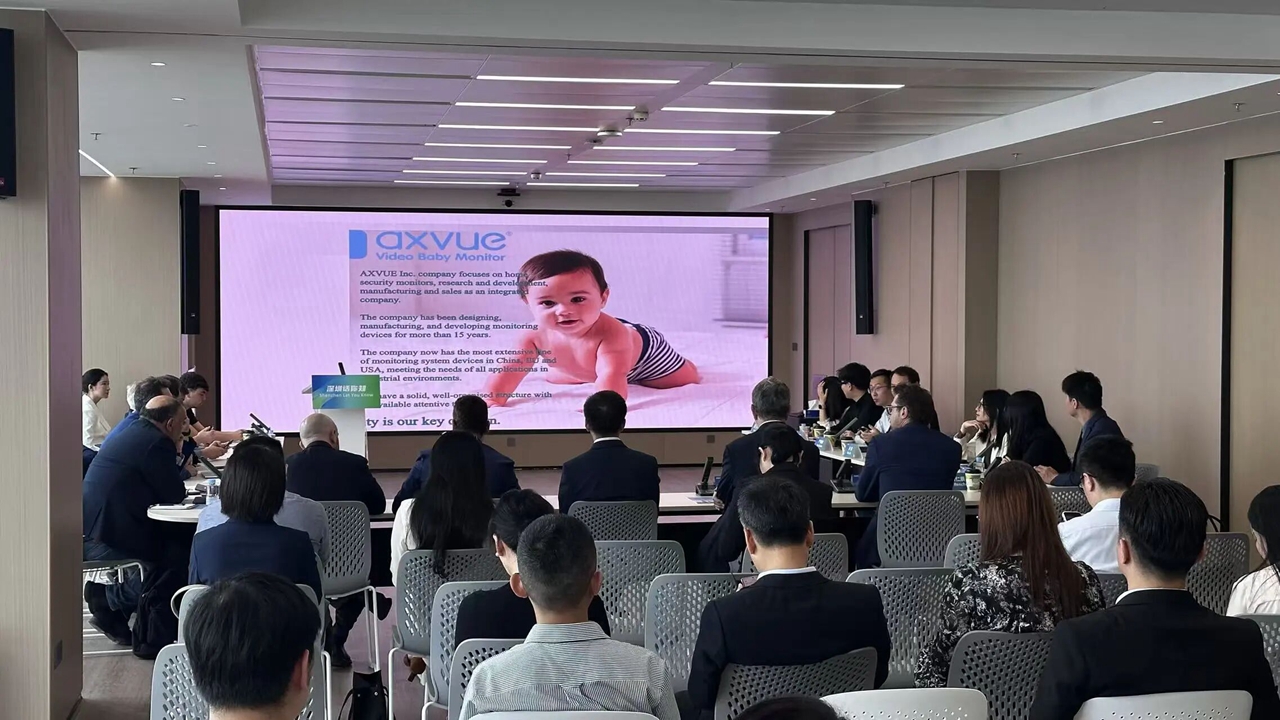
Attendees listen as a Shenzhen company representative introduce the company's products.
Cooperation can begin immediately in three concrete areas. First, robotics and intelligent automation for specialized industrial applications — machinery, packaging, food processing, eyewear, textiles, furniture, precision mechanics. The future of robotics will not be made only of general-purpose machines, but of robots designed for specific tasks, materials and industrial cultures. Italian companies bring real industrial problems; Shenzhen companies bring technology and execution capacity.
Second, AI for productivity — solutions that deliver measurable results inside a real factory: reducing downtime, improving quality control, optimizing energy consumption, supporting workers. Third, Europe-oriented co-development — using Italy as a gateway to a demanding European market, with strict standards on safety, data governance and sophisticated industrial customers. This is not export. It is co-development.
And it is more than business. A partnership built on real industrial projects — on factories, on products, on shared engineering work — is also the most solid foundation for a pragmatic and mature relationship between Europe and China. Industry has always been one of the most honest languages between nations, because it is measured in results.
Such a partnership is not built in a single meeting. It requires trust, clear business models, and clarity from the outset about how value created together is shared. The best way to build that trust is through concrete projects: a factory trial, a robotics application for a specific process, an AI system for predictive maintenance, a digital twin for industrial design. This is the language of industry, and it is the language we should speak.
Shenzhen is often described as a city of the future. I would describe it more precisely: a city where the future becomes executable. Italy is a country where industry has depth, creativity and global credibility — and, if it acts now, one of the few countries truly positioned to convert the Physical AI revolution into real industrial value.
For Italy, the choice is simple: either we connect our industrial excellence to the new geography of Physical AI, or we risk watching the next industrial revolution from the sidelines.
The author is president of ChinaEU and led the ChinaEU Executive Mission "Visit to the Future: The Physical AI Revolution" to Shenzhen.