
 Share
Share


 Print
PrintPotted kale plants sold out — but are they worth it?
Writer: Li Dan | Editor: Cao Zhen | From: Original | Updated: 2026-05-04
An edible potted kale plant, sustainably harvested and priced at 29.9 yuan (US$4.2) apiece, became the hottest product at Sam's Club in Shenzhen recently, thanks to the craze for kale among health-minded city-dwellers.
A search on the WeChat miniprogram of the retailer in Shenzhen revealed that the plant remained out of stock this morning, with some asking online if anyone can help them get one for an extra fee. A buyer claimed on social media that he “grabbed eight pots in one go when it was still available.”
The potted kale became an instant hit after grabbing buyers' attention with advertising slogans such as “plant once and harvest for a whole year.”
Currently, two kale-related products are on sale at the retailer: one is kale powder (3.5g x 100 sticks) priced at 89.9 yuan, with monthly sales exceeding 10,000 units; the other is Heytea’s kale and cucumber mixed vegetable juice drink (330ml x 12) priced at 79.9 yuan, with over 10,000 orders already placed.
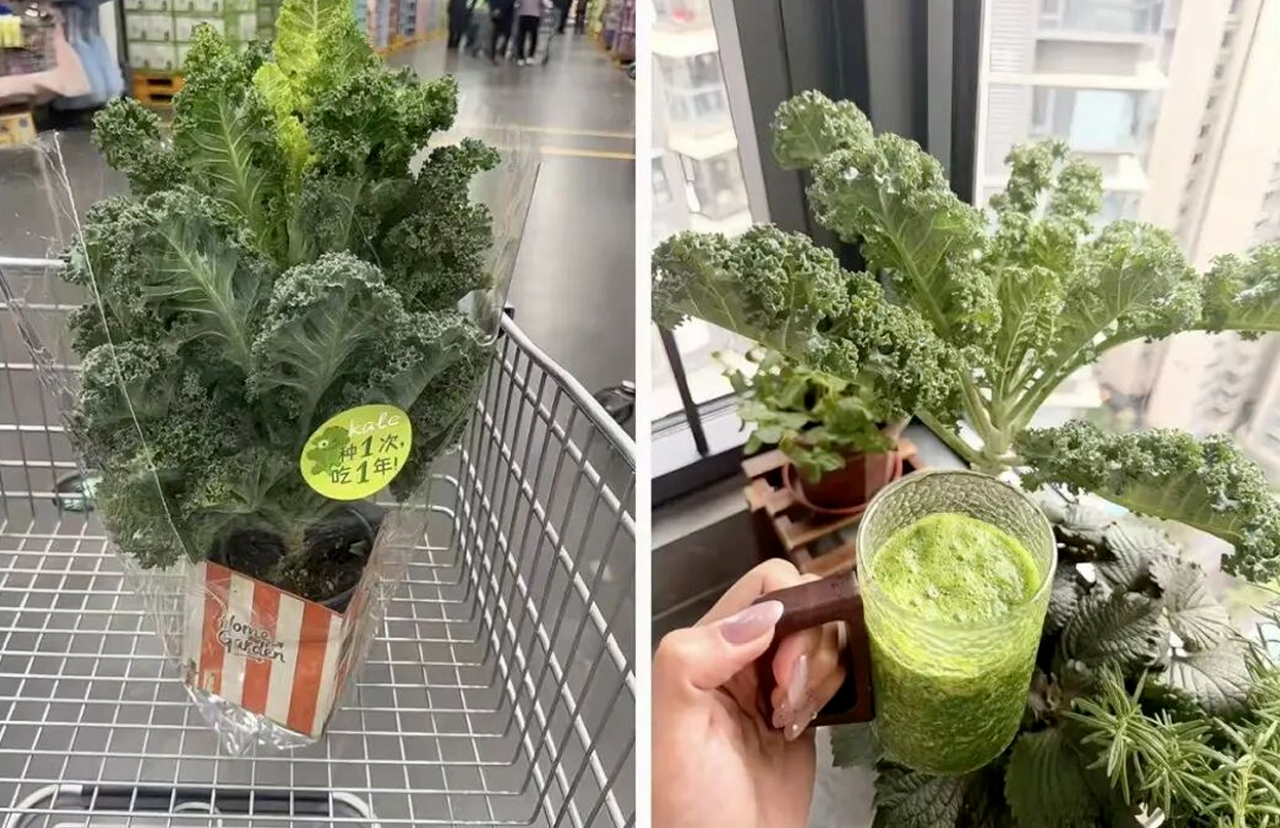
Potted kale plant is seen on social media.
Kale, originally from the eastern Mediterranean and Asia Minor, is hailed as a superfood, as it contains a rich proportion of Vitamin K, Vitamin A, Vitamin C, manganese, copper, Vitamin B6, calcium, potassium, and magnesium.
Low in calories, it is also rich in antioxidants and fiber. Some research even suggests that it's good for the heart and eyes, and may help prevent certain types of cancer.
Riding on the plant's popularity, many tea brands have come up with products containing kale ingredients. Heytea’s kale slimming drink, for instance, sold 3.5 million cups in the first month after it was marketed, and its Super Plant Tea series sold over 100 million cups within a year of launch.
Other brands such as Naixue, Auntea Jenny, and CoCo have also introduced kale products. Hema (Freshippo) launched a kale oat cup, instant noodle brand Baixiang created kale noodles, and frozen food brand Sanquan introduced a kale steamed sponge cake. Industry insiders say the sector is undergoing a deep trend shift, as consumer now prefer healthier options.
Meanwhile, the price of kale has surged. From 0.8 yuan per catty in 2024, it has now soared to 30 yuan per catty — a 30-fold increase. Organic kale is even more expensive. On the Hema app, a 100g pack of organic kale costs 8.99 yuan, equivalent to 45 yuan per catty.
Despite kale’s many benefits, experts caution:
Kale is not a miracle food — it’s healthy, but no single food can prevent or cure diseases.
Juicing removes most of the fiber, so eating whole kale leaves is better for digestive and metabolic health.
While kale juice itself is low in calories and can aid weight loss, adding high-calorie ingredients (sugar, sweetened yogurt, fatty dressings) or drinking excessive amounts could lead to weight gain instead.
People on blood-thinning medications (e.g., warfarin) should monitor their vitamin K intake, as kale is extremely high in vitamin K.
For those who are keen to grow kale on their balconies, here are some tips:
Kale needs lots of sun (about 6 hours a day). If you live in a very hot place, a little afternoon shade is okay.
Keep the soil damp, not soaking wet. Water when the top of the soil feels dry to the touch.
Use rich, well-draining soil (regular potting mix works well). Kale likes soil with compost or plant food mixed in.
Kale grows best in cool weather (spring and fall). It can survive light frost, which actually makes the leaves sweeter. Too much heat (above 25°C) makes kale bitter.
When harvesting, don't pull up the whole plant! Instead, pick the older outer leaves first, starting from the bottom. Leave the small, inner leaves to keep growing. Also watch out for small green caterpillars.
If you do it properly, the plant will keep producing new leaves for many months. The full life cycle of a kale plant lasts two years, and you can harvest seeds in the second year.