
 Share
Share


 Print
PrintExhibition showcases milestones of Chinese sci-fi history
Writer: Windy Shao | Editor: Lin Qiuying | From: Original | Updated: 2026-04-29
The Special Exhibition on Fifteen Milestones of Chinese Science Fiction History officially opened April 29, part of the first-anniversary celebrations of the Shenzhen Science & Technology Museum.
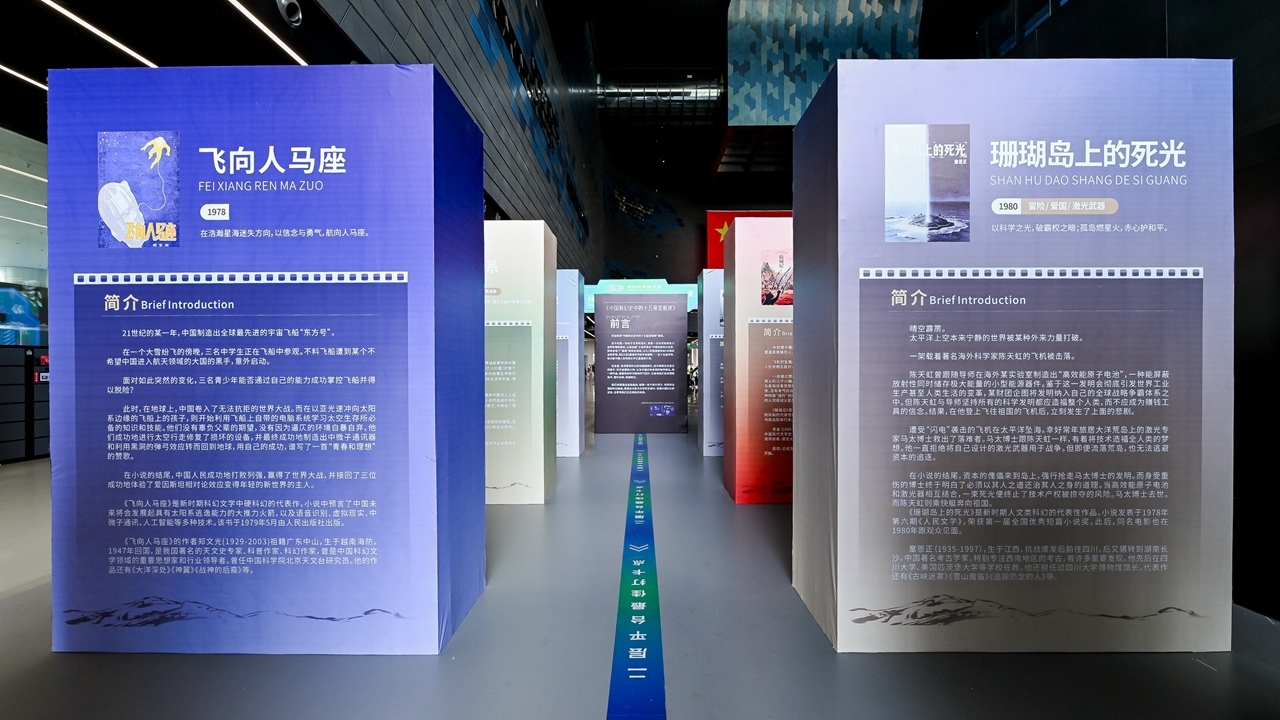 A scene of the exhibition. Photos courtesy of the event organizers
The exhibition is curated under the direction of renowned sci-fi author Professor Wu Yan, director of the Center for Science and Human Imagination at the Southern University of Science and Technology.
Shenzhen University of Advanced Technoloy's “world’s first in-orbit experimental system for a future space hospital” was simultaneously showcased, highlighting the intersection of science fiction and technological innovation and supporting Shenzhen’s dual identity as a city of science and sci-fi.
The exhibition traces the evolution of Chinese science fiction, featuring 15 landmark works spanning from the Warring States-era story “The Artificial Man by Yanshi” to Liang Qichao’s “Future Records of New China,” Lao She’s “Cat City,” and post-1949 classics such as “Dreaming Through the Solar System,” “Flying to Sagittarius,” and “Little Ingenuity Tours the Future.”
New-era highlights include “Death Ray on Coral Island,” “Western Journey 2066,” “The Three-Body Problem,” and “China Orbital,” as well as contemporary works like “Wasteland Tide,” “Heaven Father Earth Mother,” “Time-Space Painter,” the sci-fi blockbuster “The Wandering Earth,” and the Shenzhen-original sci-fi play “Cloud Body.”
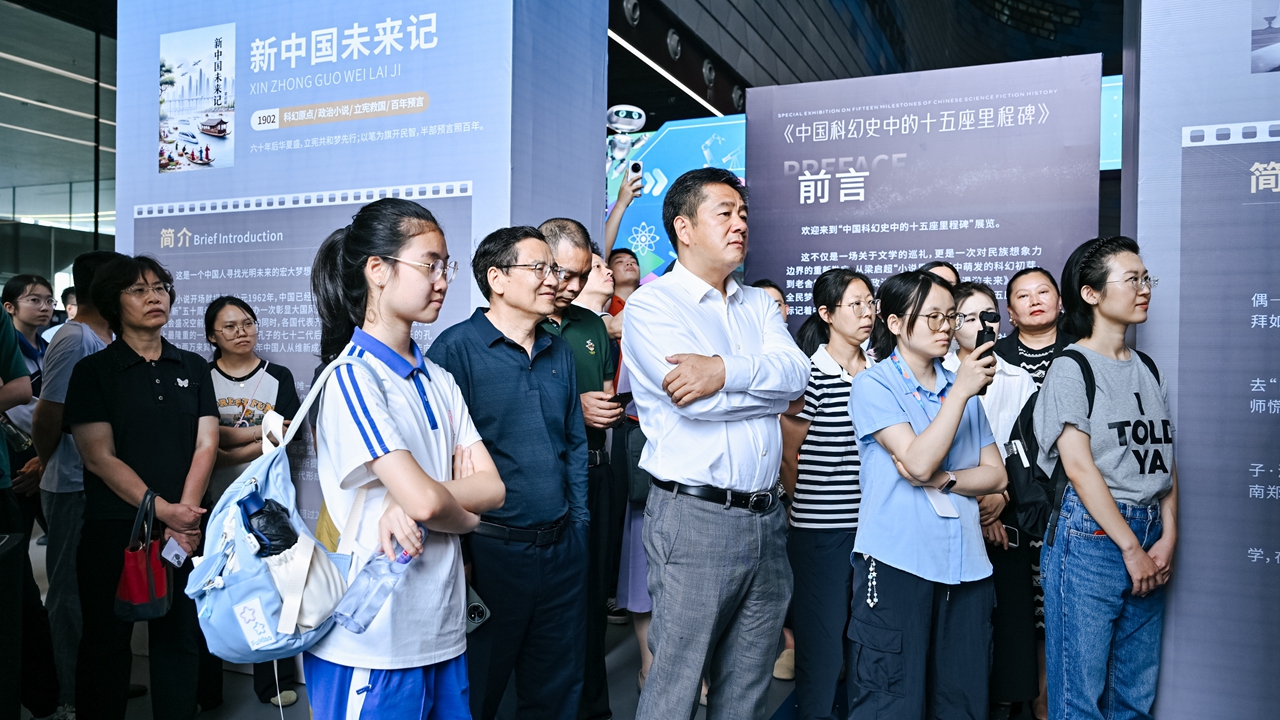
Visitors listen to the introduction of the exhibition during the opening ceremony.
The exhibition spans novels, films, and theatrical works, offering a comprehensive view of Chinese sci-fi across media.
Shenzhen’s local sci-fi authors are prominently featured, including Wu Yan’s semi-autobiographical novel “China Orbital,” Wang Jinkang’s “Heaven Father Earth Mother,” Hugo Award-winning work “Time-Space Painter” by Hai Yan, and the sci-fi play “Cloud Body” by Chen Yuehong and others.
The exhibition highlights Guangdong’s contributions to Chinese sci-fi, showcasing creators such as Liang Qichao, Zheng Wenguang, and Chen Qiufan, illustrating the region’s cultural influence on the genre.
“Science fiction is a narrative form where science and the future invade reality. These fifteen milestones mark the journey of the Chinese people measuring the future through words, recording our understanding of technology, the unknown, and tomorrow," said Wu.
During the exhibition, a roundtable discussion focused on “the space hospitals in China’s orbit,” exploring how sci-fi imagination drives real-world technological innovation.
Xu Zhiming, executive director of the Future Medicine Center and dean of the Faculty of Clinical Medicine at the Shenzhen University of Advanced Technoloy, proposed a three-step strategy translating the sci-fi concept of a space hospital into reality: first, constructing a medical experimental platform in low Earth orbit, second, developing AI-assisted diagnostics and remote surgery systems, third, establishing a fully autonomous orbital medical node with life support and treatment capabilities. What once existed only in fiction is gradually becoming reality, offering a beacon for humanity’s expansion into space.
As the world’s first digital civilization innovation museum, the Shenzhen Science and Technology Museum serves as a key platform for building Shenzhen into an international center for scientific innovation and a city of science fiction.
The museum promotes science education, technology exhibitions and industry collaboration, fostering the integration of science, culture and innovation.
The exhibition will run through June 29, 2026.