
 Share
Share


 Print
PrintTwo Shenzhen scientists elected to Academia Europaea as foreign members
Writer: Cynthia | Editor: Lin Qiuying | From: Shenzhen Daily | Updated: 2026-04-21
Two Shenzhen-based scientists have been elected as foreign members of Academia Europaea for 2026, highlighting the city’s growing presence in global scientific research.
The newly elected scholars are Qin Qinghua, professor and dean of the Institute of Advanced Interdisciplinary Studies at Shenzhen MSU-BIT University, and Wang Liping, director of the Institute of Brain Cognition and Brain Disease at the Shenzhen Institute of Advanced Technology, Chinese Academy of Sciences.
The announcement was part of the latest batch of foreign members released by the European academy, one of the world’s most influential academic organizations.
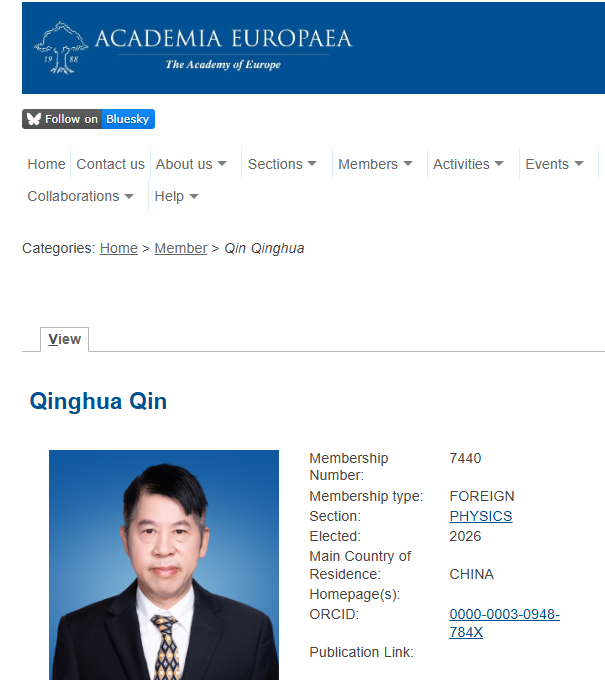
A profile page of Qin Qinghua on the official website of Academia Europaea shows his election as a foreign member for 2026. ae-info.org
Qin joined Shenzhen MSU-BIT University in March 2021 and currently serves as dean of the Institute of Advanced Interdisciplinary Studies. His research focuses on mechanics and materials science, particularly the design and performance of structural and functional materials.
He has published more than 400 papers indexed in the Science Citation Index (SCI) and authored nine English-language monographs. His international academic career includes research in Germany and Australia, and he served as a professor at the Australian National University from 2006 to 2021.
Qin has received numerous honors, including the J.G. Russell Award from the Australian Academy of Science. He has also been listed for several consecutive years among Elsevier’s Highly Cited Chinese Researchers and ranked among the world’s top 2% scientists in a list compiled by Stanford University since 2020.
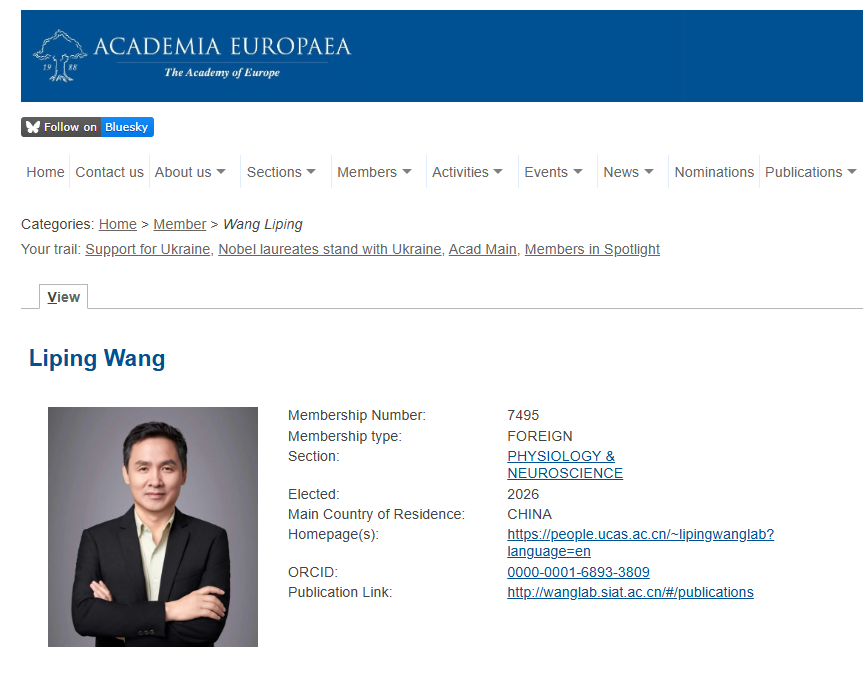
A profile page of Wang Liping on the official website of Academia Europaea confirms his election as a foreign member for 2026. ae-info.org
Wang is director of the Institute of Brain Cognition and Brain Disease at the Shenzhen Institute of Advanced Technology, Chinese Academy of Sciences, and also heads the Shenzhen-Hong Kong Institute of Brain Science.
He completed his doctoral studies at the Max Delbrück Center for Molecular Medicine in Germany and conducted postdoctoral research at Stanford University.
His research focuses on the pathophysiology of psychiatric disorders, particularly how brain circuits linked to instinctive fear function across species. He also studies how these circuits contribute to mental illness and explores potential intervention strategies, including how subcortical brain circuits interact with peripheral multi-organ systems at the cellular and molecular levels.
He has received major awards including the first prize of the Guangdong Provincial Natural Science Award and the Shenzhen Natural Science Award.
About Academia Europaea
Founded in 1988 and headquartered in London, Academia Europaea is a pan-European academy of sciences and humanities that brings together leading scholars across disciplines. Election is based on academic excellence and international impact.
Foreign membership is highly selective and regarded as a significant international academic honor.
According to the latest list released as of April 17, a total of 11 scholars from universities and research institutions on the Chinese mainland have been elected to the 2026 cohort.