
 Share
Share


 Print
PrintRuoyu Technology scientist wins nation's top AI award
Writer: Song Yingwen | Editor: Cao Zhen | From: Original | Updated: 2026-04-02
A project led by Zhang Min, chief scientist and co-founder of Shenzhen-based Ruoyu Technology, has won a top prize of the 2025 Wu Wenjun Artificial Intelligence Science and Technology Award, one of China’s most prestigious honors in the field.
The award-winning project, “Key Technologies and Applications of Deep Natural Language Understanding and Generation,” marks a significant advance in natural language processing (NLP), particularly in improving the reasoning capabilities and explainability of large AI models.
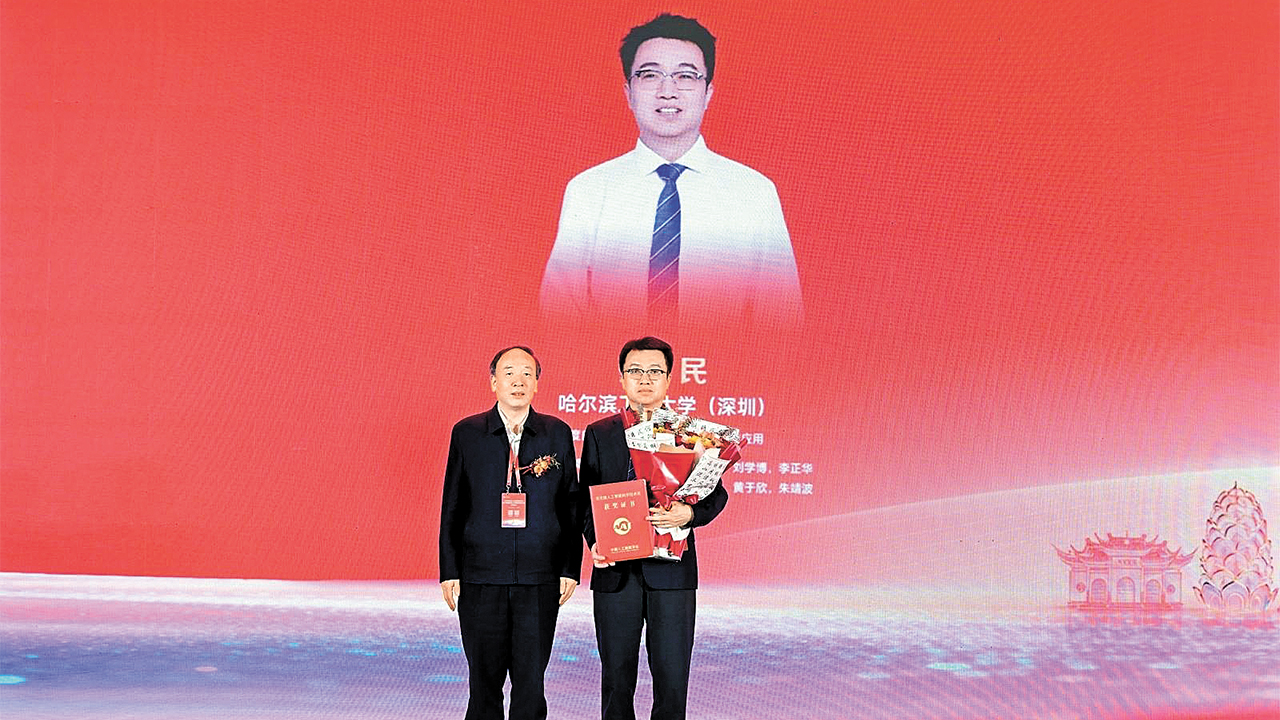
Zhang Min (R) accepts the award certificate of a top prize of the 2025 Wu Wenjun Artificial Intelligence Science and Technology Award. Photo from Bao’an Daily
Zhang, an Association for Computational Linguistics (ACL) Fellow and recipient of the National Science Fund for Distinguished Young Scholars, led a research team that developed a hybrid framework combining symbolic reasoning with connectionist approaches. The method addresses long-standing limitations in general-purpose large models, including weak logical reasoning and limited interpretability, and provides a more robust technical foundation for next-generation AI systems.
The recognition also reflects the growing capacity to translate fundamental research into real-world applications.
Ruoyu Technology, incubated by Harbin Institute of Technology (Shenzhen), focuses on developing core technologies for embodied intelligent systems — often described as the “brains” of robots. The company is backed by the university, which holds an equity stake.
At the center of its technology platform is the Jiutian multimodal large model, which integrates perception, planning and execution. The system combines large language models with 3D decoding and incorporates embodied knowledge retrieval and action-generation mechanisms, enabling more adaptive interaction with complex, real-world environments.
These capabilities are designed to address key technical challenges in embodied intelligence, including open-world perception, long-horizon task planning and complex action execution.
The company has completed multiple early-stage funding rounds and received support from Shenzhen’s top-tier talent programs. The involvement of Zhang and research teams from Harbin Institute of Technology has helped accelerate the transition of core NLP technologies from laboratory research to deployable products.
According to the company, the award represents both a milestone in its research development and a starting point for further industrialization. It plans to continue advancing its embodied AI platform as part of a broader push to build secure and self-reliant AI infrastructure.